AAHS Journal Vol. 55 No. 4 – Winter 2010
Winter 2010. 8 features in this issue.
Full-text articles are free to AAHS members. Sign in to read and download every article in this issue, or purchase individual PDFs below.
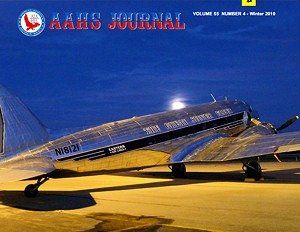
AAHS Journal Vol. 55 No. 4 – Winter 2010
- Jump to abstract ↓
- Jump to abstract ↓
- Jump to abstract ↓
- Jump to abstract ↓
- Jump to abstract ↓
- Jump to abstract ↓
- Jump to abstract ↓
- Jump to abstract ↓
No articles in this issue match your search. Clear search
Article Abstracts
75 Years of DC-3s in Flight
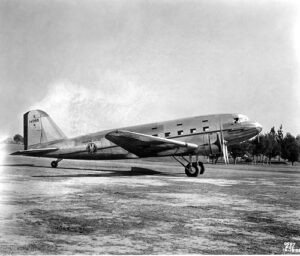
The first DST-144, X14988, is seen on December 18, 1835, the day after its first flight. The vertical fin is in the original configuration before the dorsal fin extension was added. The Wright Cyclone engines on American’s DSTs had a single row of cylinders and the narrow chord engine cowling is apparent in this photograph. (Douglas Aircraft Co. (DAC) photo SM 8587)
December 17, 2010, marks the 75th anniversary of the first flight of the
DC-3 series of air transports. It truly was the aircraft that created
practical commercial air transportation. The Ford Trimotor, the Boeing 247
and the DC-2 paved the way. However, the DC-3 series was the first to
provide commercial aviation with a financially viable aircraft on which to
build profitable operations in a broad spectrum of markets. And, it was
produced in greater numbers than any other aircraft used in commercial air
transportation. Other aircraft have eclipsed the DC-3 series in
performance, comfort and profitability. Yet, there are large numbers
operating regularly and profitably 75 years after the first flight.
In this article we will examine how the Great
Depression, government policies, entrepreneurism and WWII came together to
bring air transportation to people in every part of the world. The focus
of this article is on the first designed, built and fl own in the DC-3
series, the Douglas Sleeper Transport, or DST. The first DST flew on
December 17, 1935, 32 years to the day after Orville and Wilbur Wright
accomplished the first powered, controlled flights. This DST was powered
by two Wright engines. The first flight of the Wright fl yer was a mere
nine feet longer than the wing span of the DST.
The DST was a collaborative effort. As has often
been the case at Douglas Aircraft Company, a major product line was
created by a customer overcoming resistance from Douglas to pursue
development. In this case the customer was American Airlines and its
leader Cyrus R. Smith. American Airlines was a new organization that had
emerged as one of the winners in the Postmaster General Walter Folger
Brown meeting to divide airmail contracts among the four major airlines.
Smith and American had transcontinental passenger route aspirations. On
May 5, 1934, American began to operate services between Newark, N.J., and
Grand Central Terminal in Glendale, Calif., using Curtiss Condor sleeper
and DC-2 equipment. Grand Central Terminal was the major Los Angeles
commercial terminal in the late 1920s and the 1930s. American’s
Southerner Service operated the faster DC-2s on the daylight portion of
the route, from New York to Fort Worth. Passengers transferred at Fort
Worth to Curtiss Condor sleepers for the overnight flight to Grand Central
Terminal. Eastbound transcontinental flights operated with Curtiss Condor
sleepers from Grand Central to Fort Worth and DC-2s from Fort Worth to New
York. American’s transcontinental Route 1 covered 2,759 miles. Rival TWA
took delivery of its first DC-2 in May 1934. In August, TWA opened service
with their DC-2s between New York and the Grand Central Terminal following
a more direct northern route authorized in Brown’s airline
reorganization meeting. TWA’s transcontinental Route 19 covered 2,583
miles via Chicago and 2,555 miles via Columbus. TWA operated the faster
DC-2 . . .
This article costs $5.00 to download - or it's free for AAHS members.
Already a member? Sign in to download for free.
Fokker and the USAAS T-3 Competition
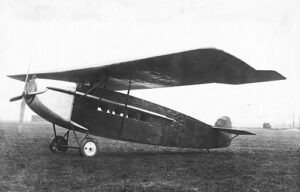
The still unpainted F.V Monoplane shortly after its completion at Schiphol Airport, without registration. This photo dates from early 1923. (Netherland Fokker photo 466 from the Gert Blüm collection)
FOKKER and the USAAS T-3 COMPETITION
In
April 1923 in the U.S. aviation press, there appeared several articles on
the Dutch Fokker F.V airliner. It was described as a logical successor in
the line of earlier Fokker transport aircraft. Of these, the F.IV, or Air
Service T-2, was already well known in the U.S. for its world endurance
record and long distance flights. Its nonstop transcontinental flight had
yet to come.
As Anthony H.G.
"Tony" Fokker stated after his four-minute first flight in the
F.V that it flew like a mob, the positive introduction in the contemporary
press was at least remarkable. When the War Department instructed the Air
Service on June 24, 1923, "to take all necessary actions to procure
all available data on the Fokker F-5 Transport and the Davis-Douglas
Cloudster...and to procure one of these planes for test" 1
in relation to the round-the-world flight project, one had to admit that
the aircraft was marketed very well in the New World. Nevertheless, only a
prototype of the F.V was ever produced and finally sold in Austria at a
substantially lowered price.
When,
some years ago, a large part of the contemporary correspondence between
the Dutch company and its New York branch was rediscovered, it became
clear how the F.V received so much attention in the U.S. Being a contender
to the USAAS Circular No. 2354 on January 1923 for 10 transport aircraft,
much effort was expended to sell the aircraft and to locate its production
in the U.S. These efforts were the first steps towards an American Fokker
factory.
Foothold in the U.S.
In the early 1920s,
Anthony Fokker put a lot of energy and cost into selling his hardware in
the U.S. A branch of his Dutch company had an office at 286 Fifth Ave. in
New York with Robert B.C. Noorduyn in charge. With WWI still fresh in
people’s minds, the branch was named Netherlands Aircraft Manufacturing
Co. (NAMC), omitting the Fokker name, which was also dropped from the
Dutch firm’s title at the time: N.V. Nederlandsche Vliegtuigenfabriek (NVNV).
Originally the Fokker name was printed only on the branch’s letterhead,
although later on the well known logo was added. After his initial visit
to the U.S. in 1920-21, Fokker was encouraged by some orders for his
aircraft and especially the U.S. Army Air Service proved to be a rather
promising customer. Although the designated quality standard of the U.S.
clients gave Fokker and especially Noorduyn a number of hard edges in the
delivery of their aircraft, sale efforts stayed strong.
Buying
foreign aircraft was at the time much criticized by the U.S. aviation
industry and especially the Manufacturers Aircraft Association, Inc.
Noorduyn realized that the only way to get lasting acceptance of Fokker
products in the U.S. was to start an American production unit. As the
level of aircraft production was very low at the time, and to avoid great
risks, such a start could only be justified by a substantial launching
. . .
Harold Ross Harris
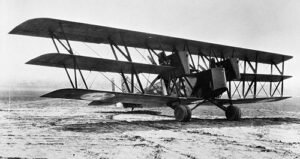
The Boeing GA-1 was based on the GAX design that Harold Harris tested. The Army initially ordered 20, soon cut to 10, and quickly learned the design was totally inadequate for the mission. (USAAS photo from the AAHS photo archives, AAHS-25052)
1895,
Lord William Thomson Kelvin, mathematician, physicist and president of the
British Royal Society, declared: "Heavier-than-air flying machines
are impossible," and, in that year, Percy S. Pilcher built gliders
that successfully flew. Among notable births were Sir Hudson Fysh,
Australian aviator and co-founder of Qantas; and aircraft designers and
industrialists John Knudsen Northrop, Leroy Grumman, and James
"Dutch" Kindelberger.
Noted
in the local vital statistics sections of Chicago’s newspapers was a
birth announcement of baby whose name was never as well-known as the
persons mentioned above but who became one of America’s premier military
test pilots, a respected administrator of Air Transport Command during
WWII and later forged a career as a successful business executive with
various commercial airlines.
Chicago
was just recovering from 12 inches of snow that descended on the city from
November 25-26, nearly paralyzing the area. The local event that occurred
on December 20 was the birth of future general Harold Ross Harris to Allen
Ross, M.D. (an ear, nose and throat specialist) and Mae Irvine Plumb
Harris of Streator, Ill., who were joined in matrimony on August 16, 1893,
and whom the groom termed "the best girl in the United States."
Later Harold would share the home with his two younger sisters, June (six
years younger) and Jessica (10 years younger).
In
his youth the family moved to Los Angeles where Harris attended and was
graduated from Manual Arts High School a year earlier than Jimmy Doolittle
(who graduated in 1914) along with Doolittle’s future wife Josephine
Daniels, and two of his dearest friends, Holland Kinkaid and Harold
Morton, a future corporate lawyer.
In
subsequent years the young Harris studied at the Throop College of
Technology in Pasadena founded by Amos Throop in 1891, which two years
later became known as Throop Polytechnic Institute. This learning
establishment eventually evolved into the California Institute of
Technology and from which Harris graduated in 1922 with a B.S. in
Mechanical Engineering. In spite of his father’s opposition, Harris
played three years of varsity football at Throop, participated in an
all-male chorus and joining an engineering fraternity. The daughter of the
future general, Alta Mae Harris Stevens, noted that her physician
grandfather was anxious "about his children’s health that led him
to imagine that none of the three would ever live to adulthood."
Nonetheless, Harold Harris would overcome his father’s sense of doom and
live 92 years.
Harris
later remembered developing an ardent desire to fly at a very young age,
after witnessing an air show at Long Beach in 1910; and from that moment
he stated that he was sure aviation would be his future. At the same
. . . .
This article costs $5.00 to download - or it's free for AAHS members.
Already a member? Sign in to download for free.
The Incredible Douglas F3D
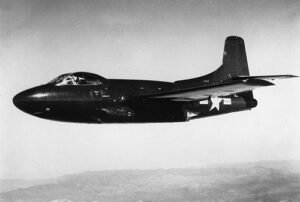
The Douglas XF3D-1, Bu.No. 121457, during flight testing in 1948. (Douglas photo ES 72025 from the AAHS photo archives, AAHS-P006218)
The was designed in
1946 and was a complete flop. A few years later, during the Korean War,
she was a resounding success and was the first jet night fighter in
history to down an enemy jet aircraft. No other jet night fighter can make
that claim and in fact that record, which was set some 57 years ago, has
yet to be equaled. She was as fat as a pig and slower than any self
respecting fighter aircraft had a right to be. The F3D, please allow me to
translate the Navy jargon for you. The F3D was a Fighter and the Third
fighter that the Navy had bought from Douglas Aircraft. It was really a
simple and defining designation system. Years later, when someone thought
that they had a better system, she was redesignated as an EF10B, which is
sort of meaningless.
As
WWII wound down, everybody had been mightily impressed by the German jet
aircraft and the Navy wanted a jet night fighter that could fly at 500
knots at 40,000 feet and possess radar intercept range of 125 miles.
Someone had assured the planners that such capabilities were compatible.
The sailors of that day were being misled. The other birds on the drawing
board at that approximate time were slim aerodynamic specimens that could
attain the altitude, but they all had trouble with the speed
specifications. The FH-1, the first jet Phantom ever built, could attain
roughly 36,000 feet and about 480 mph. Not knots or nautical miles per
hour, but miles per hour. The difference is significant - 480 mph equals
425 knots. It was the sort of a game played by the manufacturers. For
example, Douglas claimed that the F3D was capable of attaining 517 mph,
which was roughly 450 knots and to achieve that speed she would probably
have to be going straight down. Actually, when going straight down at full
power, you could get going a lot faster than you wanted to be moving. My
driver and I got into that situation on one dark night. We immediately
reduced the throttles and popped the speed brakes and the brakes instantly
slammed back into the fuselage. We kept milking the brakes to open them
and slow down and they kept slamming back until we slowed sufficiently and
changed the direction from straight down to something approximating level
flight. We had started this maneuver at 28,000 and recovered to level
flight in the gloomy murk at about 6,000 feet. That was the last time that
we ever attempted to roll the F3D at 28,000 feet at night, or in the
daytime for that matter. I say we. I was the guy in the right seat and as
we got half way through the roll we executed a split-S. Allow me to
translate that bit of aviator talk for the uninformed, we started a roll,
but about half way through the maneuver, when we were inverted something
went wrong. I suspect that the pilot who was supposedly on instruments at
the time suffered from vertigo or some other such extreme ailment and
allowed the nose to drop below the horizon. Fortunately there was still a
glimmer of a sun set on my side and I suddenly realized that the tricks
were all over and that we going straight down at full power.
The
difficulty for the F3D in attaining the desired speed
. . .
This article costs $5.00 to download - or it's free for AAHS members.
Already a member? Sign in to download for free.
The Douglas XB-19
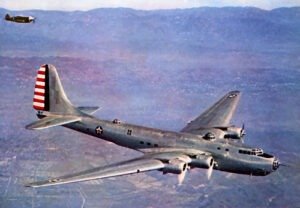
XB-19 on its maiden flight with a Curtiss P-40 escort. After taking off, the plane was flown to March AFB south of Riverside, Calif., where the initial shakedown flights were performed prior to turning the aircraft over to the USAAC. (USAAC photo from the AAHS photo archives, AAHS-P001374)
Called
both the "Winged Colossus of Santa Monica" and the
"Guardian of a Hemisphere," the XB-19 was essentially conceived
in 1930 on the drawing boards of Army Air Corps engineers at Wright Field.
Though budgets for development of new bomber aircraft were nonexistent in
the early depression years, some visionaries foresaw a future need for the
development of a long-range, heavy-bombardment aircraft. The General Staff
disagreed, and thus when funds finally became available, only twin-engine
bombers of limited range were purchased. (Among these were the B-18 and
B-23 bombers which Douglas produced in quantity. Though obsolete before
WWII, they served the Air Corps well during the lean years.) By 1935,
however, approval had at last been granted for the development of
four-engine bombers.
Origins
In
the fall of 1935, specifications for an airplane that would surpass all
others in range, payload and equipment were sent to a number of aircraft
companies.
Douglas
and Sikorsky each submitted preliminary designs to Wright Field. Both were
given contracts for final designs and mockups. Douglas’s was designated
XBLR-2 and Sikorsky’s, XBLR-3. (The XBLR-1 was the Boeing XB-15.) Three
months and $150,000 later, the Douglas mockup was completed. In April
1936, Douglas was announced the winner of the competition, and the
Sikorsky XBLR-3 was cancelled.
Progress
on the XBLR-2 progressed rather slowly due to the shortage of funds caused
by the limited military budget allocated for research and development
during the Depression years 1935 to 1937.
The
aircraft was conceived as a large, four-engine, low-wing monoplane. The
tricycle undercarriage rather unusual
. . .
This article costs $5.00 to download - or it's free for AAHS members.
Already a member? Sign in to download for free.
The P-51D/K Mustangs of the Royal Netherlands East Indies Air Force
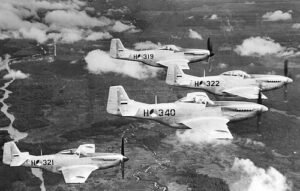
A demonstration flight conducted by 122 Squadron on November 18, 1949, celebrating 35 years of the RNEIAF. The pilots (top to bottom) were Manus Mulder (H-319), Lt. Paul Verspoor (H-322) with a newspaper reporter as a passenger, Ronnie van Beers (H-340) and Peit Admas (H-321). Red and Blue Flights are designated by spinner color. (Photo from the author’s collection)
The P-51D/K Mustangs of the
Royal Netherlands East Indies Air Force
The
interest of Dutch Military Aviation (ML) in the Dutch East Indies in the
P-51 Mustang dates back to 1941. Urgent attempts by the Netherlands
Purchasing Commission (NPC) to buy sufficient fighters for the ML resulted
in a request to the U.S. government for delivery of 100 Bell P-39
Airacobras. The request was turned down but accompanied with the message
that the Royal Air Force (RAF) would supply 100 P40Es from their
consignment. It is unclear why, but the ML did not accept this offer
immediately and requested on July 10, 1940, to acquire 100 fighters of
North American Aviation’s NA73 type instead. Again the U.S. government
refused but stated that the offer of the 100 P-40s was still valid, but
would expire on October 15, 1941. The ML again requested Airacobras, which
was refused again. When the Japanese forces attacked the Dutch East Indies
in December 1941 the ML still had no modern fighters.
Mustangs after all
After
Java fell in 1942 the ML moved their operations to Australia and New
Guinea and by 1943 were flying Curtiss P-40Ns. By 1945, this war-weary
fighter was nearing the end of its usefulness and for the reequipment of
ML No. 120 Squadron a request (N-2075) was sent to the U.S. for the
acquisition of 41 Mustangs. This request for P-51s was finally granted.
The aircraft were pulled from U.S. contracts and received Dutch marking
while still on the production line. Delivery of the first 10 P-51Ks
occurred in March 1945, followed by 10 P-51Ds in April with the remaining
21 P-51Ds arriving in June 1945. However, only 40 Mustangs actually
reached Australia and got ML serials N3-600 to N3-640. The exception was
N3-632 (USAFF 44-84795) that was not delivered. In Australia the ML
Mustangs were made airworthy at RAAF aircraft depots and the first 19
(N3-600 to N3-618) were speedily delivered during May and June 1945 to the
Dutch Personnel and Equipment Pool at Bundaberg, Queensland, located about
300km north of Brisbane well before the Japanese surrender. After VJ Day
activities slowed and the remaining aircraft were delivered between
October 1945 and March 1946. This slow down may have been a sign of lower
priority on behalf of the RAAF and a changed attitude by the Australian
government towards the Dutch "colonial" ambitions.
Flying
to Java
With the Mustang the
ML obtained a top-of-the-line fighter that had proven its worth in battle,
as well as one whose faults had been ironed out. The P-51 was heavily
armed, had good range and was easy to fly. That there were two different
versions did not matter from either a service or operation perspective
with the differences being only distinguishable by their props.
During April and May 1946
the 40 Mustangs were flown in three groups from Bundaberg to Tjililitan
Airbase at Batavia (now Jakarta). They flew via Cloncurry, Darwin, Timor,
Bali and Soerabaja, a distance of 3,200 miles. These flights were . . .
This article costs $5.00 to download - or it's free for AAHS members.
Already a member? Sign in to download for free.
The Final Flight of Ensign Paul Blair
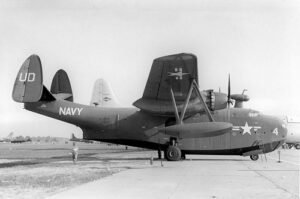
VP-203 was assigned Martin PBM-3s that were similar to this PBM-5A, BuNo 122081. The primary difference being that the -3s were equipped with Wright R-2600 Cyclone engines that produced 200 to 400 less horsepower per engine than the Pratt & Whitney R-2800s on the -5s. (Photo from the Al Hansen collection, AAHS-P000542)
The Final Flight of Ensign Paul Blair
At
the southern end of Manhattan Island in Battery Park, about 150 yards from
the South Ferry subway station on the IRT line, there stands the East
Coast Memorial, a battle monument commemorating some 4,611 fallen
soldiers, sailors, marines, coast guardsmen, merchant marines and airmen
who gave their lives in the western waters of the Atlantic Ocean during
WWII. The monument is a silent sentinel commemorating all WWII servicemen
who went missing in action in the Western Atlantic, later deemed KIA, who
perished in America’s great struggle against fascism, never to return to
their native land. The monument is appropriately oriented toward the
Statue of Liberty, sitting as it has for over a century, proclaiming
America’s commitment to freedom for all who seek refuge on her soil.
Inscribed on the western wall of the battle monument, among the names of
other honored servicemen, is a simple engraving: "Ensign Paul B.
Blair - USN Reserve - Texas." The simplicity and dignity of the
monument and its simple inscription is a metaphor for the man himself.
Born
in the small town of Alvarado, Tex., on September 30, 1919, Paul Blair was
an honor student, a fine high school athlete and, above all, a devoted
family man who during the war maintained a steady correspondence with his
parents, his sister Betty and his brother Thomas.1 And like
thousands of young men from towns both large and small, Paul Blair went to
war to do a terrible job and longed only for the day when he could return
and be with his incredibly close-knit family in Texas. There is no
bravado, no tales of daring-do and no inflated feeling of self-importance
in Blair’s sense of himself. There is, instead, only the sense of
necessity and a desire for the final day when it would all be over.
Throughout
his naval career Blair kept up a prolific correspondence to his family.
Indeed it is possible to trace his naval career, however brief, through
his letters home, most notably to his mother and father.
After
enlisting in the U.S. Navy and attending flight school in Pensacola
beginning in May 1943, Paul Blair’s naval odyssey began in PBYs, his
first airplane. "Well," he writes to his parents on June 15,
1943, "am back at the main base (Branson) taking basic - trying to
fly on instruments." However, his stay at Branson was short lived.
"I just got settled down and learn that routine at one base and they
up and transfer me! The first week here we will be studying gunnery. It is
kinda dull learning all the names and parts to the machine guns, but I
suppose it is necessary." Writing home to his mother on August 9,
1943, Blair notes that, "You ask about P Boats, mom, . . . they are
kinda large (4 bunks) a pilots compartment, radio compartment, and rear
compartment. Two engines of 1,250 horsepower each burn 300 gallons of gas,
and lately I have been flying everyday."
On
August 27, 1943, Blair sent a telegram to his mother stating that he
"Received commission and wings today - nothing definite until
Thursday." Blair was then ordered first to Norfolk, Va., and then to
Floyd Bennett Field in Brooklyn where he notes that he . . .
This article costs $5.00 to download - or it's free for AAHS members.
Already a member? Sign in to download for free.
Remember When: Commander 200
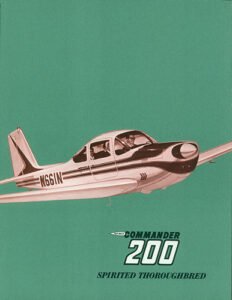
Cover to a sales and marketing brochure for the Commander 200. (From the files of Earl See)
For
those of us who recall the period, a boom in general aviation was to take
place following World War II. It was anticipated that returning airmen
would trade their wartime aircraft, flown in hostile skies, for light
planes flown over peaceful American terrain. The return of many veteran
pilots, aviators and airmen was to be the catalyst behind the figurative
statement "an airplane in every garage,"Â and it gave impetus to
artists’ conceptions of smiling families flying to vacation destinations
in futuristic light planes. Aviation magazines of the day reinforced this
vision by depicting modern-day housing developments with a runway and
individual taxiways leading up to each new home.
Aircraft companies and subcontractors shared this
optimism as they converted their wartime facilities into the manufacturing
of general-aviation aircraft. Soon their drawing boards were busy as they
transitioned from the manufacturing of bomber and pursuit aircraft of war
to the postwar pursuit of building light planes. In some cases, and for
expediency, their aircraft were prewar or updated designs. Other
companies, however, capitalized on wartime knowledge and transferred newly
developed technology into modern and innovative aircraft designs.
New light-plane designs and prototypes from major
aircraft manufacturers, including Douglas, Grumman, Lockheed, North
American and Republic, entered into development. Additionally, new light
planes from many other aircraft companies entered the developmental stage
at the end of the war (see listing of aircraft). Concurrently, production
was resumed on prewar aircraft, including the ERCo Ercoupe, Globe Swift,
and the Luscombe Silvaire.
However, the aviation boom was not to be. Many
war-weary pilots turned their vision from the sky to earthbound goals,
including home, automobile, family and peacetime employment. Also, the
exigencies and economic conditions at the time helped to fuel the death
knell of the aviation boom.
This article costs $2.50 to download - or it's free for AAHS members.
Already a member? Sign in to download for free.