AAHS Journal Vol. 55 No. 3 – Fall 2010
Fall 2010. 7 features in this issue.
Full-text articles are free to AAHS members. Sign in to read and download every article in this issue, or purchase individual PDFs below.

AAHS Journal Vol. 55 No. 3 – Fall 2010
- Jump to abstract ↓
- Jump to abstract ↓
- Jump to abstract ↓
- Jump to abstract ↓
- Jump to abstract ↓
- Jump to abstract ↓
- Jump to abstract ↓
No articles in this issue match your search. Clear search
Article Abstracts
On the Wings of Discovery: Muir Stephen Fairchild, The Life and Times of an Aviation Pioneer and Patriot

Lt. Fairchild, Charles Lindbergh and Grover Loening pose in front of an unidentified Loening OA-1A in a photo possibly taken at Bolling Field on March 11, 1928. (NASM, Smithsonian Institution photo SI 78-15946)
On
the Wings of Discovery: Muir Stephen Fairchild, The Life and Times of an
Aviation Pioneer and Patriot
In
the annals of American aviation many individuals and personalities were
familiar to the American public yet some were remarkable airmen little
known outside comradeship of their colleagues. One such innovative and
important pioneering aviator in the 20th century was Muir Stephen
Fairchild born in Bellingham, Wash., on September 2, 1894, to Harry Arson
and Georgia Ann Crockett Fairchild. His father was born near Brantford,
Ontario, Canada, but moved to the United States eventually settling in
Bellingham in 1884 where he became a prominent attorney. With the election
of Albert Edward Mead as the fifth governor (serving from 1905-1909) the
Fairchild family moved to the state capitol of Olympia when Muir’s
father was appointed chairman of the state’s Railroad Commission and its
successor the Public Service Commission from 1905 until his death in 1911.
Before enrolling in the University of Washington in Seattle in 1913,
Fairchild attended public schools in Bellingham and Olympia. While in
college he enlisted in the Washington National Guard and later served as a
radio platoon sergeant on the Mexican border in 1916. He never completed
his degree requirements for a diploma and left the university in 1917.
Fairchild died at his quarters at Ft. Myer, Va.,
on March 17, 1950. His wife, Francis Alice Rossiter Fairchild, of Omaha,
Neb., whom he had married on April 24, 1924, was with him when he was
stricken. He was attended by Brig. Gen. Dan C. Ogle, the Air Force Deputy
Surgeon. He had recently completed a thorough physical check at the Army
and Navy Hospital at Hot Springs, Ark., and was declared in good
condition, yet shortly thereafter fell ill. Mrs. Fairchild wrote on her
husband’s cousins, Mrs. George Bacon of Bellingham, informing her that
"reports were not good" and that they were returning to their
home in Virginia immediately.
General Fairchild was honored and memorialized
when the former Spokane Army Air Depot was renamed to Fairchild AFB with
the formal dedication ceremonies taking place on July 20, 1951. The event
coincided with the arrival of the 92nd Bombardment Wing’s (Heavy), the
first B-36 Peacemakers that were stationed there until 1957 when
subsequently replaced by B-52s and KC-135 tankers.
In addition, the Muir S. Fairchild Research and
Information Center at the Air University, Maxwell AFB, Montgomery, Ala.,
was named in his memory as was Fairchild Hall that is the main academic
building at the United States Air Force Academy housing classrooms,
laboratories, research facilities, faculty offices and the McDermott
Library with the mailing address of 2354 Fairchild Drive, Colorado
Springs, CO 80840-6214.
Early Military Service
Fairchild began his career by first serving as a
sergeant in the Washington National Guard from June 19 to October 5, 1916,
as a radio sergeant on the Mexican border and subsequently . . .
This article costs $5.00 to download - or it's free for AAHS members.
Already a member? Sign in to download for free.
The Airplane Designs of Hughes Aircraft Company

Hughes engineering concept drawing of the D-5 bomber. (NARA)
The Airplane Designs of Hughes Aircraft Company
Howard Robard Hughes, Jr. Many articles and books have been written
concerning his life. Eccentric, secretive, loner, among other descriptors,
have been used to describe him. In aviation he was known as an excellent
pilot, who could get into a lot of trouble in following his personal
whims.
His exploits in aviation have been well
documented. But the designs of the aircraft company, which carried his
name, are virtually unknown. This article is a progress report. The
project has a long ways to go, but I believe the new/unreported details
included herein many will find interesting. As this is an ongoing project,
any corrective information and/or amplifying information would be
appreciated (see Author’s Note at the end of this article).
Setting the Stage
At the ripe age of 14, in 1920, Hughes got his
first ride in an airplane. By the mid-1920s he was actively taking flying
lessons. At this time he had three major goals in life: to be the best
filmmaker, pilot, and golfer. Aviation and movie making co-joined in the
late 1920s in the epic production (years to make the film and a fortune
spent) on Hell’s Angels.
In a need for speed, Hughes bought a Boeing 100A
and received it in July 1929. As with most airplanes he bought, he found a
need to modify it after receiving it. First he took the Boeing airplane to
Douglas in Santa Monica but was not satisfied with the outcome. Then he
tried Lockheed in Burbank and was quite satisfied. The Lockheed project
engineer assigned to carry out Hughes’ requirements was Richard W.
Palmer, who would later work for Hughes. By mid-1932 the Boeing 100A was
ready and Hughes enjoyed flying it. In March of the following year Hughes
had the National Aeronautics Association (NAA) time him over a measured
course at Mines Field in Inglewood, California. He was timed at 212.3 mph.
In January 1934, the . . .
This article costs $5.00 to download - or it's free for AAHS members.
Already a member? Sign in to download for free.
Visitors to Parks Air College

This Northrop A-17A, in full military markings, visited Parks Air College in the fall of 1940. The pilot of the A-17 appears to be near the prop blades explaining the aircraft to some students. (Photo from the Parks Air College collection via Terry Love)
Following his service in the U.S. Marine Corps during WWI, Oliver
Lafayette "Lafe" Parks began taking flying lessons from a pilot
at Robertson Aircraft Corporation. He received his first pilots rating in
January 1926. The certificate, No. 6373, was signed by Orville Wright. Six
months later, Parks earned his transport rating. He then bought two planes
- a Standard and an Eagle Rock. Parks enjoyed taking visitors for rides
over the St. Louis area. Sometimes he earned $300 a day on these flights.
The Standard that Parks flew was less than reliable, and he encountered
several incidents that brought him to the realization that his flight
training had been too short, too fast, and too narrow.
In May 1927, Charles Lindbergh’s historic
flight over the Atlantic Ocean to Paris got people thinking about aviation
in general and aviation careers in particular. Parks was among them, since
he loved to fly.
But aviation at that time was more daredevil than
serious business. Most civilians engaged in aviation were
"barnstormers" that were usually flying veterans from the war,
who flew around the country displaying their skills and giving rides. Most
people considered a career in aviation to be a risky venture. Nonetheless,
on August 1, 1927, Parks opened up his air college in a rented hangar at
Lambert Field, near St. Louis, Missouri. He still had two airplanes –
his old Standard and a Laird Swallow. Harvey Glass became his first
student pilot. He gave a free ride to the young man and his girl friend in
his Swallow, but it crashed.
In the spring of 1928, Parks bought some acreage
in Cahokia, Illinois - just the other side of the river from St. Louis. He
had found his school site. He added charter services, educational courses,
and sightseeing flights.
Only two years after its opening, Parks Air
College made history when it became the nation’s first federally
approved flying school. Parks has Certificate Number 1. With this
distinction in hand, Parks weathered the Great Depression and . . . .
This article costs $2.50 to download - or it's free for AAHS members.
Already a member? Sign in to download for free.
Braniff International Airways 1930-1982, Part 2

BAC 111-203AE, N1544, s/n 18, at Dallas Love Field on May 2, 1965. (The Hubbard collection in the AAHS photo archives, AAHS-32759)
Braniff International Airways 1930-1982, Part 2 - Jet
Aircraft
While Braniff International Airways may be faulted for a number of things,
including those that eventually led to its demise, the airline was a noted
innovator during the 1960s and 1970s. It was one of the first airlines to
standardize its fleet in order to reduce maintenance and operating costs.
It was one of the first to hire professional designers to create wardrobes
for its cabin crews. It was one of the first to engage Wall Street
advertising agencies to help shape its public image. It was the first to
hire well known professional artists to create a unique paint scheme for
several of its jets – this influence is echoed today in the variety and
sometimes wildly outlandish paint schemes that can be found on commercial
aircraft today.
Flying the Colors
With the appointment of Harding L. Lawrence to
the presidency of Braniff in 1965 there was a new direction on image
building of the airline. New Mexico architect Alexander Girard and fashion
designer Emilio Pucci were brought in as consultants to launch the
"End of the Plain Plane" marketing campaign. Girard recommended
painting the planes in a single color selected from a palette of bright
hues, which were eventually selected as beige, ochre, orange, turquoise,
baby blue, medium blue, lemon yellow and lavender (the latter of which was
shortly dropped because lavender and black are considered bad luck in
Mexico). These seven basic colors were modified in the late 1960s to
include two-tone schemes of red over Aztec gold, orange over ochre, dark
green over light green and dark blue over light blue. The mid-1970s saw
the introduction of the "New Ultra Look" paint schemes of
sparkling burgundy, terra cotta, mercury blue, metallic blue, chocolate
brown, Peresus green and light blue.
Braniff engaged well known artist Alexander
Calder in 1973 to paint an aircraft. The result was a DC-8-62, N1805,
which became known as "Flying the Colors" and was showcased at
the 1975 Paris Air Show. Calder was subsequently commissioned in 1975 to
design a paint scheme for one of their 727-200s, N408BN, based on a U.S.
bi-centennial theme, another paint scheme with a Latin American (contract
called for Mexican theme and 50 original gouaches to be adapted for
painting tail assemblies (a la the new Frontier Airlines and British
Airways). Calder passed away before the Mexican theme was completed and
Braniff never implemented the tail art.
Braniff International Airways, as seen in Part I,
could trace its roots back to the 1920s. One criticism of the airline was
that during the 1950s and 1960s it was slow to evolve with changing
technology. Braniff didn’t begin to add jets to this fleet until the
late 1950s and really didn’t embrace jet aircraft on its routes . . .
This article costs $5.00 to download - or it's free for AAHS members.
Already a member? Sign in to download for free.
The CAF Arizona Wing‘s B-25J “Maid in the Shade’ 43-35972
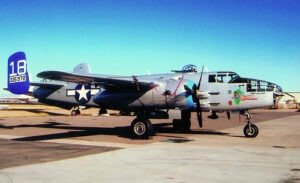
The completed fully restored B-25J "Maid in the Shade" pending FAA certification. Dec. 2008. (Photo by Dennis Strum)
The CAF Arizona Wing’s B-25J "Maid in the Shade" 43-35972
The
Commemorative Air Forces (CAF) Arizona Wing’s B-25J, 43-35972, later
named "Maid in the Shade," was in very sorry shape when it
arrived at the Arizona Wing’s hangar at Falcon Field in Mesa, Arizona,
in 1981. But after 28 years of restoration work this WWII combat veteran
airplane has again taken to the skies.
The B-25J "Maid in the Shade" is one of
two aircraft that are the cornerstones of the Arizona Wing. The other
cornerstone aircraft is the B-17G "Sentimental Journey,"
44-83514, (AAHS Journal, Summer 2007). "Maid in the Shade,"
43-35972, is the only CAF Arizona Wing airplane that has a known combat
record. During late 1944 of WWII this aircraft flew out of Serraggia
Airbase on the east coast of Corsica. It was with the 57th Bomb Wing,
319th Bomb Group, 437th Squadron where it was assigned Battle Number 18.
It flew 15 bombing missions over Italy and Yugoslavia. This aircraft has
been undergoing restoration for 28 years by the CAF Arizona Wing,
culminating in returning it to its original WWII configuration. On May 29,
2009, it took its first flight in 28 years.
But, starting at the beginning, this B-25J,
43-35972, was manufactured (construction number 108-32762) at the North
American Aviation plant in Kansas City and delivered to the U.S. Army Air
Force on June 9, 1944. It was then flown to Hunter Field, Savannah, Ga.,
on June 24, then onto Morrison Field, Fla., where it was readied for
deployment to the Mediterranean Theatre of Operation.
On July 7, 1944, the aircraft departed Morrison
Field and followed the southern route over Brazil, then across the
Atlantic to Africa. Records are missing until October 22, 1944, at which
time the plane was delivered to the 3rd Air Facility Depot and then picked
up by the 319th Bomb Group, 437th Squadron at Serraggia Airbase, Corsica.
There it was assigned the Battle Number 18. The plane proceeded to fly 15
combat missions over Italy. Her combat mission history is in the table on
the next page.
On December 31, 1944, the 319th Bomb Group
received orders to halt combat operations in Europe and prepare for
redeployment to the Pacific. The 319th operated B-25s for just two months
as an interim between B-26s and A-26s. During those two months 43-35972
flew 15 combat missions including the 319th’s first and last B-25
mission. 43-35972 was then returned to the 3rd Air Facility Depot on
January 10, 1945. In July it was flown back to the U.S. and placed in
storage.
The plane was recalled in 1946 for utility
and transport duty. During this time it served with MATS at McCord AFB,
Tacoma, Wash.; TAC 62nd Aerodrome Group Continental Air Command at
Mitchell Field, N.Y.; 1002nd Inspector General Unit at Norton AFB, Calif.;
and the 1005th Inspector General Special Investigations Unit at Andrews
AFB, Maryland. Afterwards the Air Force began to phase out the B-25s so in
. . .
This article costs $2.50 to download - or it's free for AAHS members.
Already a member? Sign in to download for free.
N1596V and N1597V, the Last of the Aussie Mossies

de Havilland Mosquito N1596V (A52-306), Sydney, June 1954. (Aero Service Corp. photo via Norman Malayney)
N1596V and N1597V, the Last of the Aussie
Mossies
It
was at Camden, New South Wales, Australia, and it was mid-1958 when Morry
Lawrence finally had his two Mossies stripped of useful components and
burnt. I once asked him why he did it and in his typical gruff voice
replied "because I promised to!" He hesitated and then added
"and I didn’t like it." The de Havilland Mosquitoes that Morry
reluctantly destroyed were the last to operate in Australia.
At least five ex-RAAF
Mosquitoes flew commercially and three of them made it to the U.S. civil
register. The five were PR Mk41 A52-319 (VH-WAD), bought by the well known
Australian pioneer aviator Jimmy Woods for the 1953 London to Christchurch
International Air Race (it never made it to the start) and that now
resides on permanent display in the Australian War Memorial Canberra; PR
Mk41, A52-324 (VH-KLG), bought by Aubrey ’Titus’ Oates DFC as his
entry in the same race and which he crashed in Burma enroute to the London
start; an FB40, thought to be either A52-55 or A52-177, purchased in 1953
by Morry Lawrence of Sepal Pty. Ltd. on behalf of Aviation Export Co. (AEC)
of Los Angeles and registered as N4928V2; and, the subject of
this article, the two PR Mk41s, A52-306 and A52-313, sold in 1954 to the
American company World Wide Surveys Inc.3 All PR Mk41
Mosquitoes were Australian built.
In early 1954 World
Wide Surveys Inc., an aerial survey joint venture between Aero Service
Corp. of Philadelphia and Fairchild Aerial Surveys Inc. of California was
awarded a high altitude (36,000 feet) contract by the U.S. Army Map
Service to photograph previously unmapped portions of Sarawak and Sabah,
Borneo. The survey was to operate from the island of Labuan. The contract
terms were lucrative but at that time there was a problem - there was a
dire lack of aircraft either capable or available to fly the work.
Aero Service Corp.,
and others, had for a number of years been using P-38 Lightnings to fly
high altitude photography and the Canadian company Kenting, since 1952,
had been operating two ex-RCAF Mosquitoes. So prompted by this, Aero
Service, on behalf of World Wide Surveys, decided to check out the
condition of the Mosquitoes known to be available in both New Zealand and
Australia. They contacted Morry Lawrence of Sepal Pty. Ltd., a
Sydney-based dealer in new and used aircraft parts (with whom both Aero
and Fairchild had had previous dealings) and he advised them that fully
serviceable Royal Australian Air Force PR Mk41s, ex-No. 87 (PR) Squadron,
were on the market "at a price." They were not perturbed by
this.
After checking out the New Zealand FB.VI
Mosquitoes, Joe Mullen, the operations manager for Aero Service, arrived
in Melbourne in early May 1954 where, at RAAF HQ, he identified the two
most suitable aircraft then available (i.e., the two with the least
hours). He promptly wrote out a check . . .
This article costs $5.00 to download - or it's free for AAHS members.
Already a member? Sign in to download for free.
Remember When, Colonial Aircraft Corp. Skimmer IV
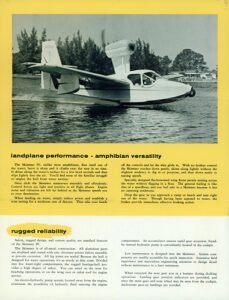
A page from an earl 1950s promotional brochure for the Colonial Aircraft Corp. Skimmer IV (Earl See collection)
For
those of us who recall the period, a boom in general aviation was to take
place following World War II. It was anticipated that returning airmen
would trade their wartime aircraft, flown in hostile skies, for light
planes flown over peaceful American terrain. The return of many veteran
pilots, aviators and airmen was to be the catalyst behind the figurative
statement "an airplane in every garage," and it gave impetus to
artists’ conceptions of smiling families flying to vacation destinations
in futuristic light planes. Aviation magazines of the day reinforced this
vision by depicting modern-day housing developments with a runway and
individual taxiways leading up to each new home.
Aircraft companies and subcontractors shared this
optimism as they converted their wartime facilities into the manufacturing
of general-aviation aircraft. Soon their drawing boards were busy as they
transitioned from the manufacturing of bomber and pursuit aircraft of war
to the postwar pursuit of building light planes. In some cases, and for
expediency, their aircraft were prewar or updated designs. Other
companies, however, capitalized on wartime knowledge and transferred newly
developed technology into modern and innovative aircraft designs.
New light-plane designs and prototypes from major
aircraft manufacturers, including Douglas, Grumman, Lockheed, North
American and Republic, entered into development. Additionally, new light
planes from many other aircraft companies entered the developmental stage
at the end of the war (see listing of aircraft). Concurrently, production
was resumed on prewar aircraft, including the ERCo Ercoupe, Globe Swift,
and the Luscombe Silvaire.
However, the aviation boom was not to be. Many
war-weary pilots turned their vision from the sky to earthbound goals,
including home, automobile, family and peacetime employment. Also, the
exigencies and economic conditions at the time helped to fuel the death
knell of the aviation boom.
This article costs $2.50 to download - or it's free for AAHS members.
Already a member? Sign in to download for free.