
Disaster Photos to New York by Airplane
J.B. Rivard
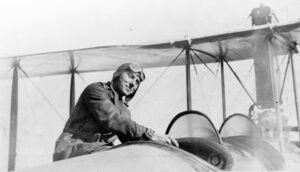
Nick Mamer climbs into the Standard. (Courtesy Spokane Valley Heritage Museum)
Disaster Photos to New York by Airplane
At Parkwater Field in Spokane, Wash., Nick Mamer, later famed for leading the nonstop coast-to-coast round trip flight of 1929,[1] inspects his airplane’s new gas tank. The 65-gallon tank he’s fitted more than doubles the fuel capacity of his open cockpit, two-bay, Standard biplane. He and partner A. A. Bennett will need the increased range afforded by this tank as they begin their unusual mission Friday, September 14, 1923.
Two weeks earlier and more than 5,000 miles west of Parkwater, terror strikes. At exactly two minutes before noon, Saturday, September 1, houses splinter and brick walls tumble. Roof beams split and tiles collapse, hurling clouds of dust across carts, streetcars, roads, and the river.
The cries of those trapped but not crushed fill the murk. As the dust settles, a few surviving structures poke defiantly through the vast white coverlet. A severe earthquake has struck the island of Honshu, devastating both Yokohama and nearby Tokyo.
Smoke issues from wreckage and explodes into orange flames. Fire, sustained by dry, splintered timbers, shoots outward on jets of gas from broken pipes. Hundreds flee to the river to escape the flames, but are incinerated by a scorching wind – a front of fire driven at high speed by its flaring internal energy.
Since its opening in the late nineteenth century, the bay-front City of Silk has flourished on international trade. Now ships rest capsized in its harbor, locomotives lie overturned near twisted rails, and bodies float in its rivers and canals.
A great hotel on the seafront has collapsed, crushing guests and staff alike. Yokohama’s homes and shops are ablaze, its citizens and merchants severely burned or dead. The tsunami and firestorms following the earthquake have created an annihilating catastrophe that is estimated to cause more than 140,000 deaths.[2]
Anchored in Yokohama’s harbor is the 23,000-ton Empress of Australia, a Canadian Pacific Steamship passenger liner.[3] Tugboats gather to assist in preparation for sailing. Passengers line the rails, waving goodbye. The earthquake hits, the ship is flung side to side and the nearby dock is ripped to pieces. In the confusion, the assisting tugs disappear. One of the Empress’s propellers becomes entangled with the anchor cable of an adjacent freighter, preventing its escape.
First Word
Listeners across the globe first learn of the Honshu catastrophe from scratchy voices on early crystal sets or via crude 1920s radio receivers.The Sunday, September 2 New York Times headline screamed “GREAT EARTHQUAKE AND FIRE RAVAGE TOKYO AND YOKOHAMA; MANY PERISH, BUILDINGS COLLAPSE; SURVIVORS FLEE IN PANIC; FIRES RAGE IN WHOLE TOKYO DISTRICT[4] is a report that relied on a message relayed by Radio Corporation of America (RCA) from an employee at an RCA station in undamaged Tomioka, a town 140 miles north of Tokyo. The employee bases his information on coverage in a morning newspaper printed in Sendai, a seacoast town 200 miles north of Tokyo. Carr Van Anda, Times managing editor,[5] is troubled with the report’s dependence on a remote, unverified source.
A decade earlier, Van Anda earned praise for coverage of the sinking of H.M.S. Titanic.[6] The Times’ coverage left
rival dailies like Pulitzer’s . . .
This article costs $5.00 to download - or it's free for AAHS members.
Already a member? Sign in to download for free.