
A Mutual Fiasco: The American Fokker F-11
Gert P.M. Blum
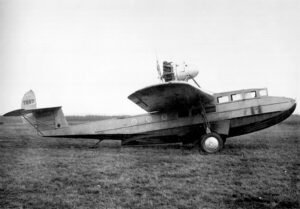
Initially configured as a flying boat American Fokker F-11, msn 901, would be modified into an amphibian with the addition of retractable landing gear. Note the abbreviated vertical stabilizer. This would be enlarged in future production versions. (American Fokker photo from the author’s collection)
A Mutual Fiasco: The American Fokker F-11
Although one of the lesser known products of the American Fokker factory, new information on the Fokker F-11 flying boat/amphibian series is still to be found. Such makes it worthy to bring wider attention to the history of this unsuccessful model. The mere knowledge that only 5 of the 21 boat hulls that were built transformed into completed aircraft (of which three were eventually sold) gives rise to this. Hence this review that also highlights the financial fiasco of this model for both the Dutch and American1 Fokker companies. It also provides an opportunity to refute a persistent misunderstanding about the identity of the third aircraft of the type.
Dutch Fokker Metal Hulls
In the Netherlands, the Fokker company (called
Nederlandsche Vliegtuigenfabriek N.V. or NVNV in short) developed in the early 1920s a small series of metal hulled flying boats/amphibians. All were single engine biplanes with a small lower wing fitted to the hull and designated as B-types. The series started with the unsuccessful B.I amphibian for Colonial use by the Dutch Navy, which flew for the first time in October 1922. It was followed by the small B.II, a reconnaissance flying boat, for which a provisional order of six aircraft was received to be operated from a new cruiser class of the Dutch Navy. The single prototype was completed in October 1923, but was sold back to the factory early in 1925.[2]
A Flying Boat for America
In January 1926 the next type was ordered by the Department of Colonial Affairs for use in the Netherlands East Indies, but the B.III flying boat did not pass the contractual trials in the Netherlands. The sale fell through, but soon afterwards Fokker succeeded in interesting its American subsidiary in the purchase. Modified as B.IIIc and now fitted with a cabin hood, the Atlantic Aircraft Corporation (AAC) delivered the aircraft to Harold S. Vanderbilt.[3]
In the meantime, far more ambitious designs appeared on the drawing boards of the AAC. One of them was a proposal of July 21, 1926, for a large navy monoplane flying boat, probably called PA-1[4] with a wingspan of 108 ft 4 in. Powered by three Pratt & Whitney Wasps and with a calculated endurance of nearly nine hours, it seemed to be intended as a new generation U.S. Navy patrol aircraft, replacing the ancient F-5L and PN-series. By the way, the same wing appeared on the XHB-2 heavy bomber design study for the USAAC on a drawing of September 21, 1926. However, both projects failed to become what would have been the largest U.S. Fokker aircraft ever built.
Both the purchase of the B.IIIc and the PA-1 proposal illustrated Fokker’s attention to an American market for flying boats. The Austrian Alfred A. Gassner, employed by AAC at the time, started designing monoplane developments of the B.III, taking shape under the American designation F-50. One of the designs was an outgrowth of September 1927, called F-50D: a modern-looking high wing flying boat for 15 passengers, equipped with two Pratt & Whitney Wasp engines that were situated side by side on top of the wing.[5] In November, the hull of a slightly larger military version (Navy Class VT) was drawn under the same type designation.
The direct predecessor of Fokker’s first American flying boat to reach construction appeared on the drawing board in mid-October 1927 as the ‘Wasp Boat’ with a single pusher engine pod on top of the wing and designated F-50E.[6] At the end of November, the boat hull was further engineered7 and ready to be built. For practical reasons, the wooden wing was . . .
This article costs $5.00 to download - or it's free for AAHS members.
Already a member? Sign in to download for free.