
On the Heels of War – Post WWII Waterman Air Charters
John Marty
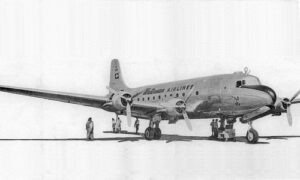
Waterman Airlines DC-4, NC-33691, was delivered at Douglas’ Clover Field in Santa Monica CA, June 26, 1946. Postwar. Douglas began conversion of all C-54/R5D aircraft in their production line to DC-4’s. Waterman purchased Douglas LN-D4-27, the 27th production airplane converted back to DC-4 airline configuration. (Waterman Airlines photo, from the John Marty collection)
On the Heels of War; Waterman Airlines Charter
On the misty, wet morning of October 20, 1946,Waterman Airlines’ (WAL)
new Douglas DC-4, NC33691, lifted off from Andrews Army Air Force Base in
Washington, D.C., bound for the war-torn city of Frankfurt, Germany.
The
North Atlantic that October day promised the usual – cold and windy with a
forecast of rime icing, an unforgiving ocean for any airplane, and in that
distant year largely devoid of other airliners.
This
was Waterman’s third transatlantic crossing in October. It would
culminate a series of ambitious and challenging charters to postwar Europe
for the fledgling air arm of Waterman Steamship Co. of Mobile,
Alabama.(1) The departure from Andrews AAFB was occasioned because
their charter was for a quasi-government agency with the longish title
United Nations Relief and Rehabilitation Administration (UNRA). Since this
was two years before the U.N. was formed, the title was apparently
coincidence. In any case, UNRA, founded in 1943, was a European-based
entity supported by the allied
powers (the Soviets noticeably absent). Their humanitarian
mission was to assist in handling the massive numbers of displaced persons
(DP), civilian, and military who were left homeless in the wake of the
war. A large portion of UNRA’s charges were persons from all across
Europe who had been used in forced labor for German war production. They
were essentially abandoned without passports or means of sustenance. This
was a major problem for the occupation forces and clearly UNRA had the
backing of the U.S. government. Waterman’s
contract was to return American workers who had stayed on after the war to
assist UNRA. They were a mix of military and civilian, male and female.
Frankfurt was the destination because of its proximity to the German town
of Aschaffensburg where UNRA had their principal refugee camp. Their
mission was ending and they were closing the camp. The DPs were apparently
being sent to their home countries, finally.
The
date, October 1946, was an inauspicious time to be going to Europe. The
world was beginning to recover from seven long years of conflict. Germany,
bombed into rubble, was a dark and unsettled country, filled with
displaced persons including former combatants now dissolving into the
civilian population.
Waterman
Airlines’ previous charters in their first four months operating the
DC-4 had been to familiar destinations of Puerto Rico and Hawaii. With the
Germany trips they were now making their first "foreign"Â flights and
going into a devastated country as
. . .
This article costs $5.00 to download - or it's free for AAHS members.
Already a member? Sign in to download for free.