
The McDonnell Douglas-Fokker MDF-100
Joe G. Callaghan and Ed Obert
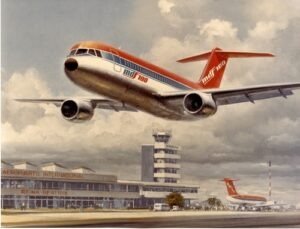
An artist rendering of the McDonnell Douglas-Fokker MDF-100 departing Queen Reina Beatrix Airport, Aruba, the former Netherland Antilles. (McDonnell Douglas-Fokker drawing)
McDonnell Douglas-Fokker MDF-100
During
the early 1980s, McDonnell Douglas (MDD) was conducting studies on an
advanced technology, twin-engine, 160-200 passenger twin-aisle jet
transport. At this time, MDD was strongly committed to the MD-80 twin jet
that had been certified and was in early stages of delivery to airline
customers. Accordingly, McDonnell Douglas was entertaining ideas of
seeking a joint partner for the development of this airplane, known as the
ATMR, for Advanced Technology Medium Range transport.
During this same time period, Fokker Aircraft was engaged
in the development of a new 150 passenger twin-jet transport known as the
F.29. Coincidentally, Fokker was interested in seeking a partnership for
the development of the F.29. Given that McDonnell Douglas had particularly
good business relationships with Holland through KLM airlines, it seemed a
natural possibility that McDonnell Douglas could be that partner.
Fokker was somewhat further
along in the development of the F.29 than MDD was on their ATMR. It
appeared that a joint venture would possibly be timelier by taking
advantage of the F.29 development. This led to Fokker and McDonnell
Douglas signing a Memorandum of Understanding in May 1981 to jointly
develop a new 150-seat aircraft to be named theMDF-100.
Fokker F.29
In
1979, Fokker’s Preliminary Design Department started from scratch with a
completely new design. Until then the F.28 had been the basis for new
designs, but now a new proposal was made: the F.29. It was to have a wider
fuselage with three seats on either side of the aisle. Normal capacity
would be 132 passengers, rising to 150 in a high-density configuration.
A stretched version would accommodate 156 and 179,
respectively. The fuselage had a double-bubble cross-section in the shape
of a fi gure "Ëœ8’ similar to that found in the Curtiss C-46 or DC-8.
Unlike the F.28, the engines were to be mounted under the wings.
Two types of turbofans were proposed to potential
customers: the 20,000 lb thrust Rolls-Royce RB432 (later to be embodied in
the IAE V2500) and the CFM International CFM56-3 of 21,000 lb thrust. The
wing would have a high aspect ratio and a supercritical profile. The Dutch
NLR (National Air and Space Laboratory) had progressively refined this
type of airfoil over the preceding 10 years or so. Now, the results of
these investigations could be applied to the F.29. For the first time at
Fokker, computers were used for design work. Also, much attention was
given to modernizing the cockpit by introducing an electronic flight
instrument system or EFIS. This meant that a large proportion . . .
This article costs $5.00 to download - or it's free for AAHS members.
Already a member? Sign in to download for free.