AAHS Journal Vol. 56 No. 3 – Fall 2011
Fall 2011. 8 features in this issue.
Full-text articles are free to AAHS members. Sign in to read and download every article in this issue, or purchase individual PDFs below.
AAHS Journal Vol. 56 No. 3 – Fall 2011
- Jump to abstract ↓
- Jump to abstract ↓
- Jump to abstract ↓
- Jump to abstract ↓
- Jump to abstract ↓
- Jump to abstract ↓
- Jump to abstract ↓
- Jump to abstract ↓
No articles in this issue match your search. Clear search
Article Abstracts
The Travel Air Mystery Ship
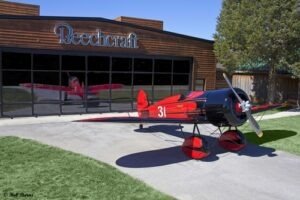
Travel Air Mystery Ship, NR614K, c/n R-2001, on the ramp in front of the Beechcraft Heritage Museum in Tullahoma, Tenn. (Photo by Robert Burns)
Travel Air’s Model "R"Â possessed beauty, speed and
aeronautical design that paved the way for a new era in American aviation.
The legend of the "Mystery Ship"Â lives today . . . a legend started by
one man’s desire to build a winning racer.
Herb Rawdon sat patiently as Walter Beech paoor, pipe in hand. The
president of Travel Air wasn’t too happy about the past racing season’s
success.
Walter
Beech was always out to win. But Travel Air hadn’t won much in 1928.
There were victories, but there were defeats, too. Defeats handed down by
the military and competitors’ airplanes. Defeats that Beech didn’t
like.
Both
men knew that the hottest thing at Travel Air was a J-5 Model 4000 with
Speed Wings. Good, but not good enough. The subject turned to company
affairs and the 1928 racing season faded away.
Perhaps
Walter Beech let it fade away, but Herb Rawdon didn’t. Within his
engineering, innovative mind an idea was forming: a concept for victory on
the race circuit in 1929. Rawdon remembered Beech’s lament. There was a
solution, an avenue to success, which Travel Air could pursue. Rawdon
believed an airplane could be designed, built and flown that would defeat
the crop of souped-up, slicked-up biplanes being raced by the military
establishment. And, he believed his "concept racer"Â could be a winner
without 600 hp and the usual aerodynamic refinements employed by the
competition.
One
thing Herb Rawdon knew for certain: the genesis of such a ship was now,
not two months before the 1929 racing season started.
He
could expect little or no company assistance. The Travel Air production
line was humming with activity, cranking out Model 6000 monoplanes and the
ubiquitous biplanes at the rate of nearly 25 ships per week!
One
year separated defeat and victory for Travel Air, and Rawdon knew every
bit of those 12 months would be needed to make his concept a reality. But
he also knew he couldn’t do it alone. Help was found in Walter Burnham,
another engineer at Travel Air who Rawdon trusted and enjoyed working
with.
Burnham
listened to Herb’s idea to build a racer. It was certainly a challenge
both men wanted to tackle, but they agreed to keep the project quiet and
work on it at home. From that evening forward for the coming year, both
the Burnham and Rawdon families saw much less of their husbands and
fathers.
A
pattern of design was emerging from Rawdon’s mind. He had always admired
the sleek, powerful float-equipped Schneider racers, particularly Reginald
Mitchell’s Supermarine designs. The Schneider ships set the pace for
others to follow in speed and sheer power.
But
it was aeronautical design that Rawdon believed could turn the tide in
Travel Air’s favor. A carefully planned and executed airframe, utilizing
minimum frontal area and possessing low drag and light weight could, when
mated to an engine of sufficient horsepower, provide excellent
performance.
Monoplane
configuration was essential, as was fixed landing gear and room for only
the pilot. Wire bracing . . .
This article costs $5.00 to download - or it's free for AAHS members.
Already a member? Sign in to download for free.
On the Heels of War – Post WWII Waterman Air Charters
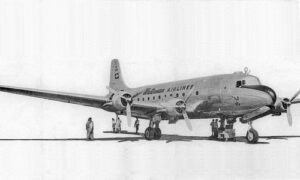
Waterman Airlines DC-4, NC-33691, was delivered at Douglas’ Clover Field in Santa Monica CA, June 26, 1946. Postwar. Douglas began conversion of all C-54/R5D aircraft in their production line to DC-4’s. Waterman purchased Douglas LN-D4-27, the 27th production airplane converted back to DC-4 airline configuration. (Waterman Airlines photo, from the John Marty collection)
On the Heels of War; Waterman Airlines Charter
On the misty, wet morning of October 20, 1946,Waterman Airlines’ (WAL)
new Douglas DC-4, NC33691, lifted off from Andrews Army Air Force Base in
Washington, D.C., bound for the war-torn city of Frankfurt, Germany.
The
North Atlantic that October day promised the usual - cold and windy with a
forecast of rime icing, an unforgiving ocean for any airplane, and in that
distant year largely devoid of other airliners.
This
was Waterman’s third transatlantic crossing in October. It would
culminate a series of ambitious and challenging charters to postwar Europe
for the fledgling air arm of Waterman Steamship Co. of Mobile,
Alabama.(1) The departure from Andrews AAFB was occasioned because
their charter was for a quasi-government agency with the longish title
United Nations Relief and Rehabilitation Administration (UNRA). Since this
was two years before the U.N. was formed, the title was apparently
coincidence. In any case, UNRA, founded in 1943, was a European-based
entity supported by the allied
powers (the Soviets noticeably absent). Their humanitarian
mission was to assist in handling the massive numbers of displaced persons
(DP), civilian, and military who were left homeless in the wake of the
war. A large portion of UNRA’s charges were persons from all across
Europe who had been used in forced labor for German war production. They
were essentially abandoned without passports or means of sustenance. This
was a major problem for the occupation forces and clearly UNRA had the
backing of the U.S. government. Waterman’s
contract was to return American workers who had stayed on after the war to
assist UNRA. They were a mix of military and civilian, male and female.
Frankfurt was the destination because of its proximity to the German town
of Aschaffensburg where UNRA had their principal refugee camp. Their
mission was ending and they were closing the camp. The DPs were apparently
being sent to their home countries, finally.
The
date, October 1946, was an inauspicious time to be going to Europe. The
world was beginning to recover from seven long years of conflict. Germany,
bombed into rubble, was a dark and unsettled country, filled with
displaced persons including former combatants now dissolving into the
civilian population.
Waterman
Airlines’ previous charters in their first four months operating the
DC-4 had been to familiar destinations of Puerto Rico and Hawaii. With the
Germany trips they were now making their first "foreign"Â flights and
going into a devastated country as
. . .
This article costs $5.00 to download - or it's free for AAHS members.
Already a member? Sign in to download for free.
The McDonnell Douglas-Fokker MDF-100
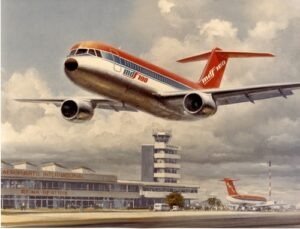
An artist rendering of the McDonnell Douglas-Fokker MDF-100 departing Queen Reina Beatrix Airport, Aruba, the former Netherland Antilles. (McDonnell Douglas-Fokker drawing)
McDonnell Douglas-Fokker MDF-100
During
the early 1980s, McDonnell Douglas (MDD) was conducting studies on an
advanced technology, twin-engine, 160-200 passenger twin-aisle jet
transport. At this time, MDD was strongly committed to the MD-80 twin jet
that had been certified and was in early stages of delivery to airline
customers. Accordingly, McDonnell Douglas was entertaining ideas of
seeking a joint partner for the development of this airplane, known as the
ATMR, for Advanced Technology Medium Range transport.
During this same time period, Fokker Aircraft was engaged
in the development of a new 150 passenger twin-jet transport known as the
F.29. Coincidentally, Fokker was interested in seeking a partnership for
the development of the F.29. Given that McDonnell Douglas had particularly
good business relationships with Holland through KLM airlines, it seemed a
natural possibility that McDonnell Douglas could be that partner.
Fokker was somewhat further
along in the development of the F.29 than MDD was on their ATMR. It
appeared that a joint venture would possibly be timelier by taking
advantage of the F.29 development. This led to Fokker and McDonnell
Douglas signing a Memorandum of Understanding in May 1981 to jointly
develop a new 150-seat aircraft to be named theMDF-100.
Fokker F.29
In
1979, Fokker’s Preliminary Design Department started from scratch with a
completely new design. Until then the F.28 had been the basis for new
designs, but now a new proposal was made: the F.29. It was to have a wider
fuselage with three seats on either side of the aisle. Normal capacity
would be 132 passengers, rising to 150 in a high-density configuration.
A stretched version would accommodate 156 and 179,
respectively. The fuselage had a double-bubble cross-section in the shape
of a fi gure "Ëœ8’ similar to that found in the Curtiss C-46 or DC-8.
Unlike the F.28, the engines were to be mounted under the wings.
Two types of turbofans were proposed to potential
customers: the 20,000 lb thrust Rolls-Royce RB432 (later to be embodied in
the IAE V2500) and the CFM International CFM56-3 of 21,000 lb thrust. The
wing would have a high aspect ratio and a supercritical profile. The Dutch
NLR (National Air and Space Laboratory) had progressively refined this
type of airfoil over the preceding 10 years or so. Now, the results of
these investigations could be applied to the F.29. For the first time at
Fokker, computers were used for design work. Also, much attention was
given to modernizing the cockpit by introducing an electronic flight
instrument system or EFIS. This meant that a large proportion . . .
This article costs $5.00 to download - or it's free for AAHS members.
Already a member? Sign in to download for free.
My Thirty Years in Aviation
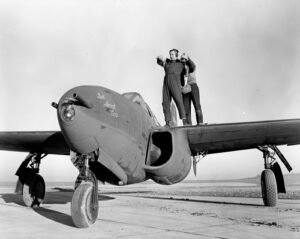
Bob Stanley getting ready for a flight in a Bell P-59. (Bell photo from the Harry Gann collection)
As I look back over
the past 30 years, in which I have continuously been engaged in the
aviation industry, I am forced to conclude that I was born at one of the
most propitious times for the pursuit of such a career. I vividly recall
the airplanes used in WWII, and I have lived to see airplanes of my own
design surpass 2,000 mph.
I remember in the 1920s, following in the Sunday
supplements, the experiments of an eccentric called Dr. Robert Goddard,
and I have lived to see his inventions in orbit around the sun, taking
photographs of the far side of the moon, and going around the world in the
number of minutes (almost) that Jules Verne described fictionally in the
equivalent number of days.
I recall the envy with which I watched my
12-year-old brother taking a ride in the fi rst airplane I ever saw, a WWI
"Jenny"Â flying from a cow pasture in western Oklahoma. It was a great
thrill to me in 1930 to be able to inspect at close range at Burbank’s
United Airport, the pride of the U.S. Army Air Corps, consisting of huge
Keystone biplane bombers, Curtiss Falcons and Douglas observation
planes.
I remember clearly the suspense of Lindbergh’s
33 hours crossing the Atlantic, and the wild exhilaration at his success,
as well as the loss of a number of transatlantic fliers who preceded him,
and the highly publicized flights over the North Pole by airplanes and
dirigibles.
I remember clearly the crash of the French
dirigible Dixmude off southern France, the crash of the British R-101
dirigible, the heroic final flight of the U.S. Navy dirigible Shenandoah,
and the tragic loss of the . . .
This article costs $5.00 to download - or it's free for AAHS members.
Already a member? Sign in to download for free.
Aircraft History of the Boeing 95
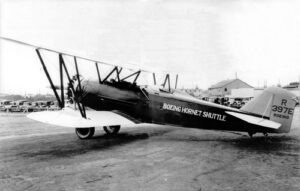
Boeing "Hornet Shuttle," NR397E, was used by Boeing and supported by the USAAC in refueling experiments in 1929 that included several coast-to-coast flights between Oakland and New York with refueling occurring over Elko, Nev., Cheyenne, Wy., and Cleveland, Ohio. USAAC participants included Capt. Ira Eaker, Capt. Clair Streett, Lt. Benard Thompson and Lt. Newton, Longfellow. Boeing pilots were Clair Vance and Harold Lewis. (Boeing photo)
Aircraft History of
the Boeing 95
With the
development of the Boeing Model 80 12-passenger airliner, the airlines
needed an all mail and cargo plane. So, Boeing built 25 of the Model 95 as
an open cockpit cargo and mailplane. All 25 were delivered between January
18 and May 8, 1929. Twenty were delivered to Boeing Air Transport (BAT),
one to National Air Transport (NAT) and four to Western Air Express (WAE).
NAT took over many of the 95s from its sister company, BAT. NAT flew them
on its Chicago-New York route and WAE operated the 95s on its Los
Angeles-Las Vegas-Salt Lake City route. The maximum 1620 pound payload
went in the three mail compartments that were in front of the cockpit and
one for express cargo aft of the pilot. The mail compartments were of 25,
20 and 35 cubic feet from the front of the fuselage to the rear. Power was
from a single nine-cylinder Pratt & Whitney R-1860 Hornet of 525 hp.
Normal cruise speed was 120 mph. The first flight of the biplane was on
December 29, 1928, and on January 30, 1929, Aircraft Type Certificate (ATC)
106 was issued. The fuel tanks, 105-gallon main and a 25-gallon reserve,
were in the center section of the upper wing. The ATC was modified in
August 1929 when the fuel capacity was increased from 130 gallons to 155
gallons. The main gear had wheel brakes that were operated by depressing
the upper part of the rudder pedals, later known as toe brakes. The 95s
were delivered with a steerable tail skid, in later years some had tail
wheels installed. In 1929, the advertised price was $24,500 but in
quantity they could be purchased for as low as $18,900.
Boeing Air Transport (BAT) crashed three of their
95s. One crash was due to weather, another had an engine failure and the
last resulted from a fuel system failure. In 1930 and 1931, the
remaining ten 95s were sold to National Air Transport (NAT) . . .
This article costs $5.00 to download - or it's free for AAHS members.
Already a member? Sign in to download for free.
The Grumman A-6 Intruder; the Beginning of a Dynastry
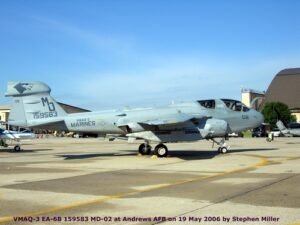
Grumman EA-6B Prowler, Bu 159583, MD-02 of VMAQ-3 at Andrews AFB, Md., on May 19, 2006. The USMC continues to operate the EA-6Bs as of 2011, hoping to replace them with an ECM version of the F-35B. (Photo by Stephen Miller, AAHS-P004011)
The Grumman EA-6 Intruder; the Beginning of a Dynasty
As usual the Marine Corps was working on a pauper’s budget. That may
come as a surprise to people that have never been in the Corps, but it is
a fact. For decades, between all of the various wars of the Twentieth
Century, the Corps was the only service that consistently returned money
to Congress. This occurred despite the fact that we wore leggings rather
than boots and we were occasionally issued WWI bayonets rather than the
shorter WWII versions.
In 1947 it was not at all uncommon to chance upon
other WWI personal combat equipment, such as cartridge belts that would
accommodate the five-round clip for the 1903 rifle rather than the
eight-cartridge clip common to the new M-1 rifle. In fact, when the
Marines landed at Guadalcanal they were still equipped with the 1903
Springfield. One other point that should be made that may explain some of
my other comments is that in 1938 the Marine Corps consisted of roughly
18,000 officers and men. Despite all of the campaigns in which the Corps
had been involved in Latin America and for which we had been vilified by
the left, there were fewer Marines available in those days than there were
New York City cops.
The story is that the Corps just kept giving the
money back, not because they were trying to curry favor with Congress,
although that must have been one motivation, but because they felt that
they just didn’t need it. After all, the equipment that they had was
only 20 years old and was still perfectly serviceable. All of which is to
illustrate the fact that the Corps is not wasteful by nature or tradition.
As the smallest, and the only expeditionary
service by law, the Corps had been fighting almost constantly since the
turn of the Twentieth Century and had been doing so on the cheap. I’m
not whining. That’s just the way it was. Despite this frugality, the
Corps was thinking way ahead of the other services when it came to
combined arms. That term can mean different things to different people.
The Navy used to think that it referred to coastal bombardment, but I’m
referring to aviation and ground coordination. Throughout the expeditions
in Nicaragua during the 1920s the Corps used airplanes to deliver ordnance
in close proximity to the troops. The reason was that our men were usually
patrolling through dense jungles and we couldn’t drag artillery through
the rough terrain. As our patrols were invariably outnumbered and
constantly being ambushed, they often needed instant help. One might
conclude that the evolution of close air support was born of dire
necessity. Aviation was the answer to the lack of artillery and this was
the first real integration of missions between ground and air.
The aviators in France during WWI had strafed the
trenches and had dropped hand-held bombs, but the distance between the
opposing forces was usually six- or seven-hundred yards. Our Army
artillery could usually do better than that and accurately and repeatedly
brought that distance down to a couple of hundred yards. Regrettably,
there were always short artillery or mortar rounds that took the lives of
our men. Men were also killed due to human error such as pilots being
unfamiliar with the terrain and the sometimes tricky technique of
identifying friendly troop positions in hazy conditions.
The point is that since we didn’t have
artillery, close air support was the only alternative available. The
ground marines and aviators set about devising procedures with which to
properly and easily identify our troop positions. They also worked on
improvising methods of control and coordination. As neither the troops nor
the aircraft had radios at that time, achieving coordination could get
tricky. By the time WWII . . .
This article costs $5.00 to download - or it's free for AAHS members.
Already a member? Sign in to download for free.
Way Back When – Travel Air Mystrey Ship
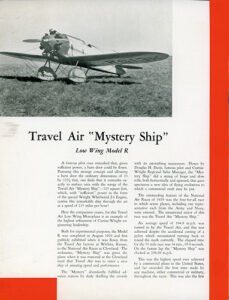
Though a "made-to-order" aircraft, Travel Air did put some promotional flyers together to promote the Mystrey Ship. (From the Hayden Hamilton collection)
Way Back When - Travel Air Mystery Ship
This series focuses on sales literature that prompted light aircraft during the Golden Age of American aviation. It will illustrate sales and marketing messages for popular, and not so well known, aircraft from the 1920s and 1930s, illuminating insight into the perspectives associated with the aviation industry of that era.
This article costs $2.50 to download - or it's free for AAHS members.
Already a member? Sign in to download for free.
Forum of Flight
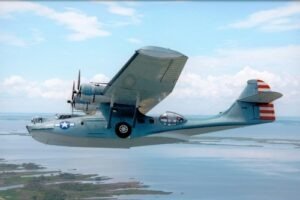
A Convair PBY-5A Catalina over Virginia Beach, Va., May, 2010. (Photo by Rich Kolasa)
The FORUM is presented as an opportunity for each member to participate in
the Journal by submitting interesting or unusual photographs. Negatives,
black-and-white or color photos with good contrast may be used if they
have smooth surfaces. Send submissions to the Editorial Committee marked
"Forum of Flight," P.O. Box 3023, Huntington Beach, CA
92605-3023. Mark any material to be returned: "Return to (your
name and complete address)."
Please include as much information as possible about the photo such as:
date, place, names, etc., plus proper credit (it may be part of your
collection but taken by another photographer).
This article costs $2.50 to download - or it's free for AAHS members.
Already a member? Sign in to download for free.