The P-51D/K Mustangs of the Royal Netherlands East Indies Air Force
Gerard Casius
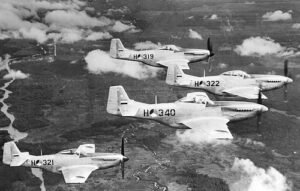
A demonstration flight conducted by 122 Squadron on November 18, 1949, celebrating 35 years of the RNEIAF. The pilots (top to bottom) were Manus Mulder (H-319), Lt. Paul Verspoor (H-322) with a newspaper reporter as a passenger, Ronnie van Beers (H-340) and Peit Admas (H-321). Red and Blue Flights are designated by spinner color. (Photo from the author’s collection)
The P-51D/K Mustangs of the
Royal Netherlands East Indies Air Force
The
interest of Dutch Military Aviation (ML) in the Dutch East Indies in the
P-51 Mustang dates back to 1941. Urgent attempts by the Netherlands
Purchasing Commission (NPC) to buy sufficient fighters for the ML resulted
in a request to the U.S. government for delivery of 100 Bell P-39
Airacobras. The request was turned down but accompanied with the message
that the Royal Air Force (RAF) would supply 100 P40Es from their
consignment. It is unclear why, but the ML did not accept this offer
immediately and requested on July 10, 1940, to acquire 100 fighters of
North American Aviation’s NA73 type instead. Again the U.S. government
refused but stated that the offer of the 100 P-40s was still valid, but
would expire on October 15, 1941. The ML again requested Airacobras, which
was refused again. When the Japanese forces attacked the Dutch East Indies
in December 1941 the ML still had no modern fighters.
Mustangs after all
After
Java fell in 1942 the ML moved their operations to Australia and New
Guinea and by 1943 were flying Curtiss P-40Ns. By 1945, this war-weary
fighter was nearing the end of its usefulness and for the reequipment of
ML No. 120 Squadron a request (N-2075) was sent to the U.S. for the
acquisition of 41 Mustangs. This request for P-51s was finally granted.
The aircraft were pulled from U.S. contracts and received Dutch marking
while still on the production line. Delivery of the first 10 P-51Ks
occurred in March 1945, followed by 10 P-51Ds in April with the remaining
21 P-51Ds arriving in June 1945. However, only 40 Mustangs actually
reached Australia and got ML serials N3-600 to N3-640. The exception was
N3-632 (USAFF 44-84795) that was not delivered. In Australia the ML
Mustangs were made airworthy at RAAF aircraft depots and the first 19
(N3-600 to N3-618) were speedily delivered during May and June 1945 to the
Dutch Personnel and Equipment Pool at Bundaberg, Queensland, located about
300km north of Brisbane well before the Japanese surrender. After VJ Day
activities slowed and the remaining aircraft were delivered between
October 1945 and March 1946. This slow down may have been a sign of lower
priority on behalf of the RAAF and a changed attitude by the Australian
government towards the Dutch "colonial" ambitions.
Flying
to Java
With the Mustang the
ML obtained a top-of-the-line fighter that had proven its worth in battle,
as well as one whose faults had been ironed out. The P-51 was heavily
armed, had good range and was easy to fly. That there were two different
versions did not matter from either a service or operation perspective
with the differences being only distinguishable by their props.
During April and May 1946
the 40 Mustangs were flown in three groups from Bundaberg to Tjililitan
Airbase at Batavia (now Jakarta). They flew via Cloncurry, Darwin, Timor,
Bali and Soerabaja, a distance of 3,200 miles. These flights were . . .
This article costs $5.00 to download - or it's free for AAHS members.
Already a member? Sign in to download for free.