The Final Flight of Ensign Paul Blair
John W. Coe
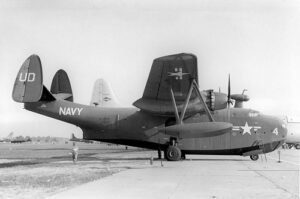
VP-203 was assigned Martin PBM-3s that were similar to this PBM-5A, BuNo 122081. The primary difference being that the -3s were equipped with Wright R-2600 Cyclone engines that produced 200 to 400 less horsepower per engine than the Pratt & Whitney R-2800s on the -5s. (Photo from the Al Hansen collection, AAHS-P000542)
The Final Flight of Ensign Paul Blair
At
the southern end of Manhattan Island in Battery Park, about 150 yards from
the South Ferry subway station on the IRT line, there stands the East
Coast Memorial, a battle monument commemorating some 4,611 fallen
soldiers, sailors, marines, coast guardsmen, merchant marines and airmen
who gave their lives in the western waters of the Atlantic Ocean during
WWII. The monument is a silent sentinel commemorating all WWII servicemen
who went missing in action in the Western Atlantic, later deemed KIA, who
perished in America’s great struggle against fascism, never to return to
their native land. The monument is appropriately oriented toward the
Statue of Liberty, sitting as it has for over a century, proclaiming
America’s commitment to freedom for all who seek refuge on her soil.
Inscribed on the western wall of the battle monument, among the names of
other honored servicemen, is a simple engraving: "Ensign Paul B.
Blair – USN Reserve – Texas." The simplicity and dignity of the
monument and its simple inscription is a metaphor for the man himself.
Born
in the small town of Alvarado, Tex., on September 30, 1919, Paul Blair was
an honor student, a fine high school athlete and, above all, a devoted
family man who during the war maintained a steady correspondence with his
parents, his sister Betty and his brother Thomas.1 And like
thousands of young men from towns both large and small, Paul Blair went to
war to do a terrible job and longed only for the day when he could return
and be with his incredibly close-knit family in Texas. There is no
bravado, no tales of daring-do and no inflated feeling of self-importance
in Blair’s sense of himself. There is, instead, only the sense of
necessity and a desire for the final day when it would all be over.
Throughout
his naval career Blair kept up a prolific correspondence to his family.
Indeed it is possible to trace his naval career, however brief, through
his letters home, most notably to his mother and father.
After
enlisting in the U.S. Navy and attending flight school in Pensacola
beginning in May 1943, Paul Blair’s naval odyssey began in PBYs, his
first airplane. "Well," he writes to his parents on June 15,
1943, "am back at the main base (Branson) taking basic – trying to
fly on instruments." However, his stay at Branson was short lived.
"I just got settled down and learn that routine at one base and they
up and transfer me! The first week here we will be studying gunnery. It is
kinda dull learning all the names and parts to the machine guns, but I
suppose it is necessary." Writing home to his mother on August 9,
1943, Blair notes that, "You ask about P Boats, mom, . . . they are
kinda large (4 bunks) a pilots compartment, radio compartment, and rear
compartment. Two engines of 1,250 horsepower each burn 300 gallons of gas,
and lately I have been flying everyday."
On
August 27, 1943, Blair sent a telegram to his mother stating that he
"Received commission and wings today – nothing definite until
Thursday." Blair was then ordered first to Norfolk, Va., and then to
Floyd Bennett Field in Brooklyn where he notes that he . . .
This article costs $5.00 to download - or it's free for AAHS members.
Already a member? Sign in to download for free.