Visitors to Parks Air College
Terry Love
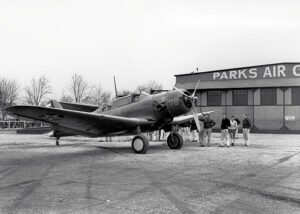
This Northrop A-17A, in full military markings, visited Parks Air College in the fall of 1940. The pilot of the A-17 appears to be near the prop blades explaining the aircraft to some students. (Photo from the Parks Air College collection via Terry Love)
Following his service in the U.S. Marine Corps during WWI, Oliver
Lafayette "Lafe" Parks began taking flying lessons from a pilot
at Robertson Aircraft Corporation. He received his first pilots rating in
January 1926. The certificate, No. 6373, was signed by Orville Wright. Six
months later, Parks earned his transport rating. He then bought two planes
– a Standard and an Eagle Rock. Parks enjoyed taking visitors for rides
over the St. Louis area. Sometimes he earned $300 a day on these flights.
The Standard that Parks flew was less than reliable, and he encountered
several incidents that brought him to the realization that his flight
training had been too short, too fast, and too narrow.
In May 1927, Charles Lindbergh’s historic
flight over the Atlantic Ocean to Paris got people thinking about aviation
in general and aviation careers in particular. Parks was among them, since
he loved to fly.
But aviation at that time was more daredevil than
serious business. Most civilians engaged in aviation were
"barnstormers" that were usually flying veterans from the war,
who flew around the country displaying their skills and giving rides. Most
people considered a career in aviation to be a risky venture. Nonetheless,
on August 1, 1927, Parks opened up his air college in a rented hangar at
Lambert Field, near St. Louis, Missouri. He still had two airplanes –
his old Standard and a Laird Swallow. Harvey Glass became his first
student pilot. He gave a free ride to the young man and his girl friend in
his Swallow, but it crashed.
In the spring of 1928, Parks bought some acreage
in Cahokia, Illinois – just the other side of the river from St. Louis. He
had found his school site. He added charter services, educational courses,
and sightseeing flights.
Only two years after its opening, Parks Air
College made history when it became the nation’s first federally
approved flying school. Parks has Certificate Number 1. With this
distinction in hand, Parks weathered the Great Depression and . . . .
This article costs $2.50 to download - or it's free for AAHS members.
Already a member? Sign in to download for free.