The Thomas Brothers: Pioneer Aeronautical Engineers and Plane Builders
Harold Morehouse, edited Hayden Hamilton
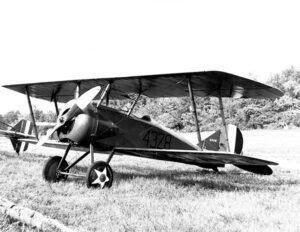
Following the formation of the Thomas-Morse Aircraft Corp., the company introduced the aircraft they are most remembered for the Model S-4, or “Tommy.†This single-seat advanced trainer was used extensively by the USAAC. Seen here is one of the few flyable, and very early, S-4Bs owned by the Old Rhinebeck Aerodrome, USAAC 4328, N74W). (AAHS photo archives, Gerald Balzer collection)
The Thomas Brothers;
Pioneer Aeronautical Engineers and Plane Builders
The Thomas brothers pioneer aviation biographies should be recorded jointly because their early aviation engineering and plane building accomplishments were made as a team.
After receiving elementary schooling in Argentina, William Thomas attended Dulwich Preparatory School at Dulwich College in Great Britain from 1900 to 1904, then the Central Technical College, London, where he graduated in Civil and Mechanical engineering in 1908. During this period, he also served an apprenticeship with the British Westinghouse Company at Trafford, England.
While in college and serving his apprenticeship William became very interested in aeronautics, endeavoring to learn all he could about the new science, and was one of the founder members of the Aero Club of Great Britain and Ireland early in 1908. In June of that year he came to the United States to work for the HerringÂCurtiss Company, Hammondsport, New York, where he did drafting and designing of motorcycle and aircraft engines for Glenn Curtiss and Capt. Thomas Baldwin through 1909. There he also witnessed the aircraft program of the Aerial Experiment Association.
Oliver Thomas, also a British engineering graduate, had come to the United States before William, as an engineer in the test laboratory of General Electric at Schenectady, New York.
In late 1909 William "got the bug" to build an aeroplane at Hammondsport. Working in a barn he started the construction of a biplane of his own design, embodying many new and unique ideas. With the help of two local mechanics, Bert Chambers and Gene Bell, and a few hand tools, this was a slow labor of several months. This first machine had a wing span of 27 feet, with front elevator and a rear stabilizer and rudder. A unique aileron arrangement was mounted between the front and rear outer struts, with a wide landing gear with long skids and four wheels mounted on leaf springs. The propeller was driven by a 22-hp Kirkham automobile engine through chain and sprockets having a 1.5 to 1 ratio. The total weight was 600 pounds.
After the plane was completed William moved his operations to Hornell, New York, in the spring of 1910 and started ground tests and flying experiments on the Page Farm near North Hornell. Following the usual taxiing practice, he made his first brief straightaway solo hop on June 28, 1910. During this period he found that the engine did not have enough power for extended sustained flight until changes were made to increase the output. In August a former friend and Curtiss employee, Walter E. Johnson, joined William and began assisting in this work. Johnson was eager to learn to fly and also began taxiing practice. With gradual engine changes to increase power his first solo flight was made at Hornell on September 7, 1910, and included a circle. Evidently after this William turned the major part of the flying over to Johnson, however he continued to fly when he personally wanted to conduct
certain tests himself.
In October an invitation was accepted to make exhibition flights during a fair at Stow Park, Binghamton, New York. This was the first public exhibition of their machine and Johnson made brief flights on October 10 and 11, which were terminated when he struck the top of one of the tents on takeoff, but he was not injured.
Shortly after this engagement all operations were moved from Hornell to Bath, New York, where their Kirkham engine was made. Johnson then made exhibition flights at the Broome County Fair, Rochester, New York. Testing and development work continued at Bath through the late fall months of 1910 and the front elevator was removed. In December Johnson began flying from the ice on nearby Lake Salubria with runners on . . .
This article costs $5.00 to download - or it's free for AAHS members.
Already a member? Sign in to download for free.