Rossevelt Field: Once the World’s Premier Airport
Robert G. Waldvogel
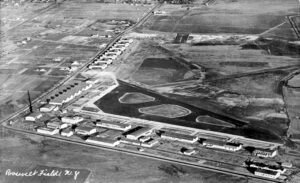
The 1930s saw continued expansion at Roosevelt Field as seen here in a period aerial photograph. (Alan Reddig, via Paul Freeman’s Abandoned & Little-Known Airfields)
Roosevelt Field: Once the World’s Premier Airport
Mention the name "Roosevelt Field" to a Long Islander and he will most likely conjure up images of sales in Macys department store, the set of golf clubs he has been eying in Dick s Sporting Goods, and lunch in the food court. But a plaque entitled "Historic New York Roosevelt Field" indicates that there was once another "Roosevelt Field" here, stating, in part, that "the level, treeless Hempstead Plains – a unique Long Island attraction since colonial days – was ideally suited for flying fields. Glenn Curtiss made the first flight here in 1909 in his ’Gold Bug,’ which resembled an enlarged box kite."
It begs the question, amid the scramble of shoppers oblivious to this historical fact: Where did this first "field" go? But more importantly, perhaps, is how did it even get started?
Airfield Origins
Like trees that ultimately spring from flat fields, the airport itself rose from one that was originally called the "Hampstead Plains."
"The central area of Nassau County, known as the Hempstead Plains, (was) the only natural prairie east of the Allegheny Mountains," according to Joshua Stoff in Historic Aircraft and Spacecraft of the Cradle of Aviation Museum (Dover Publications, 2001, p. viii). "Treeless and flat, with only the tall grasses and scattered farmhouse, this area proved to be an ideal flying field and was the scene of intense aviation activity for over 50 years."
Like a blank canvas – to use another analogy – whose ultimate depiction begins in the artist’s mind, the expanse’s first brush stroke was applied by "artist" Glenn Curtiss. While the Wright Brothers may have gotten it right, Curtiss made it better, as would soon be proven by a group of young aviation enthusiasts who organized the New York Aeronautical Society and often witnessed the failed aeronautical attempts of other early inventors.
Spurred, ironically, by these failures, they sought success by turning to Curtiss, whose own initial designs had already proven themselves and requested that he build an airplane for their use in 1909, paying for it with pooled funds. The transaction constituted the first such commercial aircraft sale in the U.S.
Named "Gold Bug," it was delivered to the society’s Morris Park airfield in the Bronx, which was little more than a deserted racetrack, prompting Curtiss to assume the secondary, but unofficial role as aeronautical advisor. His advice? Scout Long Island, with its wide-open expanses, for a more suitable location for aeronautical activities – catalyst, perhaps to his first "brush stroke."
Elmo Pickerill, one of the society’s members, recalls this scouting process.
"I was quite familiar with the terrain here on Long Island," he said as documented by Barbara Joyce Stubbe in The Story of Roosevelt Field: Forty Years of Flight, 1911-1951 (The Nassau County Historical Society Journal, pp 1-2). "This knowledge resulted in Mr. Curtiss asking me to accompany him to Long Island in search of a more suitable flying field. We drove from New York to Mineola in his Winton car. Upon arrival at Old Country Road and Washington Avenue, I pointed out the wide-open field known as Hempstead Plains. Mr. Curtiss stood up in the car for a few minutes, looking the field over. Finally, he said, ’This is it!’"
The first brush stroke was thus applied.
Although this rudimentary method hardly equaled today’s sophisticated airport site selection and analysis criteria, it led to the birth of the Mineola Flying Field. Unofficially so designated because of the Long Island Railroad’s access to it through the station of the same name, it sprouted its initial wings when Dr. Henry Walden, a society member, took off in the first American monoplane, the Walden IX, from it on August 3, 1910.
"Dawn tinged the sky over the Hempstead Plains as dentist Henry Walden, cigar clamped between his teeth, climbed into his homemade airplane and opened the throttle," according to Laura Muha in her article, "Fliers Take Wing." "The engine . . .
This article costs $5.00 to download - or it's free for AAHS members.
Already a member? Sign in to download for free.