The St. Louis Aircraft Corporation
Hayden Hamilton
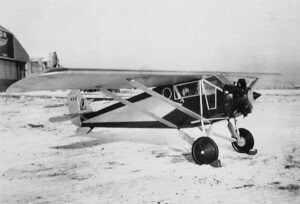
The prototype Cardinal, N422, s/n 101, in a photo possibly taken in November/December 1929. (SLAC photo from the Gerald Balzer collection, AAHS_D107445)
The St. Louis Aircraft Corporation
The St. Louis Car Company, established in 1887, had built a strong presence in the transportation business with railcars and streetcars. By the turn of the century, the company began exploring opportunities of expanding and the birth of aviation in the early 1900s seemed like a likely area to explore. St. Louis Car had already been exploring possible expansion of its business into aviation prior to WWI. In 1915, they had entered into an agreement with St. Louis aviator and designer, Thomas W. Benoist, to produce a large twin-engine flying boat of his design. Furthermore, records indicate that the company had constructed a single-engine and a twin-engine Benoist design as part of the relationship. St. Louis Car was prepared to produce as many as a thousand of the craft in one year. The partnership was contingent on a contract being secured from the British Government. The contract never materialized and only a single test article was produced and flown.[1,2]
World War I
Born of necessity during the First World War, the St. Louis Aircraft Corporation (SLAC) was a joint effort between the St. Louis Car Company and the Huttig Sash and Door Company. In 1917, the U.S. found itself in a situation where it needed to rapidly increase war production, particularly relative to aircraft production where the existing manufacturers’ capabilities of ramping up production was woefully inadequate to meet the needs.
In July 1917, the U.S. Government established the War Industries Board (WIB) to coordinate the purchase of war supplies for the War Department (U.S. Army) and the Navy Department. The WIB encouraged companies to use mass-production methods to increase efficiency and eliminate waste through standardization of products. Across the U.S. companies were encouraged to switch production to war materials. St. Louis Car and Huttig Door and Sash participated in these discussions and were excellent selections for aircraft manufacturing. Huttig Door and Sash had workers skilled in working with fir, spruce and pine – invaluable to aircraft manufacturing. St. Louis Car had workers skilled in fabricating metal fittings required for strengthening and assembling wooden structures. Both companies also had existing facilities that were easily converted to aircraft production.
Combining these assets led to the formation of the St. Louis Aircraft Corporation (SLAC). It was managed jointly with A.J. Siegel, president of Huttig Sash and Door serving, as president, and Edwin B. Meissner, vice-president of St. Louis Car, serving as vice-president of the company. St. Louis Aircraft was, therefore, uniquely prepared to produce aircraft using their existing facilities, employees and management.
The company received its first order in early 1918 for 450 Curtiss JN-4D military trainers. The first examples were ready for shipment in May. By the fall, production had reached a rate of 30 aircraft per week with 57 aircraft delivered in October 1918. Employment topped 900 at the same time. This first order was completed before the armistice and a second order had been received. The second order for 200 planes was canceled in late November 1918. St. Louis Aircraft received about $2,500,000 for their efforts.[3]
The wings and major wooden components were produced at Huttig facilities, while fuselage assembly and all metal work was performed at St. Louis Car facilities. Component parts were then tested and crated for shipment. No aircraft were actually test flown in St. Louis, nor apparently produced to flyable form. Several examples were apparently erected for publicity pictures and possibly for testing fittings, but all aircraft appear to have left the factory in crates on railcars.
The company didn’t have smooth sailing during this period. On April 27, 1918, it was hit with a labor strike over working conditions, wages and hours. The workers were out on strike for a period of three weeks before the basis of an agreement . . .
This article costs $5.00 to download - or it's free for AAHS members.
Already a member? Sign in to download for free.