Pioneering American Women Glider Pilots
Barbara Schultz
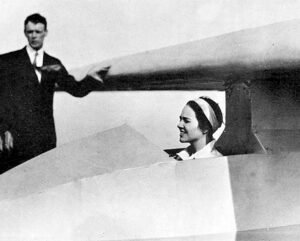
Charles Lindbergh giving Anne last minute instructions before being launched. (Jeff Byard collection)
Pioneering American Women Glider Pilots
In 1927, a wave of enthusiasm for aviation spread around the world. Smitten with Lindberghitis, citizens began a quest "to take to the skies." Youngsters built and flew balsa wood gliders. Men resurrected WWI aircraft or constructed aircraft in their backyards. Women discovered that flying was one sport that provided a sense of freedom and confidence from societal constraints. As Joseph Corn stated in his book, The Winged Gospel, "As pilots, women experienced feelings of strength, mastery and confidence which, particularly at a time when Victorian norms still rendered all strenuous effort and most activity by women suspect, seemed delicious indeed."
A small handful of extraordinary women overcame male prejudice and paved the way for a generation of competent and accomplished pilots. They effectively navigated both motorized aircraft and gliders. This article focuses on the pioneering American women glider pilots.
Maxine Dunlap
1908-1942
A resident of Pleasanton, Calif., Maxine Dunlap earned private pilot license #5894 in April 1928. She quickly accumulated 60 hours in the air before setting her sights on motorless flight. Following three weeks of lessons, Maxine entered the first glider contest held by the California Gliders Association on April 29, 1929. The event took place over the Ocean Beach sand dunes near San Francisco. Intending to qualify for a glider rating, she flew a Ferguson glider similar to a German training craft. She traveled 990 feet while staying aloft for 50 seconds. This exceeded the minimum of 30 seconds to receive a Class 3 glider license and eclipsed Amelia Earhart’s glider flight of 17 seconds. The U.S. Department of Commerce awarded her glider certificate number 8. She became the first American woman to obtain a glider pilot license of any kind. Even though she was airborne for less than a minute, Maxine successfully executed two S curves and most important, a smooth landing.
In March 1930, Maxine became president of the Bay Region California Gliding Club and supported competitions in the area. She also continued flying motor-powered aircraft. Her performances in the many air races across the country were notable. In 1935, she set a new 100-km world’s record for women for light airplanes in Tulsa, Oklahoma. Her top speed was 76.799 mph in Spartan’s first monoplane, a C2-60.
Maxine’s second husband, Coca-Cola executive and All-American tackle, Joseph J. Bennett Jr., provided the financial support necessary for his wife to continue flying. She purchased a 260-hp Stinson Gull Wing and became the family’s capable pilot. A Ninety-Nine’s newsletter related an amusing incident in her flying career when she made a forced landing in a rose garden. No damage was done, but a crowd quickly gathered. From the multitude of on-lookers a masculine voice drawled, "Now isn’t that just like a woman – landing on a bed of roses."[1]
Anne Lindbergh
1906-2001
In 1930, both Charles and Anne Lindbergh switched from powered flight to motorless flight. They traveled to San Diego, the Air Capitol of the West, to take lessons from Hawley Bowlus, a former construction superintendent for the Spirit of St. Louis. He now operated the successful Bowlus Glider School and possessed a stellar reputation as a glider designer and instructor. Nine of the first ten licensed glider pilots in the United States were graduates of his school.
Charles successfully earned his first class glider license as Anne intently observed the process. Then, it was her turn. On January 29, 1930, she completed the primary course with 10 short flights in Tillie the Toiler (598M) and was ready for her solo flight. It was made from Mt. Soledad, an 800 foot . . .
This article costs $5.00 to download - or it's free for AAHS members.
Already a member? Sign in to download for free.