
Flying Aircraft Carriers of the USAF: Wing Tip Coupling, Section 2: EB-29A/EF-84D
Brian Lockett
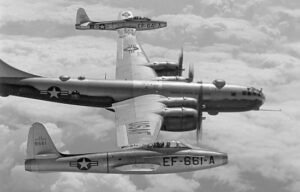
Composite aircraft in cruise configuration. The fixed pitch lock forced the Republic EF-84D Thunderjets to fly banked toward the Boeing B-29A Superfortress. (Air Force Film 18705)
Flying Aircraft Carriers of the USAF: Wing Tip Coupling Section 2:
EB29A/EF-84D
Objectives
The
success of the C-47/Q-14 wing tip coupling experiments conducted at the
Wright Air Development Center in 1949 prompted a desire to investigate the
feasibility of extending the range of strategic bomber escorts by towing
them on the wing tips of bombers. It was suggested that a bomber could tow
a pair of fighters attached to its wing tips. The fighters could be
released to engage enemy fighter aircraft.
Dr. Richard Vogt proposed that a composite
aircraft would have greater aerodynamic efficiency than a conventional
airplane due to the increase in the aspect ratio of the wings.
The ratio of the wingspan of an airplane to the
chord of its wing is called the aspect ratio. Wings with high aspect
ratios are more efficient for long-range cruising flight. The most
familiar of high aspect ratio wings are sailplanes and the Lockheed U-2.
The aspect ratio of the wing of the B-29 was
11.5. Coupling the Thunderjets to its wing tips increased the
aspect ratio to 20.3 and improved the aerodynamic efficiency of the
composite aircraft.
Wing tip coupling held the promise of providing
fighter escort for strategic bombers at a range far beyond that obtainable
by the jet fighters of the day. This escort could be carried along with
only a small reduction in the range of the bomber.
USAF Contract 33-(038)-3202 authorized Republic
Aviation Corporation to install wing tip coupling equipment in a bomber
and two fighters and to conduct tests to determine the feasibility of the
method. The project was referred to as Tip-tow.
Aircraft
Boeing B-29A Superfortress, 44-62093, was selected for the test
project. It was delivered to the Army Air Corps onAugust 11, 1945. Its
first assignment was the 241st Air Base Unit at Fairmont Field, Nebraska.
After the end of World War II, 44-62093 was
relegated to training Strategic Air Command (SAC) crews. Its designation
was changed to TB-29A on June 13, 1946. It was transferred to the Air
Defense Command and assigned to the 401st Air Base Unit at Hamilton Field,
Calif., in August 1946. It was returned to SAC and assigned to the 307th
Bombardment (Very Heavy) Group at MacDill Air Field, Fla., in October
1946.
Authority for 42-62093 was transferred to the Air
Materiel Command in February 1947. It was assigned to the 4117th Air Base
Unit at Robins Air Field, Georgia. . . . . .
This article costs $5.00 to download - or it's free for AAHS members.
Already a member? Sign in to download for free.