AAHS Journal Vol. 53 No. 4 – Winter 2008
Winter 2008. 7 features in this issue.
Full-text articles are free to AAHS members. Sign in to read and download every article in this issue, or purchase individual PDFs below.
AAHS Journal Vol. 53 No. 4 – Winter 2008
- Jump to abstract ↓
- Jump to abstract ↓
- Jump to abstract ↓
- Jump to abstract ↓
- Jump to abstract ↓
- Jump to abstract ↓
- Jump to abstract ↓
No articles in this issue match your search. Clear search
Article Abstracts
Pond Racer: Beyond the Cutting Edge
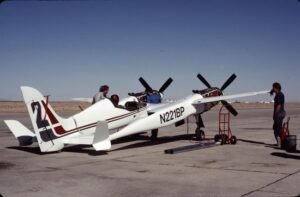
The Pond Racer undergoing preparations for the 1991Reno National Air Races. (Photo by Charles E. Stewart)
Pond Racer: Beyond the Cutting Edge
Approximately 20 years ago, deep inside the heart of the Mojave desert, an assault on unlimited air racing was taking shape. Hidden away from prying eyes in a secret hangar, a most unusual bird was being designed to take on the "heavy iron" at Reno and revolutionize general aviation. This is the story of the Pond Racer, the most exotic aircraft ever to participate at the Reno National Air Races. Built of cutting edge materials, and using the most advanced propulsion system available, the Pond Racer truly embodied American ingenuity and pioneering spirit. This story highlights the design, construction, and test flight program of the Pond Racer.
Genesis of a dream
Technically speaking, the Pond Racer was the brain-child of Dick Rutan. Soon after Dick and Jeana flew the Voyager around the world non-stop in 1986, he began getting itchy for his next challenge. Coincidentally during a brief discussion with warbird collector Robert Pond at Oshkosh 1987, Rutan realized they both shared a common goal: save existing historically significant WWII aircraft from being chopped up, highly modified, and destroyed at the Reno National Air Races. Both Rutan and Pond felt that an important part of our national history was being destroyed. "We intend to retire all those Grumman F8F Bearcats, and P-51 Mustangs to museums, where they should have been years ago."Â Rutan felt it was a crime against future generations to cut up and use the remaining few Mustangs, Corsairs, Sea Furies, and Bearcats for racing. On average, five P-51s per year were being damaged or destroyed while racing. What Rutan was looking for was a "clean sheet"Â modern aircraft design that could fly significantly faster than the warbirds at Reno, thereby saving them. Robert J. Pond (former naval aviator, industrialist, and owner of two dozen WWII combat aircraft at the Palm Springs Air Museum) kicked the idea around with Rutan about a racing aircraft using state-of-the-art technology, and in 1988 contracted with Burt Rutan to design and build a prototype that would become known as the Pond Racer.
On May 28, 1988, a press conference was held at the Planes of Fame Museum in Chino, Calif. Apainting and model were revealed (both created by Stan Stokes). Both Dick Rutan and Bob Pond realized the potential trickle-down technological advances for general aviation that this new aircraft program could bring. Through this increased level of participation, lessons would be learned, and breakthroughs would be made that would help make flying better, safer, and more exciting for everyone.
Diminishing returns and drag coefficients
"Look what’s happening in unlimited racing today. They triple the horsepower and only get two percent more speed. That ought to be telling somebody they’re working on the wrong end of this push/pull thing."Â With this simple statement . . . .
This article costs $5.00 to download - or it's free for AAHS members.
Already a member? Sign in to download for free.
Mallard Over Tahiti, 1951-1955
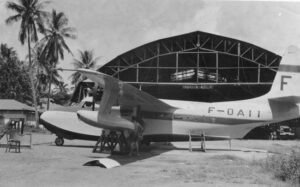
Air Tahiti’s Mallard by the Fare Ute hangar in Papeete, 1953. Soon after, the flying boat base moved out of town to Fa’aa. (Frame family collection)
Hotson
and Rodina’s valuable book on the elegant twin-engined post-WWII
amphibious flying boat, the Grumman G-73 Mallard, traces the
individual histories of many of the 59 examples produced at the company’s
Long Island, N.Y., works between 1946 and 1951. But of the 29th production
airframe, the authors were able to say only that it:
"Had been sold by the
Ford Motor Company to the Government of Tahiti. Little is known of this
operation, other than the aircraft was named "Ciel de Polynésie"
(Sky of Polynesia). It returned to the U.S. and sat for sale in 1956-57,
then was reported demolished or sold but was never heard of again."
(Fred. W. Hotson and Matthew E. Rodina Jr., Grumman Mallard: The
Enduring Classic, Robin Brass Studio, Montreal, 2006, p.72.)
Perhaps the following information and images may help to fill the gap, at
least for Grumman Mallard F-OAII’s Tahitian days. Many of the
details are taken directly from the logbook of my father, Captain A. Frame
(1916-1983), a wartime flying boat pilot who was awarded the DFC in 1941
for service in 210 and 228 Squadrons (RAF), particularly in the
evacuations of Greece and Crete in 1941, and who later served with 490
Squadron (RNZAF) and commanded 204 Squadron (RAF) in West Africa. [Author’s
note: The earlier of these episodes, and other aspects of his flying
career, are more fully described in my recently published book Flying
Boats: My Father’s War in the Mediterranean,
Victoria University Press, Wellington, 2007.]
Mallard F-OAII first flew for Air
Tahiti in 1951, and was involved in one of the oddest airmail
inaugurations in the South Pacific when, on May 3, 1951, with Captain
Joseph Pommier at the controls, it made the journey to Aitutaki in the
then New Zealand-administered Cook Islands.
The Pacific Islands Monthly of June 1951
recorded the reception on alighting:
It was approached only by
persons wearing gloves and masks. It was then realised [sic] that
Tahiti, from the New Zealand viewpoint, is infected with polio and is
tabu. . . The seaplane returned to Papeete with its load – simply the
most extraordinary incident in the dismal record of the many attempts to
establish an airmail service for Tahiti.
Captain Frame joined Air
Tahiti in February 1953 from the colorful Bryan Monkton’s financially
exhausted Trans Oceanic Airways based at Rose Bay in Sydney. The Mallard
served mainly in linking the principal islands around Tahiti (Raiatea,
Huahine, and Borabora), and to improve the reach of the Government of
French Polynesia to the outlying island groups. The logbook records a four
hour "Ëœmercy flight’ to Anaa in the Tuamotu Islands on April 12, 1953.
Frame’s laconic style: "Ëœevacuation sick native (harpoon).’ On July
1, 1953, the logbook records a flight to Hikueru: "Ëœvol sanitaire –
emergency alighting fuel shortage.’ . . . .
This article costs $2.50 to download - or it's free for AAHS members.
Already a member? Sign in to download for free.
History of the Mohawk Aircraft Company
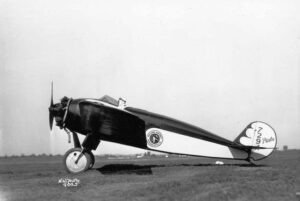
Mohawk MLV Pinto, 7294, at Minnesota State Fairgrounds, 1928. Minnesota State Fair photo #8025
History of the
Mohawk Aircraft Company
During a
period immediately preceding Lindbergh’s successful solo flight to
Europe in May 1927, several aircraft manufacturing enterprises sprang up;
many more than had done so in the two decades of time since Orville and
Wilbur cast their fate upon the wind. Some would weather the upcoming
Depression, others would not.
One of the hopeful corporations expecting to cash
in on the new flying craze was the Mohawk Aircraft Corporation of
Minneapolis, Minn. The corporation’s start began when a young man from
Minneapolis, Leon Dahlem, an engineering student at the University of
Minnesota, was bitten by the flying bug in 1926, before Lindbergh’s
flight. During this period many news features predicted man would soon be
flying not only across the vast Atlantic Ocean, but all over the country
as well. Dahlem envisioned building a simple monoplane that would be
affordable by the average enthusiast, then so vocal.
Borrowing $400 from his mother, Dahlem met with a
good friend and fellow engineering student, George A. MacDonald, the two
of them plotting ways to build the dream ship. The availability of
designer Wallace "Chet" Cummings launched this enterprise on its road
to fame and fortune. Cummings was an experienced aircraft designer. He
arrived with credentials to show he had worked on the design staff of the
Alexander Aircraft Corporation of Denver, Colo., having designed the
original Air King and gone on to help with the Eaglerock.
His portfolio included drawings of a unique low-wing monoplane, designed
for simplicity of manufacture and maintenance, geared to the sport flyer
of the day.[1] Dahlem would function as the President of a new company to
be called the Mohawk Aircraft Corporation, George A. MacDonald was to be
VP and Chief Pilot; Sumner E. Whitney, Secretary-Treasurer; Cummings the
Chief Designer; and Earl D. McKay a fifth board member.
The group turned next to the financial aspects of the
corporation. Their search for backers led them to one of the . . . .
This article costs $5.00 to download - or it's free for AAHS members.
Already a member? Sign in to download for free.
Airlift from the Abyss
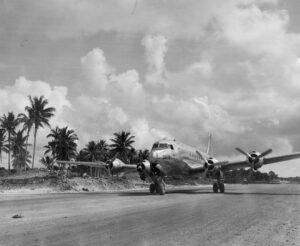
Naval Air Transport Service (NATS) R5D taking off from Guam. These airplanes were interchangeable between the two squadrons operating from Guam, VR-11 and VRE-1. (USN photo from VR-11 Command History Report)
The battle of Okinawa has been accurately described as the last great
battle of World War II.
For
the U.S. forces it was a culmination of the long Pacific island campaign,
the last major step toward Japan. For the Japanese it represented one last
chance to hold back or at least delay the Allies from setting foot on
their home islands. For both sides it was a fight imbued with bitter
hatred that had been building for three long years of Pacific war. On
Okinawa this acrimony reached a climax. It was a fight in which neither
quarter nor compassion would be shown on either side. Quite simply, the
men on the ground of both sides despised one another, and the desperate
Japanese would again revert to their ancient practice of suicidal warfare.
It is small wonder that the losses at Okinawa were among the highest of
the entire war. By the end of the three months hostilities nearly a third
of the huge American invasion force would become casualties.
Much has been written about the battle of Okinawa
but few more eloquently than Marine infantryman Eugene B. Sledge in his
combat memoir With The Old Breed at Peleliu and Okinawa.[1] As
Sledge’s Marine infantry regiment turns south on May 1, 1945, to relieve
the decimated 27th Infantry Division and join the intense fighting in
front of the Japanese Shuri defense line, he writes:
"When
we left the road, we severed our umbilical cord with the peaceful valley
up north, and plunged once more into the abyss."Â
That chapter of his book is titled "Into the Abyss"Â which seems to
perfectly characterize the war on and around Okinawa. The final eight
weeks of that battle were an inferno of fire and concussion, so traumatic
that it changed these men forever.
Across the island from Sledge’s position, 20
miles north of Shuri Castle and Kakazu Ridge and other infamous places
where Sledge fought, a particular American response to these bloody
battles was in full operation. Centered on the captured Japanese Yontan
airfield, the U.S. Navy had put in place an unprecedented airlift - an air
evacuation of the wounded larger than any conducted in this war.
Sledge’s narrative illustrates with often
graphic brutality why there had to be an air evacuation of new dimensions
at Okinawa. It is a tribute to the forethought of the salty old planners
of this operation that they saw in advance the need for more expedient
ways to handle the heavy casualties that they correctly feared. This task
was given to the men and women, of the newly formed Naval Air Transport
Evacuation Squadron One, known by the contemporary acronym VRE-1.[2]
PLANNING STAGES
Planning for this airlift operation actually began in fall 1944 when the
Chief of Naval Operations (CNO) began to strategize about the final phases
of the war. VRE-1 was formed specifically for Okinawa but clearly with an
eye toward the ultimate invasion of Japan. The large authorized size of
this squadron indicated this was in the plans.[3]
. . . . .
This article costs $5.00 to download - or it's free for AAHS members.
Already a member? Sign in to download for free.
Flying Aircraft Carriers of the USAF: Wing Tip Coupling, Section 2: EB-29A/EF-84D
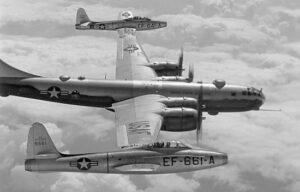
Composite aircraft in cruise configuration. The fixed pitch lock forced the Republic EF-84D Thunderjets to fly banked toward the Boeing B-29A Superfortress. (Air Force Film 18705)
Flying Aircraft Carriers of the USAF: Wing Tip Coupling Section 2:
EB29A/EF-84D
Objectives
The
success of the C-47/Q-14 wing tip coupling experiments conducted at the
Wright Air Development Center in 1949 prompted a desire to investigate the
feasibility of extending the range of strategic bomber escorts by towing
them on the wing tips of bombers. It was suggested that a bomber could tow
a pair of fighters attached to its wing tips. The fighters could be
released to engage enemy fighter aircraft.
Dr. Richard Vogt proposed that a composite
aircraft would have greater aerodynamic efficiency than a conventional
airplane due to the increase in the aspect ratio of the wings.
The ratio of the wingspan of an airplane to the
chord of its wing is called the aspect ratio. Wings with high aspect
ratios are more efficient for long-range cruising flight. The most
familiar of high aspect ratio wings are sailplanes and the Lockheed U-2.
The aspect ratio of the wing of the B-29 was
11.5. Coupling the Thunderjets to its wing tips increased the
aspect ratio to 20.3 and improved the aerodynamic efficiency of the
composite aircraft.
Wing tip coupling held the promise of providing
fighter escort for strategic bombers at a range far beyond that obtainable
by the jet fighters of the day. This escort could be carried along with
only a small reduction in the range of the bomber.
USAF Contract 33-(038)-3202 authorized Republic
Aviation Corporation to install wing tip coupling equipment in a bomber
and two fighters and to conduct tests to determine the feasibility of the
method. The project was referred to as Tip-tow.
Aircraft
Boeing B-29A Superfortress, 44-62093, was selected for the test
project. It was delivered to the Army Air Corps onAugust 11, 1945. Its
first assignment was the 241st Air Base Unit at Fairmont Field, Nebraska.
After the end of World War II, 44-62093 was
relegated to training Strategic Air Command (SAC) crews. Its designation
was changed to TB-29A on June 13, 1946. It was transferred to the Air
Defense Command and assigned to the 401st Air Base Unit at Hamilton Field,
Calif., in August 1946. It was returned to SAC and assigned to the 307th
Bombardment (Very Heavy) Group at MacDill Air Field, Fla., in October
1946.
Authority for 42-62093 was transferred to the Air
Materiel Command in February 1947. It was assigned to the 4117th Air Base
Unit at Robins Air Field, Georgia. . . . . .
This article costs $5.00 to download - or it's free for AAHS members.
Already a member? Sign in to download for free.
1936 National Air Races
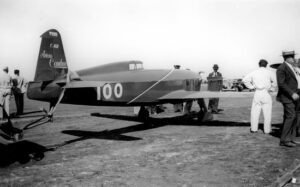
Michel Detroyat’s Caudron C-460 silenced all the critics when qualifying for the 1936 Greve Trophy Race. Detroyat’s slowest lap was faster than anything that had ever gone around a closed circuit in the United States. His fastest lap was 273.473 mph. (Photo by Emil Strasser courtesy of Gerald Liang)
The
1936 National Air Races took several dramatic changes. The site was moved
to Los Angeles, Calif., Mines Field due to the Cleveland Airport expansion
and the need to move the grandstands back. There were unexpected events in
both the Bendix and Thompson races. With the races at Los Angeles, the
Bendix cross country race started at Floyd Bennett Field, N. Y.
The starting line-up included an impressive list
of pilot/plane combinations. Benny Howard, who won the 1935 Bendix in "Mr.
Mulligan" was back, this time with wife Maxine as copilot. Lee Miles
entered the Granville-Miller "Q.E.D.," Joe Jacobson in a Northrop Gamma,
Amelia Earhart in her new Lockheed Electra, Louise Thaden and
copilot Blanche Noyes flying a Beech C-17 Staggerwing, Laura
Ingalls in a Lockheed 9-D Orion. William Gulick flew a Vultee V-1A
and George Pomeroy competed in a Douglas DC-2.
During the flight east to Floyd Bennett Field for
the Bendix start, Roscoe Turner made a forced landing on very rough ground
in his Wedell-Williams Racer near Gallup, N.M. The old Wedell-Williams
broke in half but Turner walked away with nothing more than scratches.
Benny and Maxine Howard were forced to crash land
"Mr. Mulligan" 40 miles north of Crown Point, N.M., when they lost a
propeller blade. They were caught in the twisted wreckage with severe
injuries that they survived but Mr. Mulligan was a total
loss.
Joe Jacobson climbed his Northrop Gamma to
high altitude and set out to fly non-stop from coast to coast. Joe made it
as far west as Safford, Kans., when his Gamma exploded and blew him
out of the cockpit. He parachuted safely and turned up at Los Angeles in
time to race.
Lee Miles dropped out but landed his big
Granville Q.E.D. safely.
. .
. .
This article costs $5.00 to download - or it's free for AAHS members.
Already a member? Sign in to download for free.
Remember When – Commonwealth Skyranger
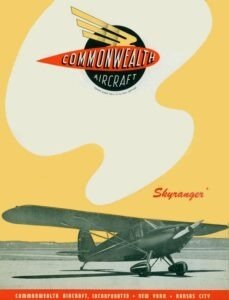
Copy of a marketing flyer for the Commonwealth Skyranger published in the early 1950s. (From the Earl C. See collection)
Remember When . . . Commonwealth Skyranger
For those of us who recall the period, a boom in general aviation
was to take place following World War II. It was anticipated that
returning airmen would trade their wartime aircraft, flown in hostile
skies, for light planes flown over peaceful American terrain. The return
of many veteran pilots, aviators and airmen was to be the catalyst behind
the figurative statement "an airplane in every garage," and it gave
impetus to artists’ conceptions of smiling families flying to vacation
destinations in futuristic light planes. Aviation magazines of the day
reinforced this vision by depicting modern-day housing developments with a
runway and individual taxiways leading up to each new home.
Aircraft companies and subcontractors shared this
optimism as they converted their wartime facilities into the manufacturing
of general-aviation aircraft. Soon their drawing boards were busy as they
transitioned from the manufacturing of bomber and pursuit aircraft of war
to the postwar pursuit of building light planes. In some cases, and for
expediency, their aircraft were prewar or updated designs. Other
companies, however, capitalized on wartime knowledge and transferred newly
developed technology into modern and innovative aircraft designs.
New light-plane designs and prototypes from major
aircraft manufacturers, including Douglas, Grumman, Lockheed, North
American and Republic, entered into development. Additionally, new light
planes from many other aircraft companies entered the developmental stage
at the end of the war (see listing of aircraft). Concurrently, production
was resumed on prewar aircraft, including the ERCo Ercoupe, Globe Swift,
and the Luscombe Silvaire.
However, the aviation boom was not to be. Many
war-weary pilots turned their vision from the sky to earthbound goals,
including home, automobile, family and peacetime employment. Also, the
exigencies and economic conditions at the time helped to fuel the death
knell of the aviation boom.
This article costs $2.50 to download - or it's free for AAHS members.
Already a member? Sign in to download for free.