Competition in a Man’s Sport, Seven Early Women Pilots
Lt. Col. Walt Wick, USAF (ret.)
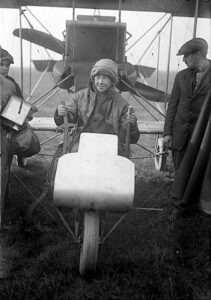
Law arriving at Governer’s Island, N.Y., after setting an American distance record of 590 miles during her flight from Chicago to New York. Notice the streamlining shield that provided some protection for her feet from the cold slipstream. Also, it appears that the individual just off the left side is holding a strip-map navigational aid that Law built. (Library of Congress)
Competition in a Man’s Sport, Seven Early Women Pilots
In the following we’ll look at seven significant women in the early years of aviation and their contributions to the art of flying as a sport and as a science. These women were pioneer pilots of courage, conviction, passion and vision.
The first flyable (fully controllable) airplane was introduced to the world in Europe and Washington, D.C., in 1908 by the Wright brothers and in 1909 by Curtiss and other Europeans at the Rheims International Air Meet in France. From that period everyone in the world was reading about aviation on front page headlines and wanting to see aviators break the records at all the air meets. Every flight was a new record and not just a short, straight line uncontrolled hop as was the case in 1903. 1910 started the rage of flight.
Women not only contributed to aviation, but changed the style of dress to fit the physical demands of flying. The Victorian style of dress, cut just above the ankle, was transformed into pants, jumpsuits and manly attire, unheard of in the early 1900s. These women were essentially test pilots in the early years and they would break altitude and distance records on most every flight. With this desire and passion – the women that followed continued to set records to the present day.
Aviation in the early 1900s drew as much attention as the space shuttle when it flew down the Hudson in New York City in 2012. It was an unknown feat with women and men aviators taking great risks every day and, of course, the more the accidents – the larger the crowds. This is the time where airplanes did not have skin to cover the pilots, nor heaters, nor parachutes, nor instruments. The U.S. was critically lacking manufacturing expertise lagging well behind the Europeans in the aviation industry. Just entering into the automobile age from that of the train was almost too much for the Americans to evaluate for world manufacturing progress. Horses were being replaced by vehicles and transportation from New York City to Chicago was a major undertaking.
This environment produced a new brand of women – independent, progressive and unimpeded by social norms – including the fearless aviatrix. Initially flying was restricted to men; however, women soon took the glamour, the pressure, the sacrifice and the rewards of challenging men’s record setting events. While they never exceeded the number of men – they contributed, challenged and succeeded at every record event. Records were meant to be broken and women did more than their share of record breaking.
Blanche Stuart Scott – The Tomboy of the Air
Blanche Stuart Scott was raised in an upper-income family in Rochester, New York. Her father gave her a new automobile for her thirteenth birthday (one cylinder Cadillac). A license was not yet required to drive, and over the next several years Blanche became a local celebrity (and a hazard, too) as Rochester’s only girl driver. As a young woman she moved to New York City, where she made headlines as the first auto saleswoman, and at 24 she was contracted by a major automaker (Willys-Overland Motor Co.) to drive across America in a publicity stunt. Accompanied by a female reporter, Scott drove 5,393 miles from New York to California (of which only 220 miles were on paved roads) making 177 stops all along the way at Willys-Overland dealerships. The trip was a great success. Blanche collected $5,000 (about $125,000 in today’s money) plus an additional $1,000 ($25,000) for extending the drive from San Francisco to Tijuana, Mexico.
Three incidents along the way influenced her future. At . . .
This article costs $5.00 to download - or it's free for AAHS members.
Already a member? Sign in to download for free.