
Bored Airmen Turn to Gliding for New Trills
Kenneth W. Barr
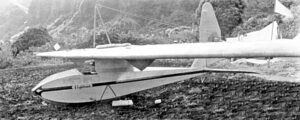
Nighthawk at the base of Nu’uanu Pali, probably Galt Field, October 1931. Note open access points for wing mounting. (National Soaring Museum Archive Photo)
Bored Airmen Turn to Gliding for New Thrills
Spectacular combat acrobatics were too tame for these United States Army flyers. So they step out and break
a world record for glider endurance flight and find secrets for building of a "perfect man-made bird."
A little more than a year ago, three young 2nd lieutenants of the 18th Pursuit Group, Air Corps, United States Army, Wheeler Field, Hawaii, began to experiment with gliders. A few weeks ago one of them broke the world’s glider endurance flying record, held by a German since 1927, by remaining aloft 16 hours 38 minutes in a glider designed by one of the trio.
Far more important, from knowledge gained by experimenting with the record-breaking glider, the youthful designer has built a plane that some of his associates call "the perfect flying wing." Others describe it more romantically as "the perfect man-made bird." Embodied in it are principles that are revolutionary in the field of aerodynamics – principles that may "step up" the speed of modern airplanes to more than twice their present capacity. So far, the inventor has only a model of the "perfect man-made bird" to prove his theory, but the model has successfully passed the most grueling tests, and as soon as financial backing is forthcoming the young officer will present his novel "perfect wing" to the aviation world.
Why did they do it? Why did these personable young men voluntarily forsake the many social pleasures that are the lot of young officers in Hawaii to slave on gliders month after month during off-duty hours? Why did they risk their lives daily in mimic aerial warfare, military acrobatic maneuvers and other equally dangerous flying that is required of all pursuit pilots, and then eagerly trundle their frail glider out of its hangar and spend the remainder of the day and part of the night placing their lives in even greater jeopardy?
The three officers smiled sheepishly and squirmed uncomfortably in their chairs when this writer shot those questions at them. Then Lt. John C. Crain,
who flew the glider to a new world’s record spoke up:
"Why did we do it? Well, I guess none of us has had enough leisure during the last 15 months to sit down and figure it out." His boyish grin was returned by his two comrades.
"But since you bring up the question," he continued, serious now, "I believe I can explain my own reactions – and I’m pretty sure it will apply to Cocke and Scott here as well – by the simple statement that we wanted a thrill. Oh," he waved a careless hand as he noted the impending interruption. "I know that we Army flyers are supposed to live on daily thrills in the air. But try it yourself some time. After you get a thousand or more hours in the air, and even before that flying becomes business-like and monotonous, just like any other daily chore. Not that we don’t enjoy it; especially some of the tricky formation flying and combat acrobatics. But after a while even that loses its thrill. So we – and a lot of other flyers – turn to gliding for new thrills. Isn’t that about the way you fellows feel about it?" Lt. Crain concluded, appealing to his confreres.
"That just about sums it up," agreed Lt. William A. Cocke, Jr, who designed the glider and the "perfect wing."
"You’ve hit the nail right on the head," 2nd Lt. William J. Scott, who assisted in building the glider and who had charge of launching it into the air on its various trials and, finally, on the record-breaking flight.
"I think you’ll find it a fact," Lt. Crain continued slowly, "that aviation, more so than many other professions, owes its constant and rapid development to the thrill hunger of . . .
This article costs $2.50 to download - or it's free for AAHS members.
Already a member? Sign in to download for free.