AAHS Journal Vol. 53 No. 3 – Fall 2008
Fall 2008. 8 features in this issue.
Full-text articles are free to AAHS members. Sign in to read and download every article in this issue, or purchase individual PDFs below.
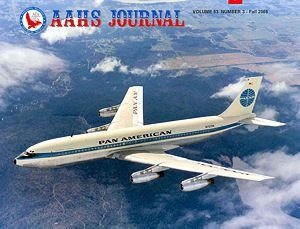
AAHS Journal Vol. 53 No. 3 – Fall 2008
- Jump to abstract ↓
- Jump to abstract ↓
- Jump to abstract ↓
- Jump to abstract ↓
- Jump to abstract ↓
- Jump to abstract ↓
- Jump to abstract ↓
- Jump to abstract ↓
No articles in this issue match your search. Clear search
Article Abstracts
Boeing 707: The World Changer
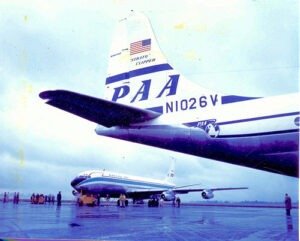
The first 7070 visits Bow Lake Airport, now Seattle-Tacoma International. The Pan Am Stratocruiser was typical of the plane at the airport at the time. (Boeing photo, K4288)
The
Boeing 707, the world’s first successful commercial jet, is a milestone
in commercial aviation history representing the point in time when
propellers once and for all gave way to jets, and air travel, having
become affordable and available, eclipsed travel by sea and rail.
The 707 also represents one of the most important
business decisions in history. Boeing Company president William Allen and
his leadership team had a vision for the future and the courage to take
the necessary risk to advance toward that future. The result went beyond
their greatest expectations as the 707 pioneered a new commercial airplane
business for the Boeing Company as well as a family of world changing
commercial jets that continues to grow, 50 years later, with the
revolutionary 787.
The Roots of the 707 – Swept Wings and Podded Engines
When the leadership of the Boeing
Co. decided to go forward with the development of a jet transport,
revolutionizing the science and technology of flight was not a new concept
to the people of Boeing who had earned a reputation of progressive
aeronautical thinking and taking risks with new technology. What Boeing
Senior VP, Wellwood Beall called "a tradition of pioneering." That
tradition went back to Bill Boeing’s command: "Let no new improvement
in flying and flying equipment pass us by." That philosophy shaped the
world’s first modern airliner, the Boeing 247 of 1933, the legendary
B-17 Flying
Fortress, the cutting
edge B-29 Superfortress,
and the revolutionary B-47 Stratojet – the world’s first
swept-wing jet bomber.
The B-47’s sleek design introduced the
combination of swept wings and engines in pods, and set the optimum design
for a subsonic jet. The design of the Stratojet is still the basic
pattern followed today in the design of nearly all subsonic jets including
the C-17, A-380 and the 787.
The success of the B-47 lead Boeing and the Air
Force to expand the concept into a larger plane with a greater range and
payload resulting in the venerable B-52 Stratofortress.
The innovative B-47 not only contributed to the B-52 but also had sparked
some interest in the feasibility of a jet transport. In 1948 Boeing
launched an internally funded study of jet transports based on the B-47
design known as the Model 473.
The Model 473 was from the start a passenger jet.
It began by using elements of the B-47 and the B-52 and in its final
configuration, known as the Model 473-60, had adopted a low wing
configuration with a double lobe fuselage similar to theC-97.
In May 1952, while Bill Allen and the Boeing
board were debating the decision to fund the development of jet transport
. . . .
This article costs $5.00 to download - or it's free for AAHS members.
Already a member? Sign in to download for free.
1935 National Air Races
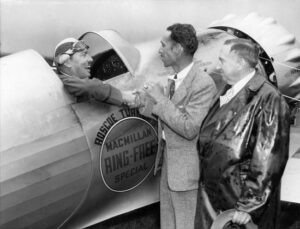
Benny Howard congratulates Roscoe Turner as he arrives at Cleveland. The race sponsor, Vincent Bendix, looks on. Turner can still smile knowing he lost by 23.5 seconds! (UPI photo from the Kimes collection)
The 1935
National Air Races (NAR) were held in Cleveland, Ohio, August 30 to
September 2. This year’s event might best be described as the "Benny
Howard year," as we will see later in this article.
Bendix Trophy Race
The Bendix Race departed from Burbank, Calif. On the
morning of August 30 with eight aircraft lining up at the starting line.
Disaster would strike almost immediately with the modified Granville
Brothers Gee Bee R1/R2 flown by Cecil Allen crashing on takeoff. Allen was
killed and the aircraft was destroyed.
Roy Leonard flying QED was forced out at Wichita, Kan.,
with a broken oil line and Earl Ortman flying a Keith Ryder made it as far
as Kansas City, Kan., before being forced out with a loose cowling. Benny
Howard with Gordon Israel as copilot flying "Mister Mulligan"Â and
using oxygen for the first time in a Bendix Race were able to climb over
the weather.
They beat Roscoe Turner in his Wedell-Williams by a mere
23.5 seconds to take first place. Russell Thaw, who would later become a
Douglas test pilot, took third place in a Northrop Gamma.
The rest of the field was made up of Roy Hunt in a . . . .
This article costs $5.00 to download - or it's free for AAHS members.
Already a member? Sign in to download for free.
Trans World Airlines: The Creation of a Global Airline by Jack Frye and Other Founders
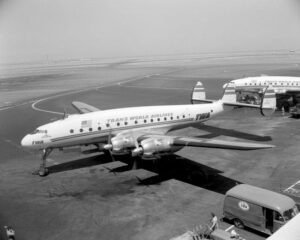
TWA Lockheed L-049 Constellation "Star of Newfoundland," N6000C, prepares to taxi from the ramp at San Francisco International Airport, June 28, 1956.This aircraft was formerly KLM Airlines PH-TAW. (Photo from the AAHS Hufford Collection, #38698)
Trans World
Airlines:
The Creation of a Global Airline by Jack Frye and Other Founders
Entering
this world far from what he will come to know and influence, William John
"Jack" Frye was born in Sweetwater, Okla., (some sources note he was
born in Sulphur, Okla., where his mother was visiting) on March 18, 1904,
to William Henry and Nellie Cooley Frye. In the years that followed he
would become an aviation visionary and who, along with Paul E. Richter and
Walter A. Hamilton, created and formed Transcontinental & Western
Airlines (T&WA, but more commonly referred to as TWA). TWA would
eventually grow into a 17,000 employee, $70 million corporation, with both
a domestic and international route network while evolving into the seventh
largest airline in the world.
At the age of eight, Frye’s mother died and he was
raised by his father and grandparents on the family’s 15,000 acre ranch
in the Texas Panhandle near Wheeler. At the age of 14, while skating on a
pond, three Army pilots flying Jennies made an emergency
landing nearby, and the rest of the day he ran errands for these airmen.
From that event his interest in aviation never ceased. Dropping out of
high school at the age of 17, he enlisted in the Army Corps of Engineers
in 1921, but was discharged a year later. Frye would join the Naval
Reserve in 1934 and eventually achieve the rank of lieutenant commander
before resigning his commission in 1952.
The year 1923 found Frye in Los Angeles, still struck by
the desire to be a part of aviation, working as a soda jerk and waiter and
saving his money to take flying lessons at a local airfield on Western
Avenue. Burdett "Pop" Fuller was taking passengers on 15 minute
flights for $5.00 and, upon meeting Jack Frye, convinced him to take
flying lessons for $20.00 per hour. Frye used all of his savings and
within seven hours had soloed. Shortly thereafter he took an innocent
customer for a flight that was against civil air regulations but the
passenger never knew of his pilot’s lack of flying experience. Frye had
previously asked his grandparents for a loan and got an emphatic no. With
money borrowed from his younger brother Patrick (known more commonly as
Don) and the promise he would teach him to fly, Frye bought half interest
in "Pop" Fuller’s flying school that had the total asset of one
Curtiss Jenny.
Like his older brother, Don had also joined the army, and
followed him to California. He lived with Jack and his first wife, Debbie
Greer. The Frye house would add more residents . . . .
This article costs $5.00 to download - or it's free for AAHS members.
Already a member? Sign in to download for free.
Minneapolis-St. Paul International Airport (Minnesota); Transition and Change
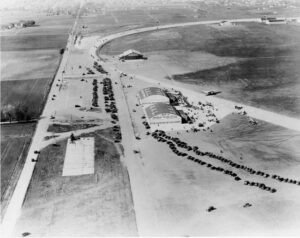
Wold-Chamberlain Field, summer 1929. A weekend air show is taking place at the site, which now has several hangars in place. The early FBO hangar has been taken off the track surface, turned and is the far hangar in line. Note the concrete pads in the left foreground. This was the 1915 speedway competitor’sgarage area. 34th Avenue runs top-to-bottom in this view looking north. (Photo by George Holey via Jim Borden)
Minneapolis-St. Paul International Airport
(Minnesota):
Transition and Change
Major
airports are places of constant change, constant metamorphosis, constant teardown and rebirth. But,
while this story is specifically about only one of those airports, it is surely representative of most large
airports around this country, perhaps the one in the reader’s
hometown. Most current major metropolitan airports began as grass
strips, serving barnstormers, then progressed over the years to
serve a wide range of general aviation, ag-applicators, airlines, military and corporate operations. Perhaps the
municipality outgrew its original 40 acres and was reborn across town
in grander style. I am emotionally close to the
Minneapolis-St. Paul International Airport (MSP), and have a historian’s
sense of its growth, having watched it over the course of its
last 55 years. I am fortunate to have a record from its infancy
and adolescence. But, though the following portrait is about
one major airport, in truth, MSP is only one of many with such
a colorful transitory background.
The Early Years
The Minneapolis-St. Paul International Airport really
began in 1915 as Twin City Motor Speedway, a two mile, high-banked oval auto speedway paved with concrete. Left
to its intended purpose, the track would today be a rival of Indianapolis or Daytona. The original owners, some of them
board members of the Indianapolis Motor Speedway Corporation, recognized in the early 1910s the need for
additional tracks for competitors to race on. In the days
of board racetracks and dirt road courses, paved
super-speedways such as Indy (paved with bricks,) were an anomaly. An additional paved high-speed track would create further fan
interest and foster the growth of American motor racing.
There was just one problem. In Minnesota, winter temperatures drop far below zero and in the spring, frost
in the ground heaves up roadways, sidewalks, and any other
shallowrooted structure - such as a concrete racetrack. By 1916, the track was virtually useless, the concrete pavement a mass
of uplifted sections, wide cracks and crumbling banks. In a fervor to build it in a few short months, no re-bar was
used, nor was that technology even well understood. A few short
races and demolition derbies were held in 1916 and a motorcycle event in 1917, but the track had become a liability and the
. . . . .
This article costs $5.00 to download - or it's free for AAHS members.
Already a member? Sign in to download for free.
Geogre Jansen (Test Pilot)
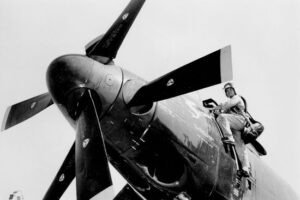
George Jansen climbing into his "favorite" plane, the Douglas XA2D-1 Skyshark.(Photo from the H. "Dix" Dixon collection)
George
Jansen was the Chief Test Pilot of the Douglas Aircraft Company’s flight test facility at Edwards Air
Force Base (EAFB) from the late 1940s into the 1960s. As a Douglas test pilot, he was my boss - a damned tough
boss to work under for which I’ve always been grateful. When
I was handed a test flight on my A3D and Jansen had signed
the test card, I knew I was good to go. He saw not only the
test to be accomplished from the test pilot’s perspective, but
also knew the history of each aircraft that flew in his stable.
And his stable consisted of ADs, A2Ds, F3Ds, A3Ds, F4Ds, A4Ds, B-66s, C-133s and T-33s. How he accomplished this I could
never understand other than his entire life was devoted to knowing both the test aircraft and the pilot who would fly
the test. As a grunt test pilot I considered George Jansen a magical figure.
I was an ex-fighter pilot from WWII and I always thought
that Jansen would have been a natural in a fighter cockpit
with his calculating mind that was usually ahead of his tongue.
It was as though he purposely controlled his slow speech to
keep his mind from running away. But he decided early to go multi-engine. Maybe a single-engine fighter was just too
simple for him.
Prior to the Pearl Harbor attack, Jansen was flying from
what he called "a pea patch" in Willows, Calif., where
he accumulated some 250 hours in small airplanes and a
private pilot’s license. When he applied for the Aviation Cadet program, the U.S. Army Air Corps grabbed him. After cadet
training he ended up in heavy bombers – Boeing B-17s and Consolidated B-24s.
Jansen didn’t talk much about his military flying days.
What we do know is that after his flight training he was assigned to the 68th Bomb Squadron of 44th Bomb Group,
known as the "Flying Eight-Balls." The group was
transferred to England in 1942 and on to Africa in mid-1943. Jansen participated in the Polesti Raid on August 1, 1942, for
which he would be awarded the Distinguished Flying Cross (DFC). The group would be transferred back to England in early 1943.
On May 14, 1943, his squadron participated in a 21 ship
follow-on raid on Kiel, Germany. The B-24s were to drop incendiary bombs on the rubble created by a 100-plus B-17 raid. The
group arrived over target with only 19 ships, with 1st Lt. George R. Jansen in command of a B-24D, 41-24009,
"Margaret Ann." The group was attacked by fighters and encountered heavy flak both inbound and outbound. Of the
19 . . . . .
This article costs $5.00 to download - or it's free for AAHS members.
Already a member? Sign in to download for free.
112 Victories: Aerial Victory Credits of the Tuskegee Airmen
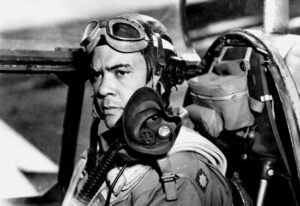
Col. Benjamin O. Davis, Jr. in the cockpit of his P-51 was the most famous commander of the 332nd Fighter Group. (Photo from the Air Force Historical Research Agency (AFHRA) collection)
112
Victories: Aerial Victory Credits of the Tuskegee Airmen
The only
African-American pilots in combat with the Army Air Forces during World War II believed they had
something to prove. They knew that if they performedwell in battle, the decision to accept them in a role from
which they had previously been excluded would be vindicated. Excellent combat performance would also contribute to
expanding opportunities for African Americans, not only in
the armed forces of the United States, but in American society
as a whole. Later known as "Tuskegee Airmen" because they
had trained to fly at Tuskegee Army Air Field in Alabama, members of the 332nd Fighter Group and its four squadrons,
the 99th, 100th, 301st and 302nd, more than met the
challenge. They shot down 112 enemy aircraft in flight. This paper describes that important part of their story.
Colonel Benjamin O. Davis, Jr. served as the most famous
of the 332nd Fighter Group commanders. His father had been the first African-American general in the U.S. Army.
Partly because he was a graduate of West Point, Col. Davis had already been commander of the 99th Fighter Squadron, the
first black flying unit in the Army Air Corps. The squadron was more than a year older than the group.
The 99th Fighter Squadron deployed from Tuskegee, Ala.,
to French Morocco in April 1943. Originally flying the
P-40 Warhawk aircraft,
the 99th Fighter Squadron began combat operations from Tunisia on June 2. While serving under the
Twelfth Air Force, the 99th and other fighter and bomber squadrons attacked enemy installations in Tunisia and
Sicily and on the island of Pantelleria in the Mediterranean Sea.
The defenders of Pantelleria, heavily bombarded from the air
and sea, surrendered on June 11 without the need for an
invasion.
On July 2, 1943, 99th Fighter Squadron pilots escorted
North American B-25 medium bombers in an attack on Castelvetrano, Italy. Enemy Focke-Wulf
Fw 190 fighters rose to intercept the bombers, and the Tuskegee P-40s intervened. On that
day Lt. Charles B. Hall scored the squadron’s first aerial victory. Never before had an
African-American fighter pilot in the U.S. armed forces . .
. .
This article costs $5.00 to download - or it's free for AAHS members.
Already a member? Sign in to download for free.
Leo Barnum Kimball
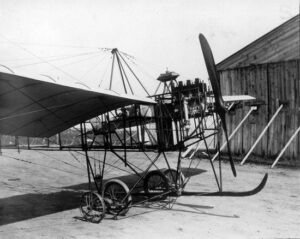
Leo B. Kimball, with the help of his friend John Andrew, built this small gasoline-powered airplane in 1912. (Photo by Leo B. Kimball from the Ev Cassagneres collection)
Leo Barnum
Kimball’s father was Erastus S. Kimball who was born in Illinois, and at the age
of two came to Connecticut with his mother, eventually settling in New Haven, where he worked for many years at the Winchester
Arms Company. On March 5, 1890, he married Anna Barnum. Erastus and his wife Anna had three children, Leo Barnum,
born April 3, 1896, Norma Alpihene Kimball and Anita Gardner Kimball.
The Early Years
While a student in Strong Grammar School, Leo Kimball
attained quite a reputation as a builder of model gliders,
and for a time he had one of his models on display at the library building. He attracted considerable attention when he won
a gliding contest at the school in 1911. It was predicted by the local newspaper (Journal-Courier)
that Kimball would attempt flights in a machine of his own design.
Kimball’s interest in airplanes and flying dates back to
when he was just 15 years old. In 1911 he and his friend,
John Andrews, designed and built their own full-size biplane
glider. It bore a similarity in configuration to the Wright
brother’s early gliders. Kimball first flew the glider on April 11, 1911, and again
on May 8, 1911, when he made five successful flights. He
did not have much control of the glider in the air, and had to bend . . .
.
This article costs $5.00 to download - or it's free for AAHS members.
Already a member? Sign in to download for free.
Remember When – Bellanca Cruisair Senior
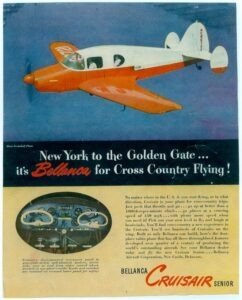
Copy of a marketing flyer for the Bellanca Cruisair published in the early 1950s.(From the Earl C. See collection)
Remember When . . . Bellanca Cruisair Senior
For those of us who recall the period, a boom in general aviation
was to take place following World War II. It was anticipated that
returning airmen would trade their wartime aircraft, flown in hostile
skies, for light planes flown over peaceful American terrain. The return
of many veteran pilots, aviators and airmen was to be the catalyst behind
the figurative statement "an airplane in every garage," and it gave
impetus to artists’ conceptions of smiling families flying to vacation
destinations in futuristic light planes. Aviation magazines of the day
reinforced this vision by depicting modern-day housing developments with a
runway and individual taxiways leading up to each new home.
Aircraft companies and subcontractors shared this
optimism as they converted their wartime facilities into the manufacturing
of general-aviation aircraft. Soon their drawing boards were busy as they
transitioned from the manufacturing of bomber and pursuit aircraft of war
to the postwar pursuit of building light planes. In some cases, and for
expediency, their aircraft were prewar or updated designs. Other
companies, however, capitalized on wartime knowledge and transferred newly
developed technology into modern and innovative aircraft designs.
New light-plane designs and prototypes from major
aircraft manufacturers, including Douglas, Grumman, Lockheed, North
American and Republic, entered into development. Additionally, new light
planes from many other aircraft companies entered the developmental stage
at the end of the war (see listing of aircraft). Concurrently, production
was resumed on prewar aircraft, including the ERCo Ercoupe, Globe Swift,
and the Luscombe Silvaire.
However, the aviation boom was not to be. Many
war-weary pilots turned their vision from the sky to earthbound goals,
including home, automobile, family and peacetime employment. Also, the
exigencies and economic conditions at the time helped to fuel the death
knell of the aviation boom.
This article costs $2.50 to download - or it's free for AAHS members.
Already a member? Sign in to download for free.