Coast-to-Coast and Back Again in a JL-6
Mark Taylor
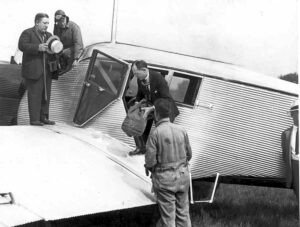
General Superintendent of the Airmail Service, L.B. Lent, helps to load mail into a Junkers Larsen (JL-6) aircraft on July 29, 1920. This airplane was one of three flown on a transcontinental pathfinding flight for the U.S. Post Office Department. It carried some mail, as well as Superintendent Lent and the cameraman, Brockhorst. The flights helped officials determine the best route of the upcoming transcontinental airmail route between New York, N.Y., and San Francisco, California. (National Postal Museum, Curatorial Photographic Collection)
Coast-to-Coast and Back Again in a JL-6
A remarkable event in the history of aviation took place in the summer of 1920. One expedition notched two records: the first coast-to-coast U.S. airmail delivery and the first round-trip transcontinental passenger flight. To do this, three airplanes left New York City, following a great circle path to San Francisco.
The U.S. Post Office wanted to establish coast-to-coast airmail delivery, and in the course of planning, they needed to fly the route end-to-end with an eye to making sure that it was ready to handle the kind of traffic that regular airmail would bring. As long as they were flying a Post Office engineer from New York to San Francisco, they would include a bag of mail. The engineer’s name was Maj. Leon B. Lent.
The Post Office route selected followed the Woodrow Wilson Airway. For the airplanes of the time, this was a very difficult route, and it was selected specifically because it would be difficult. The selection of the route was done in cooperation with the Army Air Service.
In the aftermath of WWI, the Army was making plans for how to defend the United States if the country were invaded. There were many practical problems to be solved if the military were going to use airplanes, but it was immediately realized that the Army’s problems were the same as the problems the Post Office would be facing as it extended airmail service across the nation. The Post Office could solve those problems during peace time, so that the Army did not have to face them while fighting a war.
The airplane the Post Office selected for this flight was arguably the most technologically advanced of its time. It was a monoplane made entirely of metal, and it had already set many records in Europe. The Army purchased a few and was eager to try them out. Therefore, the Army decided to join the Post Office expedition.
The third airplane joining the expedition would carry the U.S. distributor for the aircraft, as well as a couple of other passengers. The distributor’s name was John M. Larsen. The passengers were E.E. Allyne, owner of one of the leading aluminum suppliers in the U.S., and America’s top WWI ace, Eddie Rickenbacker.
The plane used by the Post Office was actually Larsen’s property, so after dropping off the mail, it would be flown, along with the plane carrying the passengers, to Los Angeles. It would be dropped off with Cecil B. DeMille, who wanted to use it to establish a commercial air service. The other would be flown back to Long Island, New York.
The Army plane would be dropped off in San Francisco for use by the Forest Service. The pilot of this plane was Capt. Harold Evans Hartney. During WWI, Hartney commanded the U.S. 1st Pursuit Group, so had been Rickenbacker’s commanding officer. Like Rickenbacker, Hartney was an American ace. Rickenbacker described Hartney as the "best pilot" flying in this expedition to the coast.[1]
At the time of this event, Captain Hartney was Chief of the Air Service School of the U.S. Army. Also a trained attorney, after leaving the Army in 1921, Hartney worked as a technical advisor and consulting aeronautical counsel to numerous aviation companies.
Both Lent and Allyne kept diaries during the expedition. Allyne self-published his in 1921 while Lent’s report disappeared in the Federal archives. I have prepared an annotated reprint of Allyne’s publication, and included Lent’s record. The article that follows is based on commentary related to those sources.[2]
There is a lot of misinformation about this event, but nothing about it is more controversial than the selection of the airplanes flown.
In the course of establishing coast-to-coast airmail, one of the decisions the Post Office had to make was what airplanes they would use. By late summer 1920, the airplane of choice was a state-of-the-art machine made entirely of aluminum. It was manufactured in Germany by Junkers and imported by an American industrialist named John M. Larsen.
It was what was labeled the "JL-6" in the United States but was actually a slightly modified Junkers F-13. Modifications included such things as improved safety glass, and better shock absorbers. There were also some modifications to the fuel system . . .
This article costs $5.00 to download - or it's free for AAHS members.
Already a member? Sign in to download for free.