Non-Skeds: The Story of America‘ Supplemental Airlines, Part 2
David H. Stringer
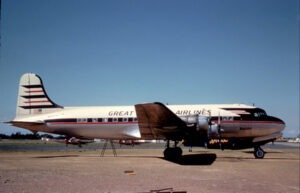
One of the more successful non-sked entrepreneurs was Irving E. Herman, who operated several large irregular carriers including Great Lakes Airlines. Note the painted rectangles that border the round windows on this Great Lakes DC-4. This was an attempt to make the old bird look like a more-modern, pressurized DC-6. (Bob Russo photo via John Corpening)
Non-Skeds: The Story of America’s Suppliemental Airlines, Part 2
SURVIVAL
While the Civil Aeronautics Board (CAB) grappled with how to handle the unregulated mass of companies that made up the irregular carriers, the regulated scheduled airlines made it quite clear that they wanted the non-skeds to be put out of business. Despite the fact that the large irregular carriers were claiming that they were creating their own traffic and not infringing on the revenue stream of the regulated airlines, the scheduled carriers estimated that they lost over $13 million in revenue to the non-skeds during 1948.
In the CAB’s initial attempt to bring some order to the irregulars by issuing letters of registration, 142 companies were recognized via this process. At first the Board did not define exactly what constituted “infrequent, irregular” service, but eventually ruled that it meant only three flights in some markets, and up to eight flights in others during any one-month period.
In 1948, at the request of the United States Senate’s Small Business Committee, the CAB launched a full-scale investigation into the large irregular carriers, supposedly to determine their rightful place in America’s commercial airline hierarchy. The CAB’s guidelines for its investigation were contained in a memorandum written by Louis Goodkind, Associate Director of the Board’s Bureau of Economic Regulation. His memo was a private, internal document for CAB staff. It was never intended for anyone’s eyes outside of the Civil Aeronautics Board. If the contents of Goodkind’s memorandum had been released, then Congress and everyone else would have been made aware of the CAB’s true attitude toward the non-skeds.
The secret memo was made public five years later, in 1953, by investigative newspaper columnist Drew Pearson. He revealed that Goodkind’s sole mission, outlined in the 1948 memo, was to put all of the non-scheduled airlines out of business. The vehicle for doing this would be scrutiny of each company by the CAB, with a planned goal of denying operating authority to every applicant. In the memorandum, Goodkind stated that all letters of registration would be revoked and each carrier would have to appear before the Board to apply for a regular Certificate of Public Convenience and Necessity, which would turn them into a certificated carrier, or for permission to continue operating as a non-scheduled airline. In Goodkind’s own words: “Either procedure has the advantage of affording a means for ultimately terminating the operations of this group of carriers.” The CAB, under pressure from the regulated scheduled airlines, had decided that it was time to bring an end to the problem of unregulated, non-scheduled airlines once and for all.
The CAB’s purge of the non-skeds began on April 18, 1949, when the Board summarily abolished authorization for all of the irregulars and began the process of having each company apply for a certificate, or for permission if they wanted to stay in business. Of the first 103 applicants to approach the CAB, the majority of them were turned down. The few from that group that were approved to function as non-scheduled operators were considered too small to offer any competitive threat to the scheduled airlines.
In the Board’s defense, something had to be done. Aside from the fact that the CAB was frustrated by carriers ignoring . . .
This article costs $5.00 to download - or it's free for AAHS members.
Already a member? Sign in to download for free.