
The Jensen Trainer Model 2: A Despression-Era Private Venture
Dan Hagedorn
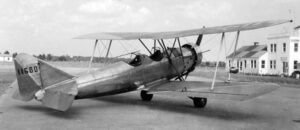
An interesting study of the Trainer Model 2 some time after July 1, 1932. The former color scheme had been scrubbed off the aircraft, and her all-metal fuselage is gleaming. The colors on the wings and tail surfaces can only be guessed at but are believed to have been green and red separated by a thin yellow stripe. The interplane struts have been replaced by conventional struts on either side. The location is unknown. (Hagedorn Collection)
The Jensen Trainer Model 2; A Depression-Era
Private Venture
“She could have been a contender.”
Although there is no record of him actually saying so, Martin “Marty” Jensen, who described himself as an “aircraft designer – pilot,” very probably must have held such sentiments by the time the astonishing trek of his little-known Trainer Model 2 finally came to an end.
Readers familiar with the work of this writer may be surprised to see the by-line associated with this story, as the history of aviation in Latin America has been – and remains – his forte.
However, believe it or not, the Jensen Trainer Model 2 had a Latin American connection, and it was this phase of its existence that first caught my attention. It was, from that point on, very much a case of “the more I learned, the more intrigued I became.”
In many ways, it is a peculiarly American story, and as the story unfolds, this may become obvious to even the most skeptical reader.
But before we get to this very interesting little biplane, we really need to know a bit more about the man behind it all.
Not Exactly a Household Name
Marty Jensen may fairly be said to have grown up alongside aviation.
Born just before Christmas on December 20, 1900 in a cold and wind-swept Jamestown, Kansas, to Nils and Marin Jensen, the family moved to South Sioux City, Nebraska, by the time he was a teenager, where he graduated from high school – just in time for the entry of the U.S. into WWI.
Although he often said that he had learned to fly in the Navy in 1917-1918 at Great Lakes Naval Aviation School in Illinois, in fact he was an enlisted aviation rating (Second Class Aviation Rigger) on a two-year, short-term enlistment. He spent six months at Great Lakes before being transferred to San Diego, where he flew frequently from the former Dutch Flats Field, and where he was attached to the Torpedo Plane Squadron of the USS Aroostock, and gained a commission as an Ensign in the Naval Reserve, at San Diego in 1925, only after he had gained an FAI civil license, rather belatedly, in 1921, having learned to fly in 1919 in San Diego. He claimed about 40 hours in Curtiss R-6s there, so this must have been when he qualified for his FAI license.
By the end of 1924, like so many WWI-era veterans who had been well-and-thoroughly bitten by flying, he had organized a rather ad hoc flying school, conducted during the winter months at Dutch Flats near San Diego, where his modest “Jensen School of Flying” logo was emblazoned across the top of what were apparently Curtiss JN-4 shipping crates, and barnstormed during the summers throughout the West.
Apparently, he soon came to realize that there were, after all, things in life besides airplanes and, on April 24, 1925, he married Miss Marguerite (invariable known in later years, . . .
This article costs $5.00 to download - or it's free for AAHS members.
Already a member? Sign in to download for free.