
Wolf Pack vs. the Red Star; Deception, Attrition and Redemption over North Vietnam
Jeff Erickson
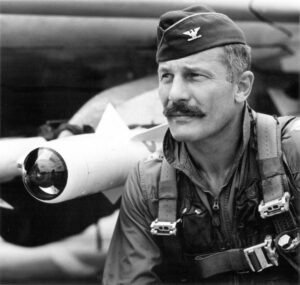
Col. Robin Olds, Commander, 8th Tactical Fighter Wing, USAF. (Photo from Paul Minert collection)
Wolf Pack vs. the Red Star; Deception, Attrition and Redemption over North Vietnam
The exploits of the legendary Col. Robin Olds and the “Wolf Pack” of the 8th Tactical Fighter Wing during the Vietnam War are well known among military aviation enthusiasts. Colonel Olds’ skill as a fighter pilot and reputation as an effective combat leader, earned during three decades of distinguished military service, are held in high regard by peers and historians alike. The story of his principal adversaries in
Southeast Asia, the pilots of the fledgling Vietnam People’s Air Force (VPAF), is not well known in the West. Preeminent among these pilots was Capt. Nguyễn Văn Cốc of the 921st “Sao Do” (Red Star) Fighter Regiment, the top scoring fighter ace of the Vietnam War. On January 2, 1967, the destinies of these two formidable air warriors converged during a brief and decisive air battle over North Vietnam. This encounter ended in a lopsided victory for the “Wolf Pack,” but that was not the end of the story.
The North Vietnamese learned important lessons from this devastating defeat and the VPAF proved to be resilient and resourceful in recovering some measure of initiative in the air battle. Strategy and tactics employed by the opposing forces continued to evolve throughout the remainder of the war, with tactical advantage shifting back and forth repeatedly until the withdrawal of U.S. combat forces in 1973. The lack of a decisive outcome in the air reflected the political and battlefield stalemate on the ground, and too many dedicated airmen on both sides perished in pursuit of unachievable goals.
ROLLING THUNDER
In March 1965, the United States commenced large-scale offensive air operations against North Vietnam. Operation Rolling Thunder was an intensive and sustained bombing campaign designed to halt the flow of men and materiel into South Vietnam and persuade the North Vietnamese regime to cease support for the communist insurgency in the south. Rolling Thunder missions targeted industry, storage facilities, transshipment points, lines of communication and air defenses. U.S. Air Force and Navy combat aircraft struck at the heart of North Vietnam’s military and industrial infrastructure with ever-increasing frequency and devastating impact on the Hanoi regime’s capacity to make war. A large proportion of USAF bombing missions over North Vietnam were flown by F-105D Thunderchief fighter/bombers (known as “Thuds”) operating from bases in South Vietnam and Thailand.
In response to this onslaught from the air, North Vietnam gave top priority to strengthening and expanding its air defenses. With massive aid from the Soviet Union and Communist China, North Vietnam fielded a powerful air defense system to challenge U.S. air dominance. At the core of this system was a network of early warning radars and surface-to-air missile sites, armed with the deadly S-75 (NATO SA-2 Guideline) missile. High value target areas were also defended by an array of anti-aircraft artillery (AAA) ranging from 100mm radar-directed guns to rapid fire 23mm, multi-barrel automatic cannons and heavy machine guns. This state-of-the-art air defense system presented a formidable threat to strike aircraft and was responsible for a large majority of U.S. combat aircraft losses over North Vietnam.
THE VIETNAM PEOPLE’S AIR FORCE
North Vietnamese leaders also took steps to establish a force of fighter/interceptor aircraft, using equipment and pilot training provided by their Soviet and Chinese sponsors. The Vietnam People’s Air Force (VPAF) received its first jet fighter aircraft, the Soviet designed MiG-17 (Chinese J-5) in February 1964. Initially based in China, these aircraft equipped the first operational jet fighter unit, known as the 921st Sao Do Fighter Regiment. The MiG-17 was a subsonic, post-Korean War design and variants supplied to the VPAF . . .
This article costs $5.00 to download - or it's free for AAHS members.
Already a member? Sign in to download for free.