
Wisconsin’s Flying Trees: The Plywood Industry’s Contribution to WWII
Sara Witter Connor
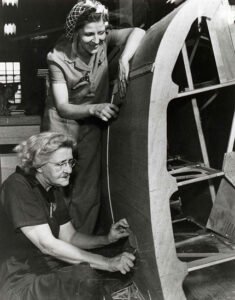
Women played an important role in the manufacture of WWII gliders. Here we see two working on the [experimental] snow glider nose. (Photo from the Villaume Collection, St. Paul, Minn.)
Wisconsin’s
Flying Trees: The Plywood Industry’s
Contribution to World War II
Few people might realize it, but World War II was won in part by Wisconsin plywood. The Wisconsin plywood industry’s contribution to WWII had its extraordinary beginning in central Wisconsin. Ultimately, it had an international impact on the outcome of the war. More that 25,000 gliders and aircraft made of wood and plywood, Wisconsin‘s "Flying Trees," were manufactured during the war. These included the de Havilland Mosquito – nicknamed the "Wooden Wonder" – which was considered one of the most effective bombers available to the Allied forces. The U.S. Army Air Corps’ wooden gliders were a key component in battles across Europe, Africa and Burma, including the D-Day invasion. Howard Hughes, an aviation legend of the 1940s, along with Henry J. Kaiser, known as the "father of shipbuilding," used Wisconsin plywood products for manufacturing ships and planes, most notably the "Spruce Goose." The central Wisconsin communities of Marshfield, Stevens Point, and Wisconsin Rapids provided a range of wood products made from the forests of northern Wisconsin. Most of the aviation plywood used in the war was manufactured in Marshfield at the Roddis Lumber and Veneer Co. The logs for the plywood and veneer came from northern Wisconsin including Rusk, Price, Ashland, Iron and Vilas counties and their communities such as Park Falls, Butternut and Phillips.
The Roddis Lumber and Veneer Co. had experience in wartime and plywood manufacturing from WWI, making plywood for the United States government as well as the French and Italian aircraft manufacturers. During WWII, 90 percent of their operation in the Marshfield plant was dedicated to the war effort. Many other hardworking people in Wisconsin‘s forest products industry collaborated to develop this wartime industry: the creative and ingenious scientists at the U.S. Forest Products Laboratory in Madison, Wis., who invented revolutionary products; the innovative and visionary business leaders who built state-of-the-art production plants; and the dedicated men and women who worked in the plants to produce these unique products were all vital contributors . . .
This article costs $5.00 to download - or it's free for AAHS members.
Already a member? Sign in to download for free.