
Who Saw this Coming: The U.S. Coast Guard Support for the Gemini 3 Mission
Tom Beard
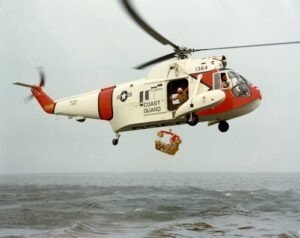
USCG Sikorsky HH-54A Seaguard, 1364, was a sister ship to the three helicopters,1366, 1367 and 1369, that participated as part of the Gemini 3 recovery team. (USCG photo)
Who Saw this Coming: The U.S. Coast Guard Support for Gemini 3 Mission
The first manned Gemini flight and first U.S. space flight with two astronauts aboard featured the test of a fully maneuverable capsule. The Gemini 3 (Gemini-Titan, GT-3) was unofficially dubbed “Molly Brown” (from the movie Unsinkable Molly Brown). Command Pilot, Astronaut Virgil I. “Gus” Grissom’s first spaceship, Mercury 4 (Mercury-Redstone, MR-4), named Liberty Bell Seven, sank and was lost after his first space mission during after-landing recovery attempts. Grissom chose “Molly Brown” as a witty reference over NASA’s reluctance for this capsule’s call sign. During the flight, Grissom altered Gemini 3 spacecraft’s orbit to a more circular pattern, using on-board thrusters, practicing techniques, which would be applied during upcoming Gemini rendezvous and docking missions.(Lethbridge) This time the U.S. Coast Guard was there nearby at splashdown to recover both astronauts and prevent the second capsule from sinking beneath Grissom.
Not all went as intended.
NASA mission planning assigned two backup Coast Guard recovery forces, each consisting of a small ship bearing a helicopter, located miles up-range from GT-3’s intended splashdown location. The prime recovery units, Navy aircraft carrier, USS Intrepid, with two Navy Sikorsky SH-3A Sea Kings, along with two Navy destroyers, were within a 10-mile ring calculated as the spacecraft’s water landing spot. Furthermore, Intrepid carried NASA personnel to handle the spaceship’s post-flight recovery and examinations plus multitudes of news reporters to witness this “first” pilot-controlled spaceship’s return from earth orbit.
The two large Navy helicopters were aboard Intrepid to pluck astronauts from the sea at the expected close by landing site. The carrier would hoist the capsule aboard with a crane for NASA. The Air Force had a C-54 flying overhead in the recovery area carrying two para-rescue swimmers to assist the astronauts in escaping from the capsule and aid them, in their clumsy space suits, into rafts. These swimmers, once parachuting to the capsule, were also to install a floatation collar buoying the capsule, preventing it from sinking, while waiting for Intrepid to arrive and pluck it from the sea. The Air Force backup flight could respond by flying quickly to any nearby location should the spaceship land outside the planned landing zone.
Coast Guard engagement, as a part of the recovery team, came 14 days before splashdown. A helicopter detachment was quickly assembled at Aircraft Repair and Support Center (AR&SC), Elizabeth City, N.C., with pilots, crewmen and helicopters “from five widely scattered air stations, many who did not known each other…and yet from the beginning . . .
This article costs $5.00 to download - or it's free for AAHS members.
Already a member? Sign in to download for free.