
When Pigs Flew: The TFX Affair
Chris Hansen
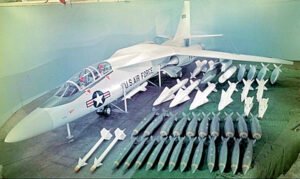
Mockup of Lockheed’s CL-590 design for the TFX proposal). (Lockheed photo)
When Pigs Flew: The TFX Affair
October 1962 – Few who were alive back then have forgotten the Cuban Missile Crisis. Certainly not me; because for a boy just turned seven, nothing was more exciting than the prospect of nuclear war, and I spelled my way through the newspapers for clues as to when the fun might start. I was a bit miffed when, after a couple of weeks, it seemed like things had returned to what passed as normal then.
What I did not know about, and hardly anyone alive today remembers, was the task President John F. Kennedy and his Defense Secretary Robert S. McNamara turned to next. With as much care, effort and trepidation as they seemed to have devoted to Nikita Khrushchev’s missiles, they decided upon, and finally announced, the “winner” of the TFX “fighter” competition. The words in quotes were a bit imprecise, as we shall see.
The TFX (tactical fighter, experimental) was NOT just another aircraft program. It was a project expected to revolutionize flight and point the path for decades to come. Whoever won that first contract stood to become “the Ford” of aviation. Soon, though, some modified this to “the Edsel” of the skies.
The TFX saga is a long one. It began in wartime Germany. You could fairly say it ended with the retirement of the last F-111 aircraft in Australia in 2010 – although to be sure, some other variable-geometry (“swing-wing”) aircraft are still flying.[1] This short article will be restricted to the crucial events in 1962-63 when the TFX affair produced big headlines after triggering a ferocious Senate investigation. That probe threatened the very survival of President Kennedy’s administration. Kennedy’s death ended the “real” TFX probe. When it restarted, it focused on Secretary McNamara’s mishandling of the F-111 project. Readers interested in the entire story – and it contains many surprises – are welcome to read my book, When Pigs Flew: The TFX Affair.[2]
Though originally inspired by the captured Messerschmitt P.1101 prototype, the TFX project per se had begun in 1959. It was fiercely promoted by two men who both officed at Langley, Virginia.[3] One was NASA’s Dr. John Stack, who had already shepherded numerous swing-wing models through his transonic wind tunnel at NASA Langley. The other was Gen. Frank Everest, chief of Tactical Air Command, who thought the new concept was just what he needed to strike back effectively at the Warsaw Pact in the event of nuclear war.
The project was about to go out for bid when Defense Secretary Thomas Gates decided – in a measure of either prudence or uncommon courtesy – to allow the incoming Democratic administration the honor of the go-ahead. That was the last time the TFX followed its flight plan. After Robert McNamara settled into the Pentagon, the plane seemed to defy all regular predictions. It would become an immense debacle for not just him, but for the U.S. Navy, the military at large, and indeed for the Kennedy brothers. The initially highly admired super-manager from Ford was undone by Vietnam – but the TFX ran a close second and in crucial, telling ways, the program resembled McNamara’s Asian nemesis.
Instead of competing the already finished Request-for-Proposal and Work Description, which described a medium-range nuclear interdictor for the Air Force, McNamara and his . . .
This article costs $5.00 to download - or it's free for AAHS members.
Already a member? Sign in to download for free.