Two Years in Strategic Air Command: A Navigator’s Experiences
Cal Taylor, Illustrations by Capt. Jerry Thompson
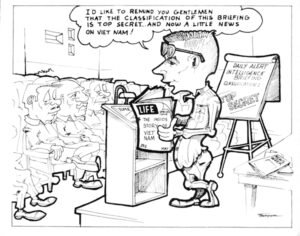
The intelligence officer’s briefings had to be pertinent to the EWO missions and keep up with current events. (Illustration by Jerry Thompson)
Two Years in Strategic Air Command: A Navigator’s
Experiences
Introduction to Strategic Air Command
In the summer of 1955, I attended my first Civil Air Patrol (CAP) summer encampment at Portland AFB, Oregon. Aged only 15, I knew little about the young United States Air Force (USAF), which I was eventually to enter in 1963. My knowledge of the air service focused mostly upon the airplanes of WWII. The encampment was therefore the first introduction to three of the four Air Force missions of the time; airlift, air defense and the strategic bomber force. From the small eastern Oregon town of Lakeview, an Air Force Reserve Curtiss C-46 took me and other CAP cadets to Portland. There, the primary assigned aircraft were Northrop F-89D air defense fighters. During the encampment, all cadets had an orientation flight in a Douglas C-124. Then, we went to a special showing of the new James Stewart film, Strategic Air Command. Most knew of the Convair B-36 bomber and the movie was a true thrill. Also, the film was an impressive portrayal of life in Gen. Curtis LeMay’s command.
Over the years, there was an occasional observation of a B-36 flying over Eugene, Ore., accompanied by the unique sound of its six reciprocating engines and four jets on later models.
Over the next eight years, I learned much more about the Air Force through my reading, CAP training and Air Force Reserve Officer Training Corps experience at the University of Oregon. Commissioned in 1963, I reported to the USAF Undergraduate Navigator Training (UNT) school at James Connally AFB, near Waco, Texas. There, it became apparent that many UNT graduates would be assigned to Strategic Air Command (SAC), like it or not. This article will detail my experiences related to SAC between 1963 and 1967. It will be spiced a bit with cartoons by Capt. Jerry Thompson, a B-47 pilot in the 68th Bomb Wing (BW) at Chennault AFB, La., and in the B-52H with the 319th BW, Grand Forks, North Dakota.
Days of the Bomber Barons(1)
During the early 1960s, when I was new to the United States Air Force, SAC was nearing its zenith, which would continue for many years. At the end of WWII, Gen. Hap Arnold, the Army Air Force (AAF) commander and Gen. Carl Spaatz, who commanded bomber forces in Europe and the Pacific, insisted that American air power be built around strategic bombardment. Bomber operations during the war were seen as adequate demonstration of the theories of Billy Mitchell, Italy’s Giulio Douhet and Royal Air Force (RAF) Air Marshal Hugh Trenchard that strategic bombardment was the key to air force success. By 1946, the AAF also had the atomic bomb and one unit, the 509th Composite Group at Roswell Field, N.M., capable of delivering the bomb. The AAF established SAC on March 21, 1946, at Bolling AFB, D.C., commanded by Gen. George C. Kenney. The command’s initial equipment was B-29s, B-17s, a few B-25s and P-47s, P-51s and three P-80s. . . .
This article costs $5.00 to download - or it's free for AAHS members.
Already a member? Sign in to download for free.