
The Vought V-326 and V-326A, These test beds remain unknown
Alain Pelletier
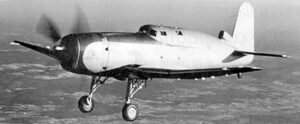
The thick curved windshield of the Vought V-326 produced distortions that bothered the pilots as well as restricted their vision over the long nose. (Vought photo from the author)
The Vought V-326 and V-326A, These test beds remain unknown
The Vought V-326 and V-326A, now forgotten, launched the career of the Pratt & Whitney R-4360 Wasp Major, one of the finest engines designed during the Second World War.
The "Wasp Major" engine finds its origins in the late 1930s. At that time, at Pratt & Whitney, chief engineer Leonard S. "Luke" Hobs was studying the possibility of building a very powerful radial engine with four rows of seven cylinders. To do this, he built a model using R-2800 Double Wasp engine cylinders. Wind tunnel tests showed that the drag of this engine differed little from that of the less powerful R-2800.
In August 1940, Hobs managed to convince Gen. Henry "Hap" Arnold, head of the Army Air Corps, of the urgent need to develop and produce this engine that, in the military standard, became the R-4360 Wasp Major. Hobs produced a working prototype by April 1941, eight months after the launch of the program. It was an impressive engine for the time: a power of 3,000 hp, 4,362.5 cu. in total displacement the 28 cylinders, 56 spark plugs, all for a mass of 3,400 lbs.
Seeking a single-engine aircraft large enough to serve as a test bed for this imposing engine, Pratt & Whitney set its sights on the Vultee Vengeance prototype. The XA-31A serial number 42-35824 became the Vultee type V-85 after undergoing the necessary modifications. Unfortunately, the tests with this plane were of short duration since, on September 15, 1942, victim of an engine failure, the V-85 crashed in the middle of a field in Connecticut.
Pratt & Whitney then began looking for a new single-engine aircraft. Two engine engineers, Alfred H. Marshall and Rudolph Wallace, with the help of Charles A. Lindbergh as a consultant, competed for an aircraft using the Vought Seawolf wing, tail and landing gear. In fact, two aircraft were planned for test bed service, which respectively received the designation V-326 and V-326A. The V-326 was intended for the development of the Wasp Major, while the V-326A was to be used for the development of supercharging systems intended to equip advanced versions of the Wasp Major.
Having to operate at an altitude of more than 40,000 ft, these two planes were equipped with a pressurized “capsule” for a crew of four. This capsule, completely independent of the plane itself, was roughly shaped like a cylinder with rounded extremities. Pressurization was provided by a Garrett Research electric compressor. The capsule had to be able to maintain a . . .
This article costs $2.50 to download - or it's free for AAHS members.
Already a member? Sign in to download for free.