
The Stages of U.S. Airline Deregulation
Robert G. Waldvogel
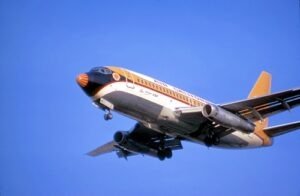
The third type of carriers generated by deregulation were the intrastate carriers like Air California that had not been subject to CAB regulations in the past. Air California Boeing 737-293, N467GB, c/n 19714. (Photos from the AAHS photo archives, AAHS-S002936)
The Stages of U.S. Airline Deregulation
Regulation
Although U.S. airline deregulation was initially envisionedas leading to an increased number of carriers whose divergentservice concepts, market segments, fleets, and route structures would have produced new competition, stimulated traffic, andlowered fares, it ultimately came full cycle and only resultedin virtual monopoly. Three distinct stages occurred during itsevolution.
The regulation itself traces its origin to 1938 when Congressadopted the Civil Aeronautics Act. Its resultant five-memberCivil Aeronautics Board (CAB), formed two years later in1940, regulated fares, authorized routes, awarded subsidies,and approved interline agreements, among other functions.“Regulation, by definition, substitutes the judgment of theregulator for that of the marketplace,” according to Elizabeth E.Bailey, David R. Graham, and Daniel P. Kaplan in their book, Deregulating the Airlines.(1)
So regulated had the environment been, in fact, thatan airline often had to resort to the purchase of another carrierjust to obtain its route authority. Delta Air Lines, for example,long interested in providing nonstop service between NewYork and Florida, continually petitioned the CAB for the rights.But the regulatory agency felt that Northeast, a small localservice carrier often plagued by low traffic, financial loss, andbad weather because of its route system, needed the lucrativeFlorida route’s revenue potential to boost it back to health andgranted it the authority instead.
Undaunted, Delta ultimately resorted to acquiring theregional carrier along with its 727 “Yellowbird” fleet andsubsequently received approval for the merger on April 24,1972. But these extremes would shortly no longer be needed.A glimpse of the future could already be had in Californiaand Texas. Devoid of jurisdiction over local air transportation,the CAB could neither exercise fare nor route authority overintrastate airlines and these carriers, usually offering highfrequency,single-class, no-frills service at half the fares theregulated “trunk” airlines were forced to charge, consistentlyrecorded both profit and traffic growth.
Air California and PSA Pacific Southwest Airlines, forexample, operating in the Los Angeles-San Francisco market,saw yearly traffic figures increase from 1.5 million passengersin 1960 to 3.2 million in 1965. Texas-based Southwest Airlinessimilarly provided low-fare service between Dallas andHouston and other Texas points. These airlines demonstratedthat true deregulation could yield fares accessible to averageincomepassengers, provide greater airline and service conceptchoice, and stimulate traffic.
Passengers and government alike increasingly decriedregulation during the mid-1970s, citing the examples set byAir California, PSA, Southwest, and other intrastate airlinesas demonstrable proof that deregulation could produce mutualairline- and passenger-benefit. At least that was the theory.Ultimately conceding to reason and democratic rule,President Jimmy Carter signed the Airline Deregulation Acton October 28, 1978, in the process eliminating the need forCAB approval of route entrance and exit and reducing most . . .
This article costs $5.00 to download - or it's free for AAHS members.
Already a member? Sign in to download for free.