
The Operational History of Lockheed C-141, 65-9408
John Vadas
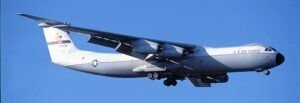
65-9408 after completion of ‘B’ model modifications. (Photo by Dave Mosedale)
The Operational History of Lockheed C-141, 65-9408
An airplane, just about any airplane, is an inanimate object generally constructed of sheet aluminum, rivets, hydraulic fluid and engine oil. No heart and no soul, so they say. On any production run any one aircraft looks just like the one that preceded it off the assembly line, and the one that came after it, the only difference being the serial number. But occasionally a single aircraft, a single serial number, will come to have a significant personal meaning in our lives. For instance, the serial number of the aircraft you flew when you first soloed. The serial number of the aircraft on which you first painted your name that signified you as the primary crew chief. The serial number of the aircraft in which you pushed the envelope one day and it was only by the grace of God and a forgiving airplane that you survived. This then is the human interest story of one such aircraft, Lockheed C-141 65-9408.
Acceptance
C-141A 65-9408 was accepted by the Air Force in early April 1967 and was assigned to the 437th Military Airlift Wing (MAW) at Charleston AFB, South Carolina. At a time when the six operational airlift wings and the one training wing of the Military Airlift Command were coming up to strength with Lockheed’s new Starlifter, it was not uncommon for new aircraft to be reassigned between Wings for short periods of time. 65-9408, however, was an exception. Almost all of its operational career from 1967 to 1994 was spent with the 437th MAW at Charleston.(1)
Prelude
On July 26, 1968, the war in Viet Nam was at its peak, Operation Rolling Thunder had been in force for two-and-a-half years, and I was an F-4 Phantom crew chief with the 555th TFS at Udorn RTAFB, Thailand. On that particular day, I was working the grave yard shift from 6:00 p.m. to 6:00 a.m., and it started out no different than any other shift. At about 8:00 p.m., I was in the process of completing a preflight inspection for an early morning sortie when the flight chief stopped by the revetment.
The flight chief informed me that one of our aircraft required an engine run on the trim pad at the north end of the base and asked if I would assist two other crew chiefs to tow the aircraft to the pad and get it set up. As we turned out of the squadron parking area towing the aircraft, I was seated in the cockpit ready to apply the brakes in case of any emergency. As we turned onto the taxiway I noticed a C-141 parked on a concrete pad between the runway and taxiway also at the north end of the field, approximately 50 yards from the trim pad. At this point in time the C-141 was relatively new to the inventory and this was the first one I had actually seen. The spot lights from the AGE equipment lit up the darkness and reflected off the aircraft fuselage, and I remember wondering, why was it parked way out there in the middle of nowhere? As we got closer, I could make out the shapes of the security guards and flight crew around the aircraft. Had I realized at the time what my future held in store I would probably have paid more attention to the serial number, 59408, on the vertical stabilizer and to the Wing identification number, 437 MAW, on the nose of the aircraft; but, at that moment, I had no way of knowing why they would be significant and how our paths would later cross. I was more interested in getting the F-4 to the trim pad and getting back to my preflight inspection.
What I also did not know at the time was that both the C-141 and its flight crew were taking part in Operation Sentinel Echo. They were staging out of Udorn AB awaiting the release of three American POW’s whom they would then medevac either to Clark AB in the Philippines or to Kadena AB on Okinawa. The three Air Force pilots scheduled for release by North Viet Nam were Maj. Fred N. Thompson, Maj. James F. Low, a Korean War Ace and Capt. Joe V. Carpenter.
We positioned the Phantom on the trim pad, left the crew chief to assist the engine specialists’ test run the engine, and headed back to the squadron area. As we left the trim pad I . . .
This article costs $5.00 to download - or it's free for AAHS members.
Already a member? Sign in to download for free.