The Life and Times of Ralph S. Damon
Justin H. Libby
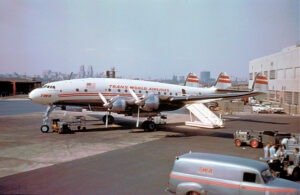
While Howard Hughes and TWA were the lead airline for the Lockheed Connie, he avocated acquisition of the Douglas DC-6B over the L-749. Damon successfully opposed this assuring that the Constellation remained in the TWA fleet mix and expanded in the future. This TWA L-749A, N6008C, was photographed at an undiclosed location in the early 1950s. (AAHS photo archives, AAHS-P001790)
The Life and Times of Ralph S. Damon
I was a child growing up in Cincinnati, Ohio, I had dreams of becoming president of a major airline and on many occasions sat down to write chief executives of various carriers on how to achieve my objective. The majority of responses were no more than form letters but two return correspondences were unique. I was informed by the publicity department at Lake Central Airlines that I was authorized to take a trip on one of their airliners from Greater Cincinnati Airport in Erlanger, Kentucky, to Richmond, Indiana, with an adult. My ticket would be free but my father who volunteered to be my chaperone would have to pay a round trip ticket that was in those days rather inexpensive. Due to the excitement of the venture I did not sleep the night before the flight, and anyway we had to be at the airport at 6:00 AM for the departure that took off on time. The problem was we arrived in Richmond before we left Cincinnati due to the fact that Indiana, except for a few locations, was on Central time. Nonetheless, it was exciting to get to sit in the cockpit for no one else was on the plane, be presented with aviator wings and I even remember the name of the copilot (Bozday) and the beautiful stewardess (weren’t they all in those days?), a Miss den Houten. I was astonished by the graciousness of the airline executives in offering a young person such a moment to remember for a lifetime.
The other event from my inquiries was to receive a handwritten letter from the president of Trans World Airlines, Ralph Damon, detailing how to become a president of an airline and that I should never abandon the dream. As the years past my goals became more reasonable but I never forgot the kindness and courtesy of Mr. Damon who died very young as he approached 59 on January 4, 1956. In this essay I would like to pay tribute to this very important chief executive who advanced my interest in the world of flight and helped develop and foster the rise of commercial aviation in the United States.
Early Years:
Ralph Shepard Damon was born on July 6, 1897, in Franklin, N.H., the son of William Cotton Damon and his wife Effie Ives Damon. He attended a local elementary school and later a Society of Friends secondary school in Providence, Rhode Island. He then entered Harvard University and graduated with a Bachelor of Arts cum laude in 1918 with the goal was of becoming an astronomer. During the Great War his life’s ambitions changed forever to one of being involved in aviation. Initially assigned to the Army Aviation Section Signal Corps Ground School at the Massachusetts Institute of Technology. He later learned to fly at Carlstrom Field in Arcadia, Fla., and flew Army mail and dispatches between Carlstrom Field and Dorr Field that was situated eight miles away. All this before he was qualified to drive a car. Damon received his discharge on May 14, 1919.
Damon’s dreams of being involved in the infant aviation industry had to be temporarily put on hold. Unable to find employment with an airplane manufacturer, he took a position with D.P. Robinson and Company of Pittsburgh as a rodman on a survey gang charting a power housing project. He left the company in June 1920 to join the Curtiss Aeroplane and Motor Co. in Buffalo, New York. When that position did not work out, he joined in an airplane factory owned by G. Elias and Brother as a millwright. Within two years he was plant superintendent.
While employed at Elias, he married Harriet Dudley Holcombe of Boston on October 14, 1922. This union produced four children (Priscilla, Barbara, William and Edmund). Not only did he change his marital situation, but also altered his career by seeking and achieving employment again at the Curtiss Aeroplane and Motor Co. as a mathematician on a wing-stress design at the company’s facility in Garden City, New York. Within six months he advanced to assistant project engineer on a military contract and soon rose to become the chief project engineer. A year after joining Curtiss he was appointed chief factory inspector and not long afterwards factory superintendent, a position he held until 1928. In that year Curtiss joined the Robertson Aircraft Co. of St. Louis, Mo., in the building of commercial planes and Damon was appointed . . .
This article costs $5.00 to download - or it's free for AAHS members.
Already a member? Sign in to download for free.