
The Fokker F-32: The First Wide-Body Airliner
Hayden Hamilton
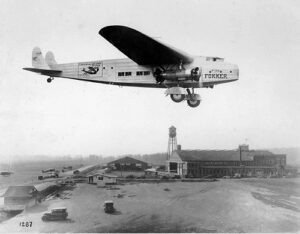
A rare shot of Fokker F-32 NC124M in flight. (Fokker photo from the author’s collection)
The Fokker F-32: The First Wide-Body Airliner
1929 found a number
of early airlines with a need for increased capacity on certain routes.
Along the eastern seaboard of the United States, Universal Aviation Corp.’s
New York City to Washington, D.C., had capacity issues. On the west coast,
Western Air Express (WAE) was dealing with the same issue on its route
between San Francisco and Los Angeles. Both were operating Fokker F.10As
with Universal also having Fokker Super Universals and Fairchild 71s. All
of these planes and their contemporaries had seating capacities of six to
14 passengers (see chart). The highest seating capacity aircraft in early
1929 carried only 15 passengers. The only alternatives offering increased
capacities were the Sikorsky and Consolidated flying boats, which for
these specific routes did
not really fit the requirements. Literature also indicates that Fokker
had some hope of marketing the aircraft to wealthy private owners as "roomy
and luxurious air-yachts."Â[1]
Fokker, recognizing that there was a potential market for
a larger aircraft and spurred on by Universal’s and Western’s
encouragement, set about developing what was anticipated to be a much
larger and hopefully more economical design to fulfill this need. What
evolved was an enlarged F.10A that essentially doubled the carrying
capacity of the day. Not unlike what the 747 did with its introduction,
becoming the first modern wide-body aircraft, the F-32 was heralded as "game
changer."Â The parallels between the two aircraft are quite similar. The
Fokker F-32 was the first American aircraft with twin seating on both
sides of a center aisle. The 747 was the first to introduce a seating
arrangement arranged around two aisles. The F-32 was the first commercial
aircraft to provide a functioning galley for the preparation of hot meals.
It was the first to offer two passenger lavatories. It was the first four-engined
commercial aircraft operated in the United States.
Aircraft Passenger
Seating CapacityFokker F-32
32 Fokker F.10A
12-14 Fokker Super Universal
6 Ford Trimotor
5-AT-B12-15 Fairchild 71
7 Stinson SM6000
11 Curtiss CO
Condor20 Boeing 80
14
Fokker believed that the F-32 would provide economies
of scale that would put it in high demand. For example,
its purchase price was 37 percent less per passenger than its
own popular Fokker F.10A Trimotor. The larger machine also required less engine power per passenger than comparable
three-engined aircraft.2 These economic
considerations were thought to solidify demand for the F-32, in spite of a
price tag of $110,000 per aircraft – a price that made it the most expensive
. . .
This article costs $5.00 to download - or it's free for AAHS members.
Already a member? Sign in to download for free.