
The First Zemke Fan, May 12, 1944
Dr. Gerhard Kaschba
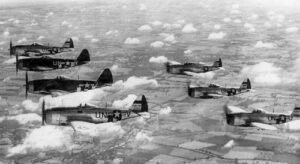
Flight of 63rd Fighter Squadron, 56th Fighter Group on patrol in this undated photograph. UN-Z (2nd from bottom in left row) could be Zemke, depending on the date of the photo. (From the Gerald Balzer collection, AAHS photo archives)
The First Zemke Fan on May 12, 1944
Background
In January 1944, Gen. James Doolittle took command of the 8th U.S. Army Air Force. The commander-in-chief of the USAAF, Gen. Henry H. Arnold, had previously given the order in his new Year’s message: “This is a must – destroy the enemy air force wherever you find them, in the air, on the ground, and in the factories.” Until then, the fighter groups of the 8th USAAF had been required to provide defensive escort for the bombers. Doolittle, on the other hand, saw in the fighters a flexible offensive weapon designed to fight the enemy far away from the bombers. Maj. Gen. William E. Kepner, commander of the 8th U.S. Fighter Command, informed the commanders of his fighter groups about the change of tactics. One of these men was Col. Hubert Zemke.
Col. Hubert Zemke and the 56th Fighter Group
In September 1942, the then Major Zemke assumed command of the 56th Fighter Group. The unit had been transferred to England in January 1943. On April 8, 1943, Zemke was promoted to colonel. He put great emphasis on flight discipline, teamwork and the development of new tactics. Under his leadership, the 56th Fighter Group by the summer of 1943 had risen to become the most successful American fighter group in Europe. General Doolittle once described Zemke as the “greatest fighter group commander.” During WWII, Colonel Zemke scored a total of 17.75 confirmed air victories and 8.5 aircraft destroyed on the ground. American media gave the 56th Fighter Group the name “Zemke’s Wolfpack.” As early as the summer of 1943, Zemke had begun to doubt the validity of the defensive escort tactics. Without the knowledge of his superiors, he experimented with new forms of escort protection. During the missions, he positioned a fighter squadron, for example, about five to 10 miles ahead of the leading bomb group. In this way, German fighters should be detected early and frontal attacks on the bombers significantly reduced.
In April 1944, the 56th Fighter Group was relocated from Halesworth to Boxted. Both airfields were located in southeast England. The group was divided into the 61st, 62nd and 63rd Fighter Squadrons and equipped with the Republic P-47 . . . .
This article costs $5.00 to download - or it's free for AAHS members.
Already a member? Sign in to download for free.