The First of the Many, Stearman PT-13, 36-02
Thomas E. Lowe
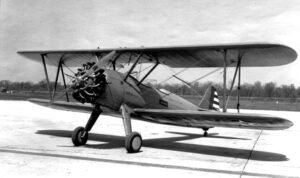
Stearman PT-13, s/n AC-36-2, c/n 75001 at Wright Field, Ohio while undergoing service testing in 1936. Note the Lycoming R-680-5 engine, McCauley steel blade propeller and spin strips on leading edges of both the upper and lower wings. (Photo credit: USAAC via National Museum of the USAF)
During 2020, the commemoration of a major milestone in the history of the Stearman Aircraft Company of Wichita, Kan., was observed. That occasion was the first flight of the first production Stearman Model 75, PT-13, U.S. Army Air Corps (USAAC) serial number (s/n) AC-36-2, Stearman construction number (c/n) 75001. It has been 85 years since that flight occurred and it initiated the first major U.S. Army Air Corps contract for the Stearman Aircraft Company. It began the full scale production of perhaps the most significant WWII primary trainer aircraft obtained by the USAAC and later the U.S. Navy as well as several other allied countries.
The long quest by the Stearman Aircraft Co. to obtain a contract for production of a primary trainer for the U.S. military establishment began in 1930. Lloyd Stearman designed a small, utilitarian biplane designated as the Model 6 Cloudboy that was powered by the 165-hp Wright R-540 engine. In 1930 the U.S. Army Air Corps conducted a competition to replace the obsolescent Consolidated PT-3 that had served as the Army’s main primary trainer since the 1920s.
The Stearman Aircraft Co. submitted its first Model 6 Cloudboy, c/n 6001, civil registration NC786H, for evaluation by the USAAC. The USAAC designated it as the XPT-912. After the evaluation flights were completed it was returned to Wichita and a second Model 6A, c/n 6002, NC787H, was constructed that incorporated modifications as ordered by the Army. In December, 1930, the Stearman Aircraft Co. received a contract from the USAAC to build four Model 6 aircraft, now designated as the YPT-9, for service testing. The first of these four aircraft was delivered to the USAAC on March 2, 1931.
Eventually, the USAAC rejected the YPT-9 as its new primary trainer, as well as designs by some other aircraft companies. Instead it selected the Consolidated YPT-11. Although the Stearman Aircraft Co. was unsuccessful in securing its first Army contract at that time, it did gain valuable experience in dealing with the U.S. military services.[1] The Stearman Aircraft Co. built six more Model 6 Cloudboy aircraft that were sold on the civilian market, which brought the total number of the Model 6 Cloudboys built to 10.[2]
The next attempt by the Stearman Aircraft Co. to develop a primary trainer aircraft that might satisfy U.S. Army Air Corps and U.S. Navy requirements began in late 1933. It was a completely new design and was a totally in-house project without any federal funding. Stearman engineers, Harold Zipp, Jack Clark and Chief Engineer Mac Short took a rudimentary sketch of a modified Model 6 Cloudboy that Lloyd Stearman had made in 1931 and upgraded it into what eventually became the Stearman Model 70, c/n 70001, NC571Y.
The Model 70 was tested by the USAAC, which designated it as the XPT-943. It was also tested by the U.S. Navy. The military pilots were satisfied with its basic flight characteristics and handling qualities, but their opinion was that its stall was too gentle and its spin recovery too unpredictable for its use as a primary trainer.[3]
No orders for production of the Model 70 by either the Army or Navy followed. However, the U.S. Navy later did express an interest in the design and requested that the Stearman Aircraft Co. provide a proposal for a new trainer based upon the Model 70, but built to Navy specifications. The resulting airplane was the Stearman Model 73, designated as the NS-1 by the U.S. Navy. Between 1934 and 1936 the U.S. Navy ordered 63 Model 73, NS-1 trainers. That order consisted of 41 actual airplanes plus enough spare parts to build an additional 20 airplanes.[4]
This was the first contract to produce a primary trainer for a branch of the U.S. military establishment that the Stearman Aircraft Co. received and it served to whet their appetite for more. The NS-1 trainers went on to serve the U.S. Navy faithfully for several years and were stepping stones for the. . .
This article costs $5.00 to download - or it's free for AAHS members.
Already a member? Sign in to download for free.