
The Douglas Model 1155 Strategic Bomber: Too Little, Too Late
Cal Taylor
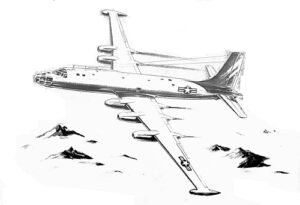
Six-jet Douglas Model 1155 strategic bomber in flight. (Artist’s conception, Douglas Aircraft Co. from the author’s collection)
The
Douglas Model 1155 Strategic Bomber:
Too Little, Too Late
At the end of WWII, the Army
Air Force was looking ahead toward a turbine-powered strategic bomber. The
Convair B-36 design dated to 1941 and work was underway on Boeing’s
B-47. In 1945, Boeing received word that the AAF wanted a long-range
strategic bomber. In June 1947, a competition brought designs from four
companies; Boeing, Douglas, Martin and Convair.
Both the Douglas and Boeing entries were
straight-wing aircraft. The Boeing Model 426 was initially designed with
six turboprop engines. Later application of German design concepts led to
the swept wing and podded jet engines, similar to the B-47. Martin’s
Model 236 was a 275,000-pound airplane with a 195-foot wingspan. Convair’s
entry was the most extreme, with four turboprop engines mounted on a wing
with 30-degree forward sweep and an eight-degree dihedral.1 The
Douglas entry was its Model 1155, a prosaic variant of the DC-6 airliner
powered by four or six jet engines.
Economic motivations
Beginning in 1938, American
aircraft manufacturing grew into the country’s largest industry. By
1945, it had attained its modern configuration, in production capabilities
and methods. Management was experienced in both handcrafted and serial
production and was young enough to continue with the companies for years
to come. There was a large body of skilled workers and plentiful,
experienced engineering personnel.2
Looking ahead to the postwar period, there
was both hope and concern. Production facilities were adequate, having
been built with government assistance. There were capital reserves of $117
million available for reconversion and readjustment. Bank debt was low,
$13 million, and 15 aircraft companies had an aggregate capital exceeding
$620 million.3
Despite planning for the adjustments,
the immediate postwar years were challenging for the aircraft industry.
The military market contracted sharply. The AAF shrank from 243 groups in
1945 to a point where there was not one completely
. . .
This article costs $5.00 to download - or it's free for AAHS members.
Already a member? Sign in to download for free.