
The Douglas DC-8 Skybus
Robert E. Williams
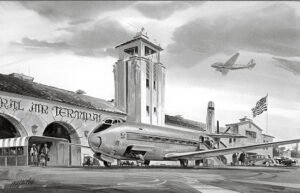
Artist’s rendering of a DC-8 Skybus a the Imperial Air Terminal in California showing the easy of service and convenience in loading. (Artwork from Douglas El Segundo courtesy of The Boeing Company)
By mid-1945, WWII was in its final months. Aircraft production was slowing down and military contracts were being cancelled. Research and development engineers at Douglas, Santa Monica, were busy designing the aircraft that would serve the airlines in the coming postwar expansion years. They reasoned that three basic models with growth potential would be required for the short, medium, and long-haul route systems.
The DC-3, carrying 21-24 passengers, was a 10-year-old design and out of production after more than 10,000 had been built. It was deemed too small for airline operations and too expensive to operate. A replacement was needed. The DC-4, adopted by the military at the start of WWII as the C-54, was still in production with over 1,000 in service. Carrying 44 passengers, it would see wide airline usage into the 1960s. The DC-6, carrying 52-68 passengers, was a larger and more powerful version of the DC-4. The DC-7, as originally offered to the airlines, was a civil version of the C-74 Globemaster designed to carry 125 troops and a crew of 13. When finally produced, however, the DC-7 was a stretched version of the DC-6. The C-74 made its first flight from the Long Beach airport on September 5, 1945. By then, Pan Am had cancelled its order for 26 placed earlier that year, and no other airlines expressed any interest.
The DC-8 Skybus, Douglas Model 1004, was a radically new design intended to replace the DC-3 on short-to-medium range routes. It would carry twice the passengers at half the seat-mile cost of the DC-3.
Using design and performance data gained from the XB-42, which first flew on May 6, 1944, Douglas designers originated a new concept in transport aircraft: a twin-engine, low-wing monoplane incorporating the basic principle of "centerline thrust," an outstanding development in the design of multi-engined aircraft. Experimental flight tests with the XB-42 indicated superior characteristics relative to high rate of climb, high load-carrying ability, elimination . . . .
This article costs $5.00 to download - or it's free for AAHS members.
Already a member? Sign in to download for free.