
The Development of the Tiltrotor Aircraft
Martin Maisel
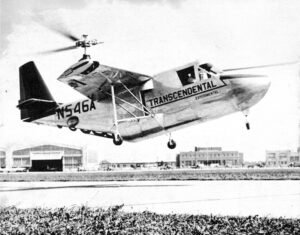
Transcendental Model 2. (Ames photo AD98-0209-12)
Development of the Tiltrotor Aircraft
Since the early days of powered flight, aircraft visionaries
and designers pursued the creation of an aircraft that
would provide the elusive capability for vertical takeoff.
While achieving controllable hover was challenging enough,
practical planners knew that vertical takeoff aircraft had to have
sufficient speed and range in forward flight to allow the aircraft
to be operationally useful. These capabilities became the
fundamental performance goals of as well as the rationale for
the tiltrotor aircraft. As it turned out, over half a century would
pass before the tiltrotor would evolve from a novel concept to a
successful new class of aircraft.
Early Tiltrotor Aircraft
Although several early helicopter designs achieved various
measures of success, the Focke-Wulf Fw-61, which flew in
1936, is widely considered to be the first fully operational
helicopter. This aircraft had two laterally displaced (side-byside)
rotors mounted on open frame-outriggers. The Fw-61 was
capable of vertical takeoff, sustained hover, low speed
maneuverability, and a record helicopter forward flight speed of
112 km/h (70 mph).
Around the time the Fw-61 set the helicopter speed record,
several conceptual designs were proposed that appeared to
recognize that the maximum attainable speed of the pure
helicopter would be limited by the
edgewise flight of its rotor. In forward
flight the helicopter rotor blades
experience an acceleration and
deceleration as they “advance” into
and “retreat” from the oncoming air
stream. As the helicopter exceeds an
airspeed of about 170 knots (230
mph), the advancing blade tip
encounters near-sonic speeds, resulting
in a dramatic increase in drag. At the
same time, portions of the retreating
blade experience reverse flow and
become incapable of producing
adequate lift. These fundamental
problems result in a limitation of the
maximum speed that can be achieved
by a conventional helicopter. To
eliminate those problems a new . . .
This article costs $5.00 to download - or it's free for AAHS members.
Already a member? Sign in to download for free.