
The Development Cycles of Long Island MacArthur Airport
Robert G. Waldvogel
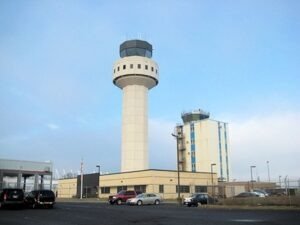
The FAA replaced the existing 1962 control tower in 2003 with the 157-foot cylindrical tower.
The Development Cycles of Long Island MacArthur Airport
Long Island MacArthur Airport, located on 1,310 acres in Suffolk County, Long Island, is the region’s only commercial service facility, which has, for most of its existence, struggled with identity and purpose, operating in the shadows of both JFK International and La Guardia.
Its second, oval-shaped, 50,000 square-foot passenger terminal opened in 1966 and, sporting two opposing, rampaccessing gates, had exuded a small, hometown atmosphere — so much so, in fact, that scenes from the original Out-of-Towners movie were filmed in it.
Its subsequent expansion, resulting in a 1,000% increase in passenger terminal area and some two million annual passengers, was sporadic and cyclic, characterized by new airline establishment, which always sparked a sequence of passenger attraction, new nonstop route implementation and additional carriers, before declining conditions kindled a reverse trend. During cycle peaks, check-in, gate, and ramp space were at a premium, while during troughs, a pin drop could be heard on the terminal floor.
Its catch-22 struggle always entailed the circular argument of carriers reluctant to provide service to the airport because of a lack of passengers and passengers reluctant to use the airport because of a lack of service. This, in essence, is the force that shaped its seven-decade history. And this, in essence, is Long Island MacArthur Airport’s story.
Origins
The 1938 Civil Aeronautics Act, under Section 303, authorized federal fund expenditure for landing areas provided the administrator could certify “that such landing areas were reasonably necessary for use in air commerce or in the interests of national defense.”
At the outbreak of WWII, Congress appropriated $40 million for the Development of Landing Areas for National Defense or “DLAND,” of which the Development Civil Landing Areas (DCLA) was an extension. Because civil aviation was initially perceived as an “appendage” of its military branch, it was considered a “segment” of the national defense system, thus garnering direct federal government civil airport support. Local governments provided land and subsequently maintained and operated the airports. Construction of 200 such airfields began in 1941.
A Long Island regional airport, located in Islip, was one of them. On September 16, 1941, the Town of Islip – the intended owner and operator of the initially named Islip Airport – sponsored the project under an official resolution designated Public Law 78-216, providing the land, while the federal government agreed to plan and build the actual airport. The one-year, $1.5 million construction project, initiated in 1942, resulted in an airfield with three 5,000-foot runways and three ancillary taxiways. Although it fulfilled its original military purpose, it had always been intended for public utilization. Despite increased instrument-based flight training after installation of instrument landing system (ILS) equipment in . . .
This article costs $5.00 to download - or it's free for AAHS members.
Already a member? Sign in to download for free.