
The Bremen, First Westward Non-Stop Transatlantic Airiplane Flight – 1928
Ed Martin
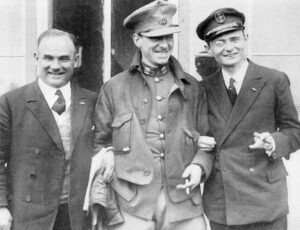
The Three Musketeers – Left to Right - Hermann Kohl, Major James C. Fitzmaurice, and Baron Von Hunefeld. (Casement Aerodrome Museum photo)
The Bremen, First Westward Non-Stop Transatlantic
Airplane Flight – 1928
The challenge of crossing the Atlantic non-stop by air commenced with balloon flights in the 18th century. The first transatlantic balloon (helium filled) non-stop crossing west to east was in August 1978, by Eagle II from Presque Isle in Maine to just outside Paris, France, pilots were, Ben Abruzzo, Maxie Anderson and Larry Newman. The first hot-air balloon flight was on July 2-3, 1987, piloted by Richard Branson and Per Lindstrand. Airships also accepted the challenge and were successful with the flight of the British Airship R34 from Scotland to New York on July 6, 1919, and completing a return flight to Britain. This was followed in 1924 when the Zeppelin Airship LZ-126, name was changed to USS Los Angeles, upon its arrival at Lakehurst, New Jersey. The possibility of a fixed-wing airplane making such a non-stop transatlantic flight emerged after the successful advances in aviation during WWI. Achieving such a flight was encouraged by major newspapers and companies awarding large financial prizes upon completion.
First announced in 1913 and renewed following the end of WWI, the Daily Mail in London, offered a prize of 10,000 pounds (approximately, $1.5million today) to:
“. . .the aviator who shall first cross the Atlantic Ocean in an aero plane in flight from any point in the United States of America, Canada, or Newfoundland and any point in Great Britain or Ireland in Seventy-Two (72) consecutive hours.”
In 1919 Raymond Orteig, a French born New York hotelier offered a prize of $25,000.00, “to be awarded to the first aviator who shall cross the Atlantic in a land or water aircraft (heavier than air) from Paris or the shores of France to New York, or from New York to Paris or the shores of France without a stop.”
The transatlantic race from west to east was on.
In May 1919 the NC-4 Curtiss flying boat of the United States Navy completed a multi-stop flight to Lisbon, Portugal. This was followed in June 1919 by two Royal Air Force (RAF) pilots, Capt. John Alcock, and Lt. Arthur Whitten Brown in a WWI modified Vickers Vimy bomber. They departed St. John’s, Newfoundland and crash landed in a bog near Clifden, County Galway, Ireland. They were presented the Daily Mail prize of 10,000 Pounds at the Savoy Hotel in London by Winston Churchill and later knighted by King George V. Sadly Captain Alcock was killed six months later in a plane crash in France.
The non-stop transatlantic flight to Paris now became the goal and many unsuccessful flights were attempted (see commemorative flight covers) until May 21, 1927, when Charles A. Lindbergh in a custom built Ryan monoplane the Spirit of St. Louis completed a solo transatlantic flight from New York to Le Bourget Airport on the outskirts of Paris, France. He was awarded the Raymond Orteig prize of $25,000 and many other honors.
Crossing the Atlantic from east to west was a more difficult challenge due to weather and especially the prevailing winds. This did not deter many from accepting the challenge only to end in defeat or tragedy.
A young German aristocrat named Ehrenfried Gunter Freiherr von Hunefeld, an aviation enthusiast was interested in making such a flight. He had been unable to serve in the German Air Force due to bad eye sight resulting in wearing a monocle. He did serve in the German Army and during WWI, at the battle of Flanders, was wounded in the leg.
In 1927, following the success of the Lindbergh flight, Baron Von Hunefeld and Hearst Newspapers each purchased a Junkers W 33 aircraft that they planned to fly non-stop across . . .
This article costs $5.00 to download - or it's free for AAHS members.
Already a member? Sign in to download for free.