The Aviation Career of Brig. Gen. Eilliott Roosevelt, USAAF
Chris Hansen
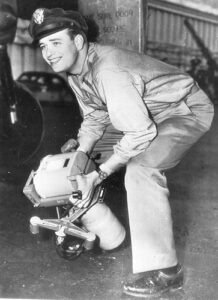
Roosevelt loading a reconnaissance camera in Algiers, January 1943. (From Historic Images via the author)
The Aviation Career of Brig. Gen. Eilliott Roosevelt, USAAF
Few Air Force officers – if any – have been so controversial and then so forgotten. It’s not fair – at least not the“forgotten” part. In the short span of four-and-a-half years, President Franklin D. Roosevelt’s second son enjoyed a truly meteoric rise in the Army Air Forces, beginning with his appointment as a Captain in the Specialist Reserve on his 30th birthday in September 1940. When his father died in April 1945, Elliott’s extraordinary career was effectively over. After the president’s funeral, Elliott did not return to his command in Europe, and he mustered out on VJ-Day, August 15, 1945.
Elliott Roosevelt’s achievements in the Air Corps were legendary – some of them literally so. Yet his real contributions, particularly in reconnaissance, were valuable and enduring. It’s
just that for every heroic feat, there was at least another scandal, another controversy, another crisis that sometimes even lurched dangerously towards criminality. Congress investigated Elliott’s wide-ranging activities eight times, from 1934 to 1973. He skated every time.[1]
During his father’s administration, Elliott’s escapades were front-page news and regular fodder for the gossip columnists. Why his zigzag career has been largely forgotten today, I do not know, but I found during my research of his biography enough hair-raising material to find the oblivion outrageously unjust. Perhaps his strange life was considered unsuitable for historical investigation, especially by those who carefully police the memory of Franklin D. Roosevelt and his family. Perhaps too many murky episodes of that time would be resurrected for the popular taste. Or perhaps it is just a glitch in historiography.
The importance of Elliott Roosevelt’s work, especially in aeronautics, cannot be gainsaid. Mostly by virtue of his pedigree and name, Elliott managed to intersect and often affect some of the most important developments in aviation, in the air war against Germany, and in great power diplomacy. In this venue I shall leave out the non-aviation activities, although they were
as colorful and reckless as one can conceive. There is more than enough in his flying career to fill a highly entertaining book.
Before the War
Elliott Roosevelt, born in 1910, showed an early interest in flight, but only as one component of a thrill-seeking and fearlessly ebullient personality. He said that as a youngster, he had taken what amounts to dual instruction in a home-built contraption, courtesy of some friends; and when his father was Assistant Secretary of the Navy in the Wilson administration, he had an opportunity to become familiar with airplanes, although there is no record that FDR took along his sons on his inspection trips in the air. Young Elliott hung around Roosevelt Field2 at Mineola, Long Island, and met several early aviators there, most notably Charles Lindbergh. His acquaintance with air pioneer J. Parker van Zandt resulted in a trip over the Grand Canyon in 1928. But the flights never resulted in a certificate. There were two problems: Elliott had a hard time concentrating on one thing for any length of time – plus he was nearly blind.
Mother Eleanor said he “couldn’t see 10 feet without his glasses,” which he seldom wore. In truth, he registered 20/200 in one eye and 20/300 in the other. This would raise some eyebrows when finally he was rated a command pilot in . . .
This article costs $5.00 to download - or it's free for AAHS members.
Already a member? Sign in to download for free.