
The American Gyro AG-4 Crusader
H.N. “Dusty’ Rhodes
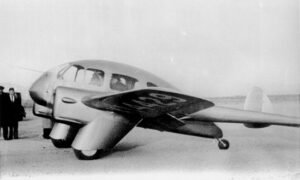
Amercian Gyro AG-4 Crusader. (Photo from the author’s collection)
The American Gyro AG-4 Crusader
America’s great economic depression was at its lowest ebb in 1933. It was hardly a time to design and build a revolutionary new airplane. An abandoned garage located on Arapahoe Street in downtown Denver, Colorado, was hardly a place to build the revolutionary new aircraft. Notwithstanding these debilitating factors, Thomas Miles Shelton designed and built the new Gyro
Crusader. This 1934-"˜35 "one off" was an unusual ship in many ways with twin tail booms, twin vertical fins and rudders and a tear-drop fuselage. Power was provided by two Menasco C-4 engines, each rated at 125
hp.
Early publicity indicated the ship would reach a top speed of 233 mph and a cruising speed of 210 mph while landing at 55 mph. Flight testing in early 1935 showed an indicated top speed of 180 mph at 8,000 feet, roughly equivalent to 209 mph at sea level. Landing speed was 60 mph with flaps extended. If these numbers were factual, Crusader was a great performer for its
time.
Shelton was a self-educated aeronautical engineer. In 1933, he was 32 years of age. He has been described as "trusting, affable and mild mannered."Â Shelton never married so far as is known to the author. His mother exerted a great influence on him throughout his
life.
For many years, he had planned a truly tail-less airplane with rudders and vertical fins at the wing tips. In finalizing the design for his Crusader, he bowed to conventional wisdom and placed a trailing tail section on two tail booms. The ship would resemble the designs built for Jack Northrop by Avion in the late 1920s and early
"˜30s.
Because of its unique shape, the Crusader was often called the "Shelton Flying Wing"Â but its resemblance to a flying wing, as generally perceived, was slight. Another term for the plane was "Gyroplane"Â and this reference probably referred to the company that built it rather than the configuration of the machine. Some considered the design to be a precursor to the Lockheed P-38 fighter of WWII. However, it was
. . .
This article costs $2.50 to download - or it's free for AAHS members.
Already a member? Sign in to download for free.