The Air War in Korea: A Russian Perspective
Alexander Pavlowich
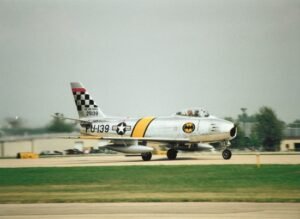
The North American F-86 Sabre came to the Korean War in late 1950. The 4th Fighter Interceptor Wing was the first F-86 unit to score kills on the MiG-15. This beautifully restored example was seen at the EAA Fly-in July 2002. (Photo Rich Kolasa)
The Air War in Korea: A Russian Perspective
In June 1950, I did my service in Mig-15s at Moscow. Suddenly, Commander of the Moscow PVO, General-Colonel K. Moskalenko, brought us a top-secret order about a new, unknown conflict in the Far East. Urgently, an alarm was declared! By night we took a very long and very secret train to the unknown Far East. Far Eastern weather was very bad, tropical with heavy downpours. I had not seen this in all my life! It was ghastly! Many ducks were swimming on our future airfield. A new alarm for our unknown war was starting for us. First we operated from Mukdan airbase, and after a few days our 18th Aircraft Regiment was flown to Andun
airbase.
Our first flight was the whole regiment and staff: 24 Mig-15s in three groups, eight in each group. We had an order that in-flight radio communication was prohibited. Be silent! We dressed in Chinese uniforms and our aircraft were marked with Chinese markings. It was to have been a very top secret action, but for us it was especially bad because our orders were: "In combat speak only Korean."Â We spoke only a Korean vocabulary (specialized for combat
flying).
Our attitude towards American pilots were complicated. During WWII, both the U.S.S.R. and the U.S.A. were allied opposite Hitler. In the Korean War, both Soviet and American pilots were not seen as enemies – we were only opponents. Our principle in the air was, "competition with whomever,"Â but we were soon sorry for
. . . . .
This article costs $2.50 to download - or it's free for AAHS members.
Already a member? Sign in to download for free.