The Air Force’s early Airlift and Operation Strawboss
Maj. Gen. Stephen T. Keefe, Jr. USAFR (Ret.)
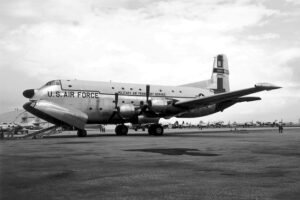
The Douglas C-124 became operational at the start of the Korean War. The C-124 was called the Globemaster II and had the load carrying capability to airlift heavy ground forces equipment or 200 fully equipped troops. (Photo from the Harry Gann Collection)
The Air Force’s Early Airlift and Operation Strawboss
Although members
of the Air Force Reserve have become accustomed in recent years to
performing missions for the USAF on a daily basis all over the world, such
has not always been the case. Prior to the present associate and unit
equipped wing programs which provide MAC with the ability to greatly
expand its capability overnight, the Air Force Reserve evolved slowly but
steadily as a combat-ready force. However, there were a number of
noteworthy individual events that led to Operation STRAWBOSS, one of the
first and largest airlift movements in the Air Force Reserve’s history.
This moved the entire 4th Fighter Wing from our country’s east coast to
Korea to support early hostilities in the Korean War. Everything was moved
– from the wing’s total force of F-86 Sabrejets and all of
their personnel, to the last piece of support equipment.
In 1949, President Harry Truman called his
service chiefs together, firmly requesting them to more effectively
organize and employ their reserve forces. Since the end of World War II, a
reserve force of the USAF (after its separate identity had been
established in 1947) was in place, but little if any effective
organization existed nor was any realistic training being accomplished.
Less than a year after the conclusion of the war, a number of Army Air
Force Base Units (Reserve Training) or "AFBURM" had been
established around the country. The aircraft assigned were mostly trainers
from the war such as T-6s and T-11s and reservists in the area were
encouraged to participate. At the beginning, it was mostly pilots,
navigators and bombardiers who were getting some flying time. No specific
missions were assigned and organization was haphazard at best.
Only a few non-flying officers and even fewer
enlisted personnel were in evidence.. . . . . . . . . .
This article costs $5.00 to download - or it's free for AAHS members.
Already a member? Sign in to download for free.