
The Aeronca Story: Birth of the Personal Plane
Richard Harris
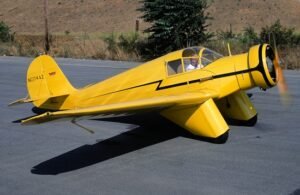
Clean, cantilever-wing Aeronca LB, underpowered with Aeronca’s tiny engines, and a radical departure for Aeronca, didn’t turn out so well - until the two-seater was fitted with a stout 90-horse LeBlond radial. Suddenly the streamlined, tapered-wing L became a 120-mph (105-mph cruise) personal speedster. But LeBlond sold out to an Aeronca competitor, Rearwin. While production continued briefly with Warner radials (in the LC, shown here), the L-series faded before it blossomed. Only a few dozen were built before a flood washed away the remains of the program. (Photo by Charles E. Stewart)
The Aeronca Story: Birth of the Personal Plane
Jean Roche (pronounced "row-SHAY"Â), born in Royan, France, 1894, came to the U.S. three years after the Wright brothers’ first flight, at age 12, settling with his parents in New York City. He spent much of his boyhood experimenting with model aircraft " a growing fad of the times. Active in model-aviation clubs in the New York area, he won awards for his planes, and earned money carving propellers. He spent hours with other model aviators on Long Island, and around the real aviators who frequented the island " like pioneer barnstormer John B. Moisant, and aircraft-designer Gieuseppe
Bellanca.
Young Jean absorbed all the aviation knowledge he could from this hub of experts. His mother tolerated (with varying degrees of displeasure) his cluttering the house with various aircraft subassemblies. In 1910, Jean helped build a stubby-winged clone of the delicate French Demoiselle monoplane. Where do you test-fly a homebuilt airplane in New York City? First time, its owner tried to fly it from home plate at Yankee Stadium. It flew eight inches high for about 10 feet, hitting a ladder before making outfield. But Roche, 16, was arguably now a co-creator of a real man-carrying flying machine. At 17, he even applied for a patent on an aircraft-stabilizing airfoil idea. (Too advanced for its day, it found no takers, but Roche would land a
. . . .
This article costs $5.00 to download - or it's free for AAHS members.
Already a member? Sign in to download for free.