
Remembering DC-3s, a Dream Come True and Ron Alexander
Denny Caldwell
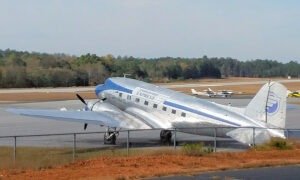
Ron Alexander‘s Douglas DC-3A, N28AA, c/n 2239, once part of Trans-Texas Airways‘ fleet. (All photos by the author)
Remembering DC-3s, a Dream Come True and Ron Alexander
My first flight in a commercial airliner was a family excursion from Detroit Metropolitan Airport to Asheville, N.C., 400 miles south as the crow flies, but considerably farther on this “milk run” route in the late 1950s. As I recall, we left Detroit on a springtime morning in a 4-engine Delta DC-7, landed in Columbus or Cincinnati (or both), then changed to a smaller plane for the next legs to Lexington and Knoxville. Arriving behind schedule at Knoxville, our flight was met by an agent assigned to help our family hustle to a distant gate to board a DC-3 for our final leg to Asheville. Entering through its rear door and walking uphill to our seats felt strange to me after riding in newer tricycle-gear planes that sat on the ground with the floor level inside.
I looked outside the windows the whole time and enjoyed every part of the journey: the early morning departure, rising above the wisps of ground fog into the clear sky, watching the terrain change from flatland to hills as we flew southward, and later in the day, cruising through the scattered bumpy cumulus clouds. Turbulence and clouds were difficult to avoid in the unpressurized DC-3 flying at the lower altitudes.
Another series of flights taking us home a few days later finished long after dark. I recall the hypnotic sight of blue engine exhaust flames, the image fixed in my memory along with the sound and vibration of propellers and the firing of dozens of cylinders: RPM, manifold pressures and mixtures set just right by the crew.
Not long after the family trip, I read the classic aviation book written by Ernest K. Gann, Fate is the Hunter; it became my favorite book about aviation. One of the airplanes Gann wrote about was the DC-3, and ever since reading the book and watching them fly daily over my childhood home near Willow Run Airport, I developed a great fondness for the elegant, radial-engined DC-3 and its military sibling, the C-47. I admired
DC-3s from afar and up close at airshows and museums, and I could identify them by ear without even seeing the plane. After the family adventure, the next (and last) time I flew in a DC-3 was in July 1967 from Houston Hobby when Trans-Texas Airways (a.k.a. “Tree-Top Airlines”) delivered me to Fort Polk, La., for army basic training.
Through 50 years of my aviation career, I had a fantasy that someday I might actually fly a DC-3 with its tailwheel and two big radial engines. But, only after my retirement from airline flying did I take the opportunity to fly a tailwheel airplane, and I had never operated a radial engine in my life. I was beginning . . .
This article costs $5.00 to download - or it's free for AAHS members.
Already a member? Sign in to download for free.