Reginald Denny: "Father" of Radio Controlled Aircraft
Charles Shaw
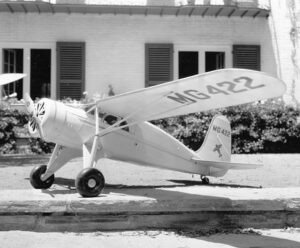
The "Dennyplane" created by Reginald Denny and sold in his shop. (From the Robert Littlefield collection, AAHS archives)
Reginald Denny: “Father” of Radio Controlled Aircraft
In November of 1939 British actor and Royal Flying Corps gunner, Reginald Denny sold 53 radio- controlled aircraft to the U.S. Army, which were to be used as target practice by anti-aircraft gunners.[1] The notion of unmanned aircraft was very much a novel concept at this time with the only previous examples being the “aerial torpedoes” built during WWI, as well as the early drone experiments carried out by the British and U.S. militaries.[2] Denny’s sale to the U.S. Army marked the first instance of unmanned aircraft being mass-produced. He would later go on to sell close to 15,000 drones to the U.S. military over the course of WWII.[3] The fact that Denny’s status as a UAV pioneer was seen only as a secondary accomplishment next to his long and illustrious acting career speaks volumes to the kind of life he led, but it is certainly not to be overlooked.
Born in 1891, the son of a successful stage actor and opera singer, Denny was introduced to the theatre lifestyle at a very young age. He got his first acting role at the age of seven in the stage performance of A Royal Family and would continue acting in both stage plays and silent films throughout his childhood and early adult life. In 1911, at the age of 20, Denny performed his first acting job in America and in the following years performed in both India and Australia.[4]
With such a glamorous lifestyle in Hollywood, one would hardly consider him to be inclined towards aviation, but that would change in 1917 when he returned to Britain to enlist with the Royal Flying Corps, three years into WWI. Denny was stationed at Hastings airfield in Kent. There he went through pilot training flying Bristol Fighter F2Bs as a gunner. It was during a nighttime training exercise that Denny’s plane was hit by friendly AA fire. Denny was wounded in this accident but made a full recovery. This incident would turn out to be the closest thing to combat that Denny would ever see as he completed his training in 1918, right as the war ended.[5]
Denny was released from service and returned to Los Angeles to continue his acting career, however, his time in RFC appeared to have sparked an interest in aviation that followed him throughout the rest of his life. The earliest example of this in his postwar life was his honorary inclusion in a group of prominent stunt pilots at the time, known as the 13 Black Cats.[6] Named for their frequent invocation of superstition during their stunts, performing on Friday the 13 and making frequent use of ‘Bad Luck’ symbols just to add to the thrill, this group consisted of former war pilots, Hollywood stuntmen, and movie actors. Denny first got involved with the group by loaning them a Curtiss Jenny he owned at the time. His status in the group, however, never moved beyond an honorary member. Denny made at least one attempt at performing a stunt flight, what was to be a jump from the wing of the plane with a parachute. When the time came to jump, however, Denny froze up and clung to the strut. The pilot made several attempts to encourage him to jump, even shaking the wing of the plane at one point, but in the end, Denny clung desperately to the strut of the plane until it landed safely on the ground.[7]
Denny’s interest in flight kept burning bright and he would continue to be of aid on several aviation-related projects around Hollywood, including one instance in which he loaned a Sopwith Snipe to Howard Hughes for use in a war film.8 In the 1930s Denny would take an interest in model planes, which would eventually lead to him founding the business where he would leave his mark on the aviation world, the Reginald Denny Hobby Shop.
The shop began humbly enough selling models of all breeds, from warplanes, seaplanes, flying wings and more. In addition to planes, the store also sold model rockets and slot cars, even featuring a large slot car track with several different lanes.
Business did not come easily at first. The shop struggled for the first few years it was open and nearly closed for good until Denny found a new partner in the form of a young oilman named Nelson Paul Whittier. Whittier put up $75,000 to improve the shop and bring in more tools and supplies. They formed Reginald Denny Industries in 1935 to develop a new radio . . .
This article costs $5.00 to download - or it's free for AAHS members.
Already a member? Sign in to download for free.