PROJECT OUTING: USAF Evaluation of the Probe and Drogue In-Flight Refueling System
Bryan Gardner
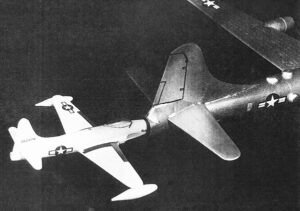
Pneumatic tail cone with fighter engaged and refueling. (AAA Report M-139, October 1949) All American Airways proposed three schemes for refuelling fighters, involving the insertion of the fighter nose into the tail of a tanker, into an open-ended nacelle towed by the tanker, or into a fairing lowered by an extended arm from the tanker. In the latter case, the fighter could be hoisted up to the belly of the tanker.
PROJECT OUTING: USAF Evaluation of the Probe and
Drogue In-Flight Refueling System
Shortly after the USAF became a separate service in September 1947, the bombardment mission was examined in the light of potential threats. But, with the exception of the Convair B-36 – then facing an uncertain future – current bombers and those under development lacked sufficient range to reach targets in the Soviet Union, then seen as a potential aggressor.
Aerial refuelling was considered the most practical method of achieving strategic capability and plans were made for developing refueling methods and modifying bombers. In March 1948, Air Materiel Command planned an aerial refueling development program, with Boeing designated supplier of refueling equipment. This aimed at achieving the “earliest possible solution to the refueling problem” and, lacking a readily-available American system, a contract was placed for the supply of British “looped hose” equipment, with Boeing installing it in B-29 and B-50A bombers.
Meanwhile, Boeing developed the “flying boom” system and the first boom contact was made between B-29s in October 1948.
The bomber escort mission was retained in Strategic Air Command for more than 10 years after the war, but the short range of early jet fighters, compared with the long range of bombers they were to escort, led to several range-extension methods being tested, including “parasite” fighters and wingtip towing. Although refueling in flight was considered there was no practical method then available for refueling single-seat fighters.
In December 1947, Maj. Gen. L.C. Craigie, Director of the Research and Development Office, Deputy Chief of Staff, Materiel, wrote to the commanding general, Air Materiel Command (AMC) requesting a study be initiated to determine the feasibility of extending escort range of F-80 and F-84 fighters by refuelling from B-29 or B-50 tankers.[1] Tankers would be sent to timed rendezvous positions along the bombers’ route at distances of approximately 1,000, 1,500 and 2,000 miles from home base. Escorting fighters would refuel in flight at these points and continue with the bombers to the next rendezvous.
AMC wrote to the Republic Aviation Corp. in July 1948, advising that the USAF was “very interested in a practical solution of air-to-air refueling” and that a high priority had been assigned to the project. Various methods were being examined and Republic was asked to forward information on any studies made for refueling the F-84.[2]
All American Aviation also studied the problem and in October 1949 proposed three methods of refuelling fighters[3]: the first involved a fighter (F-80) inserting its nose into a special tail cone in the bomber/tanker, where it would be secured and refueled; in the second scheme, the fighter would contact an open-ended nacelle trailed from the tanker, while in the third scheme, the fighter would contact an arm extended from the bomber, when it could be refueled or raised into the belly of the bomber. However, these schemes were rejected as both the boom and the probe/drogue systems were then being developed.
Frederick Steel, assignor to the Curtiss Wright Corp., filed a patent application on March 30, 1949, for a method of refueling fighter aircraft (USP#: 2582609). Featuring a trailing ‘bird’ (drogue) with aerodynamic surfaces for stable flight and a retractable probe in the fighter, this employed electromagnetic means for coupling. This application was made two days before the British company Flight Refuelling Limited (FRL) probe and drogue patent application was made in the United Kingdom (UK) (GB 676430) but there were significant differences between the two schemes and the Steel patent was not developed.
Although the Boeing boom system was under development, priority was given to bomber installations and the first boom tanker, the KB-29P, entered service in 1950, initially to support the SAC B-50D fleet. The first fighter to be equipped with . . .
This article costs $5.00 to download - or it's free for AAHS members.
Already a member? Sign in to download for free.