Primary Light Airplane Gliding School at Janesville, Wisconsin
Sara W. Connor & Charles L. Day
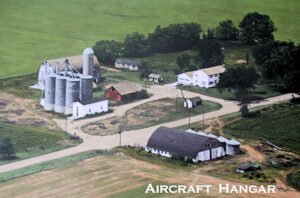
Atkinson Farm with quonset workshop in foreground. (Photo courtesy of the Atkinson Family and David Fellows)
Primary Light Airplane Gliding School at Janesville, Wisconsin
As America entered WWII, we were hindered by the inability to deliver a
self-contained fighting force with heavy equipment into battle behind
enemy lines. In the early 1930s, the Army had banned officers from flying
in soaring gliders. All existing soaring gliders were personally owned by
individuals. As a result of the treaties signed at the end of WWI, Germany
was not allowed to have powered military aircraft pilot training. However,
the result was Germany’s development of an elite corps of glider pilots
and an excellent glider pilot training program. America was not to be out
maneuvered and acted hastily to establish its own glider pilot training
program. While Wisconsin had established in 1939 its own Civilian Pilot
Training (CPT) programs for training single-engine power pilots, it would
also create its own gilder pilot training program in Janesville led by a
famous Wisconsin barnstorming aviation pioneer. The Badger State would,
therefore, supply only not the plywood for "Wisconsin’s Flying
Trees" (AAHS Journal Vol. 53, No. 2, Summer 2009) but also the
crews to man them.
Significantly, in early 1941 the U.S. Army Air Corps (USAAC) had no glider
designs, no gliders, and no glider pilots. The Army had no real experience
or idea of the direction a glider program should take. In contrast, to
skirt terms of surrender after WWI, Germany had been building both primary
and soaring gliders to train pilots during the 1930s. This German pilot
training was not just for glider pilots but was the basic flight training
for powered aircraft pilots.
America was caught short by a stunning German raid in Belgium to capture
Fort Eben Emael, but America reacted quickly! In February 1941, the head
of the USAAC, Gen. Henry H. Arnold, ordered Wright Field, Dayton, Ohio, to
develop requirements for larger cargo glider designs. These cargo gliders
would be large enough to move men and equipment into battle as a unit. By
the end of March 1941, General Arnold ordered Wright Field to solicit
designs from United States manufacturers based on those criteria. Maj.
Frederick R. Dent, Jr. had been placed in charge of glider design,
engineering, procurement and testing at Wright Field. Maj. Bruce Price was
his assistant.
Until General Arnold’s order, there were fewer than 160 civilian, Silver
C licensed, glider enthusiasts and even fewer gliders in all of the United
States. The gliders themselves were one and two seat sailplanes. They were
soaring gliders, not large, cargo-carrying gliders for men and equipment.
A few of these civilian glider pilots were appointed or conscripted into
the USAAC glider program. Some were hired as civilian glider pilot
instructors. One was a distinguished Wisconsin glider pilot from Wisconsin
Rapids, Dick Johnson. He would become a USAAC Glider Pilot Instructor and
later hold the U.S. Soaring records for altitude and distance.
To obtain gliders quickly in 1941-42, approximately 73 privately owned
soaring gliders appropriated by the Army in preparation for whatever
flight training program was to be created. By December 1941 Wright Field
had placed orders for soaring gliders with a number of manufacturers
including the . . .
This article costs $5.00 to download - or it's free for AAHS members.
Already a member? Sign in to download for free.