
Passion, Serendipity and Perseverance; Completing the "MY GAL SAL" Story
Capt. Marc "Fig" Feigenblatt
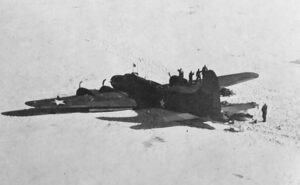
"My Gal Sal" on the ice cap shortly after its forced landing. (USAF via NARA)
Passion, Serendipity and Perseverance; Completing the "MY GAL SAL" Story
Author’s note: The motivation for this articles came from a gift from a neighbor of a section of aircraft spar from Boeing B-17E "My Gal Sal," 41-9032, removed during her 12-year restoration. While familiar with the basics of her story, I was now motivated to find everything possible about her history.
America
By early 1941, America’s active participation in the growing world conflict seemed inevitable. The War Department ordered the production of 36,500 airplanes and training of 30,000 pilots each year. While not officially at war, many young men were already enlisting. Such was the case for nearly every one of the men who would later crew the bomber named "My Gal Sal." At the same time, America was engaging its industrial power, transforming factories and designing ever more lethal machines of war. In light of the events in Europe, much of that focus fell upon aircraft design. In September 1941, the B-17E debuted as a far more capable, potent and radically different version of this heavy bomber. On March 16, 1942, B-17E 41-9032 rolled off the assembly line and was delivered to the recently created Army Air Forces. By this time, America was officially at war, and planning for the establishment of U.S. air bases in England.
Operation BOLERO
There was much work to be done in planning for the massive build-up of the Army Air Forces in England, but the first and most obvious task was to define the method and means necessary to deploy aircraft. Code named Operation BOLERO, chief among priorities was plotting the route which aircraft would utilize. Due to range constraints, aircraft had to hop-scotch across the Atlantic. The route chosen stretched from Maine to Canada, then Greenland and Iceland before arriving in Britain. Greenland needed air bases, with the northern alternate field being a particular challenge. Gen "Hap" Arnold, Chief of the Army Air Forces, personally selected world-renowned aviator and Nordic expert, Bernt Balchen to oversee construction and command the northern base known as Bluie West 8. A Norwegian officer whom Arnold commissioned as a U.S. officer, Balchen had gained fame as Admiral Byrd’s pilot in the Antarctic. Bolero was well on its way to beginning operations.
97th Bomb Group
By May 1942, Boeing B-17E 41-9032 had been assigned to the recently created 97th Bomb Group located at MacDill Army Airfield in Tampa. Shortly thereafter, the 97th moved to a new field in Sarasota where its buildup accelerated with an influx of newly trained men. With crew and plane now mated as one fighting unit, pilot Ralf Stinson dubbed his new bird “My Gal Sal†after his girlfriend. For the next several weeks, "Sal" and her crew would train incessantly and prepare for the deployment to England. Unanticipated delays ensued and involved brief stateside relocations. New armament, engines, radios and turrets were installed at Middleton, Pennsylvania. Following the Japanese attack on the Aleutians, a brief relocation to Seattle for submarine patrol duty was ordered. Nevertheless, by the end of June, "Sal" was back in the Northeast and all the pieces were in place for the planned deployment of the first contingent of B-17s to England.
Chaos
At 0830 on June 26, the first of 15 B-17s departed Presque Isle, Maine, on their historic sortie. Leaving the fueling stop at Goose Bay, Canada, elements comprised of four aircraft each, staggered 15 minutes apart, made their way to Greenland. "SAL" would be one of four bombers in the lead. While enroute, weather at the primary airfield, Bluie West 1, had badly deteriorated. The trailing 11 aircraft were able to turn back to Goose Bay, but the lead element had progressed too far and hadn’t the fuel needed for a return.
Chaos ensued for the four Greenland-bound. Training in the states had been rushed to meet wartime demands and crews inexperienced in navigation at extreme northern latitudes struggled to cope. Radio discipline was poor, resulting in simultaneous and garbled transmissions, and was complicated . . .
This article costs $5.00 to download - or it's free for AAHS members.
Already a member? Sign in to download for free.