
Pan American Airways, the Pacific Challenge
Edited by Ed Martin
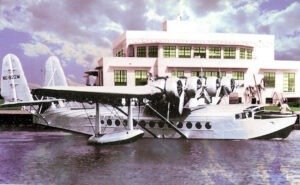
Sikorsky S-42, NC822M, at Dinner Key, PAA Miami Base. (Postcard from the editor‘s collection)
Pan American Airways, the Pacific Challenge
In 1927 Pan American Airways was awarded an air mail contract from Key West, Fla., to Havana, Cuba. Following the success of these flights and later expansion into the Caribbean and South America, Juan Trippe, President of Pan American Airways, turned his thoughts to conquering the vast expanses of the Atlantic and Pacific Oceans. The shorter distance from the U.S. to Europe across the Atlantic Ocean was an attractive challenge with many obstacles, particularly weather. The Pacific was a more viable alternative. However, no aircraft then existed capable of flying the long distances involved; but Trippe decided to accept the challenge.
The following events are referenced from the John B. Russell Collection Vol. 2 of newspaper clippings, published by United Press International (UPI) and Associated Press (AP) in the Miami Herald and Miami Tribune, as received via Pan American Airways’ radio, during the initial flight of the China Clipper from Alameda, Calif., to Manila, Philippines, on November 22, 1935.
Technical difficulties involved were monumental the distance from the west coast of the U.S. to China was over 8,000 miles. Extensive research would be necessary to determine if this route was feasible. Suitable aircraft would need developing, navigation requirements, weather and wind variations, landing and refueling bases, personnel and passenger accommodation and, where necessary, government approvals would all be required. In 1931, Pan American Airways issued specifications for an aircraft that could accomplish the task of flying 2,500 miles to Hawaii with a suitable payload. A year later the Sikorsky Co., and Glenn L. Martin Co, submitted acceptable proposals for flying boats. In late 1932 Pan American Airways placed orders for three Sikorsky S-42 and three Martin M-130 flying boats.
Another major consideration was where to originate-terminate such a flight from the U.S. A great deal of consideration was given to flying the northern route to Alaska and over Siberia to China for which Pan American Airways acquired an interest in Pacific Alaska Airways.
Charles Lindbergh, a Pan American Airways technical advisor, and his wife Anne (Morrow) Lindbergh, surveyed this route to China for Pan American. After much research it was determined that cooperation from the Russian government would not be obtained, which determined that the route be across the Pacific Ocean.
Alameda Airport in San Francisco Bay would be the origination point and Hong Kong across the Pacific as the termination with stops at Hawaii and Manila along the way. The Pacific islands of Midway, Wake and Guam would serve as intermediate rest and refueling bases. Fortunately, these small islands were U.S. possessions with Midway Island approximately 1,400 miles from Honolulu, and Wake Island was another 1,300 miles westwards with Guam a further 1,400 miles of flying. Manila in the Philippines was the initial . . .
This article costs $5.00 to download - or it's free for AAHS members.
Already a member? Sign in to download for free.